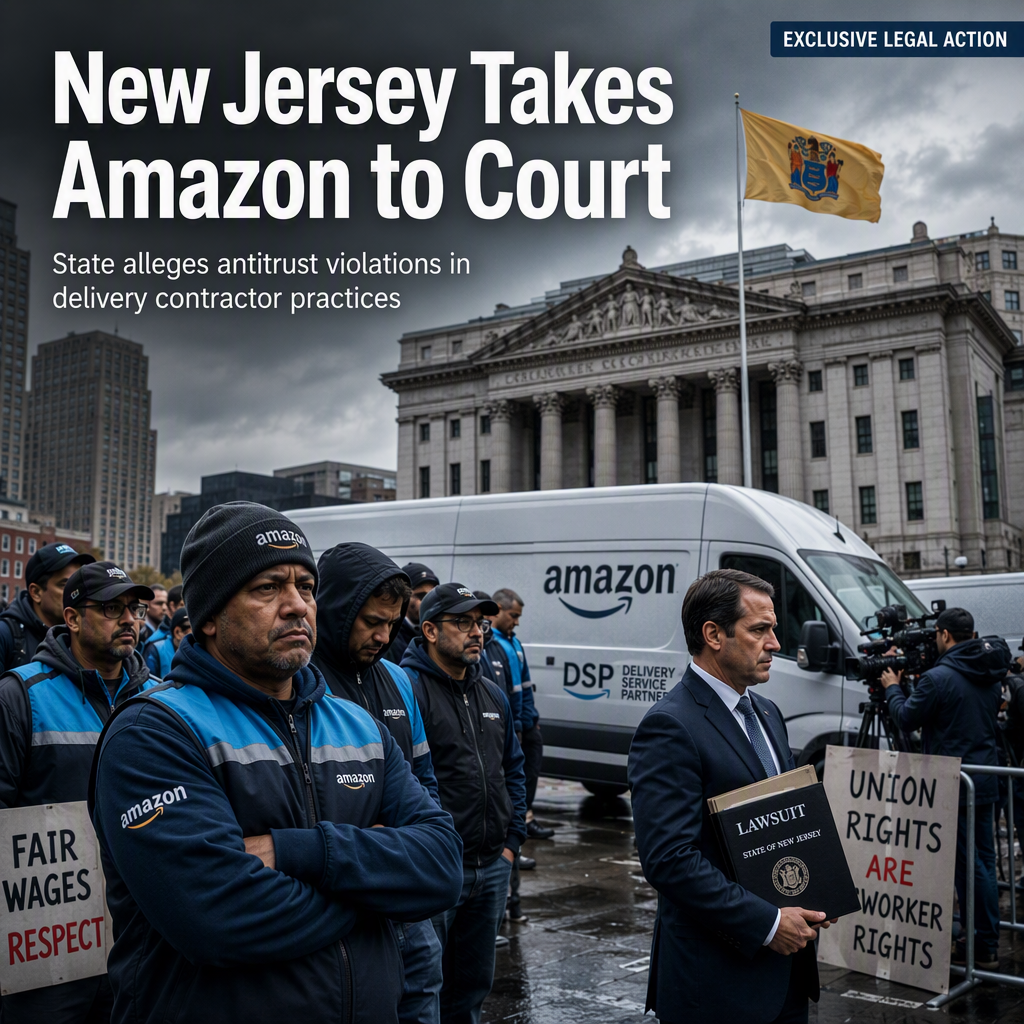
New Jersey Attorney General Jennifer Davenport announced a lawsuit against Amazon, alleging the company violated antitrust laws by abusing its power over third-party delivery contractors, which has led to suppressed competition and harmed workers in the state [1]. The complaint, filed in U.S. District Court for the District of New Jersey, claims Amazon's third-party delivery model results in lower wages, unfair working conditions, and a lack of competition among delivery service providers (DSPs) [1]. According to Davenport's office, Amazon prevents delivery workers from unionizing, restricts contractors from hiring each other's drivers, and limits competition for labor, causing employees to 'endure harsher working conditions than they should' [1].
Davenport stated, 'Amazon built a company worth trillions while subjecting drivers in its delivery network to artificially low pay and punishing working conditions thanks to its overwhelming power in the labor market' [1]. The lawsuit alleges that since 2018, Amazon's delivery service partner program has relied on thousands of small contracted companies for last-mile delivery, reducing reliance on major carriers like UPS and FedEx and speeding up deliveries [1]. However, lawmakers, regulators, and labor advocates have increasingly scrutinized this model, arguing that Amazon uses the third-party contractor label to avoid liability and direct employment responsibilities, while still controlling wages, schedules, and uniforms [1].
The complaint further accuses Amazon of having a 'monopsony' over the market for delivery driver services, meaning it is the dominant buyer of such labor, giving it significant influence over employment conditions [1]. The DSPs are described as 'economically dependent on Amazon' and unable to compete for drivers by offering higher pay or better conditions, which allegedly allows Amazon to keep driver wages low [1].
Market implications include potential regulatory changes, as New York City is considering legislation that would require Amazon to employ DSPs directly. Amazon has responded by stating it may 'consider relocating delivery operations' outside the city if such measures are enacted, and a tech industry group has warned this could lead to higher shipping costs for consumers [1]. Amazon representatives did not immediately respond to requests for comment [1].
CONCLUSION
New Jersey's lawsuit against Amazon highlights growing regulatory scrutiny of the company's labor practices within its delivery network. The outcome could have significant implications for Amazon's business model and labor market dynamics, especially if similar actions or legislation are pursued in other jurisdictions.