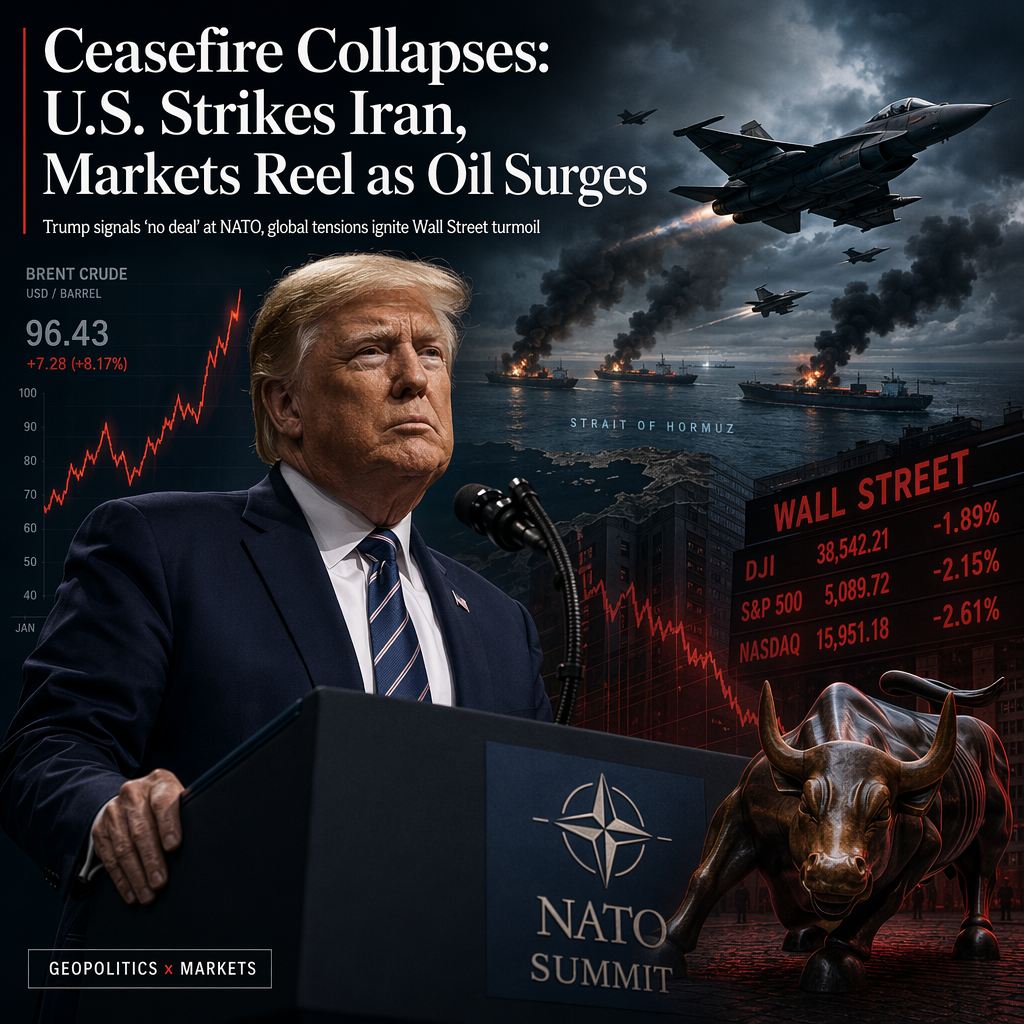
U.S. President Donald Trump announced the collapse of the Iran ceasefire, stating it was 'over' during the NATO summit, and signaled a lack of interest in reaching a new deal with Iran amid renewed hostilities in the Strait of Hormuz [1]. Following this declaration, U.S. forces conducted additional strikes in response to Tehran's attacks on commercial ships in or near the Strait of Hormuz, according to U.S. Central Command [1]. Trump also criticized NATO allies, particularly Spain, over defense spending and called for cutting off all trade with the country [1].
The escalation in Middle East tensions had immediate market repercussions. Key indexes, including the Dow Jones Industrial Average and S&P 500, declined, while oil prices surged sharply. International Brent crude futures rose 5.43% to $78.19 per barrel, and West Texas Intermediate futures jumped 4.37% to close at $73.52. The Nasdaq Composite, however, gained 0.2% despite the broader market downturn [1].
In corporate news, Apple expanded its partnership with chipmaker Broadcom in a multi-year deal expected to exceed $30 billion, marking Apple's largest U.S. manufacturing commitment to date [1]. Meanwhile, SpaceX stock closed at $148, below its debut price of $150 per share for the second consecutive day, following its recent inclusion in the Nasdaq-100 index [1].
Federal Reserve policymakers were revealed to be divided over the future path of interest rates at their last meeting, with some members seeing potential for easing inflation and lower rates, while others anticipated the opposite. Fed Chairman Kevin Warsh described the debate as a 'family fight,' which concluded with the Fed holding rates at 3.5%-3.75% last month [1].
In Asia, South Korean AI chip firm Rebellions, backed by Samsung, is targeting an IPO in the first or second quarter of next year. CEO Sunghyun Park stated the company is considering listing options in the U.S. and is in talks with both the New York Stock Exchange and Nasdaq [1].
CONCLUSION
The collapse of the Iran ceasefire and subsequent U.S. strikes have triggered a surge in oil prices and declines in major stock indexes, highlighting heightened geopolitical risks. Corporate developments, such as Apple's expanded Broadcom partnership and SpaceX's stock performance, also contributed to market volatility. The Federal Reserve remains divided on rate direction, while investor interest in AI chips continues to grow, as evidenced by Rebellions' IPO plans.