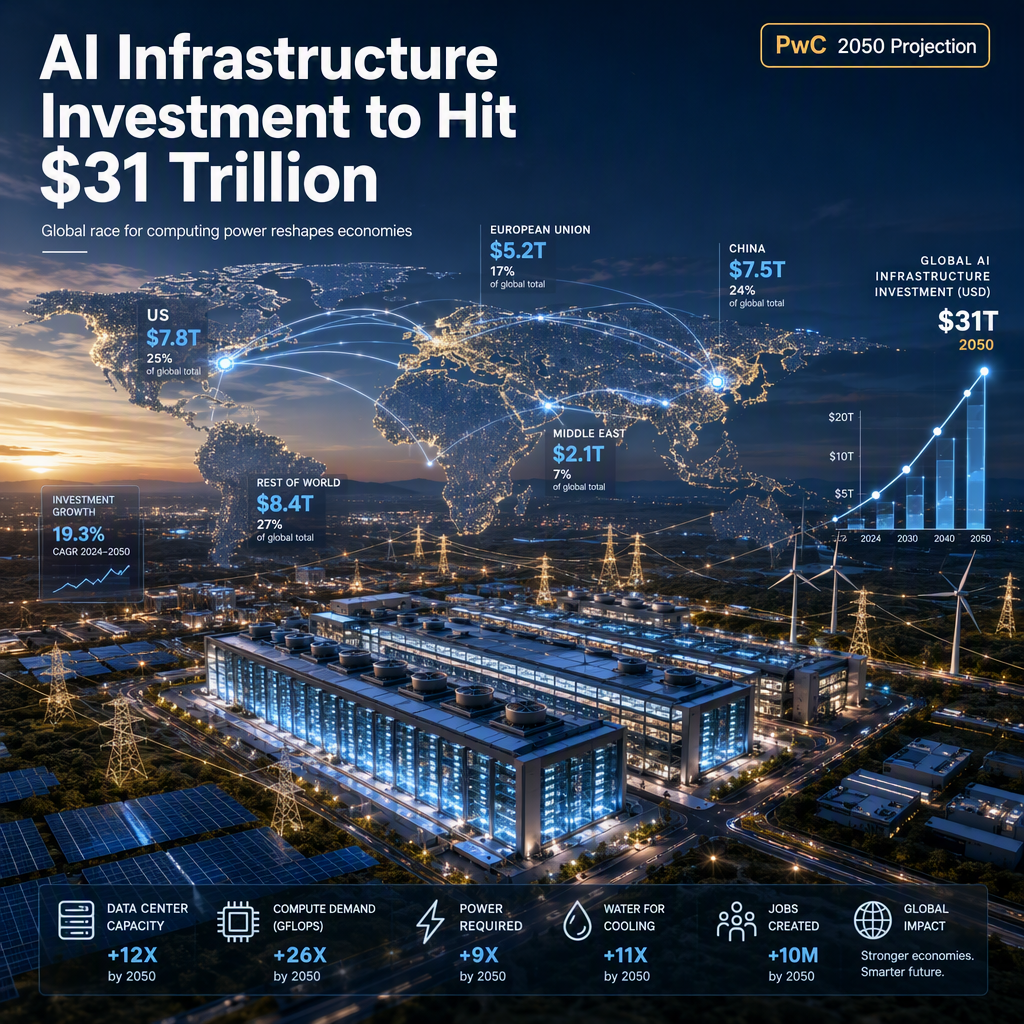
A new analysis by PwC projects that global capital expenditures on artificial intelligence (AI) infrastructure will reach $31.6 trillion by 2050, as companies ramp up investments to build and upgrade computing capacity for advanced AI models. This estimate represents the central scenario within a plausible range of $22 trillion to nearly $50 trillion, highlighting significant uncertainty but underscoring the sector's rapid growth trajectory [1]. Annual investment in data centers is forecasted to rise from approximately $800 billion in 2026 to $1.8 trillion per year by 2050, reflecting the increasing demand for robust AI infrastructure [1].
Regionally, the Americas are expected to account for $16.5 trillion of the $31.6 trillion in cumulative investment, with the U.S. alone representing about $15.1 trillion, or roughly 48% of the global total. In an upside scenario, cumulative capex in the Americas could reach $27.1 trillion by 2050. PwC attributes the U.S.'s dominant position to its central role in the advanced chip ecosystem, the presence of major AI model developers and hyperscalers, and supportive state-level policies that foster talent, capital, and innovation [1].
The Asia-Pacific region is projected to see $8.2 trillion in cumulative capex, driven primarily by China and India due to their large populations and rapidly expanding digital economies. Europe is expected to account for $5.6 trillion, which is below its share of global GDP, largely due to power constraints, planning friction, and fragmented regulation. The Nordic countries are highlighted as a promising alternative to Western European hubs, thanks to their renewable-heavy energy grids, lower electricity prices, and favorable climates for data center cooling [1].
Other regions include the Middle East, with an estimated $1.1 trillion in cumulative capex, and Africa, with $255 billion through 2050. Clara Cutajar, global infrastructure leader at PwC Australia, emphasized that AI infrastructure is becoming a defining capital allocation challenge for the next generation, impacting technology, energy, real estate, supply chains, regulation, and financing. She noted that capturing this investment requires active positioning, as the AI buildout will not automatically benefit all participants [1].
CONCLUSION
PwC's report signals a transformative wave of investment in AI infrastructure, with the U.S. poised to lead global spending. The projected $31.6 trillion in capital expenditures by 2050 underscores the sector's critical role in shaping future economic and technological landscapes. Investors and industry stakeholders must actively position themselves to capture opportunities in this rapidly evolving market.