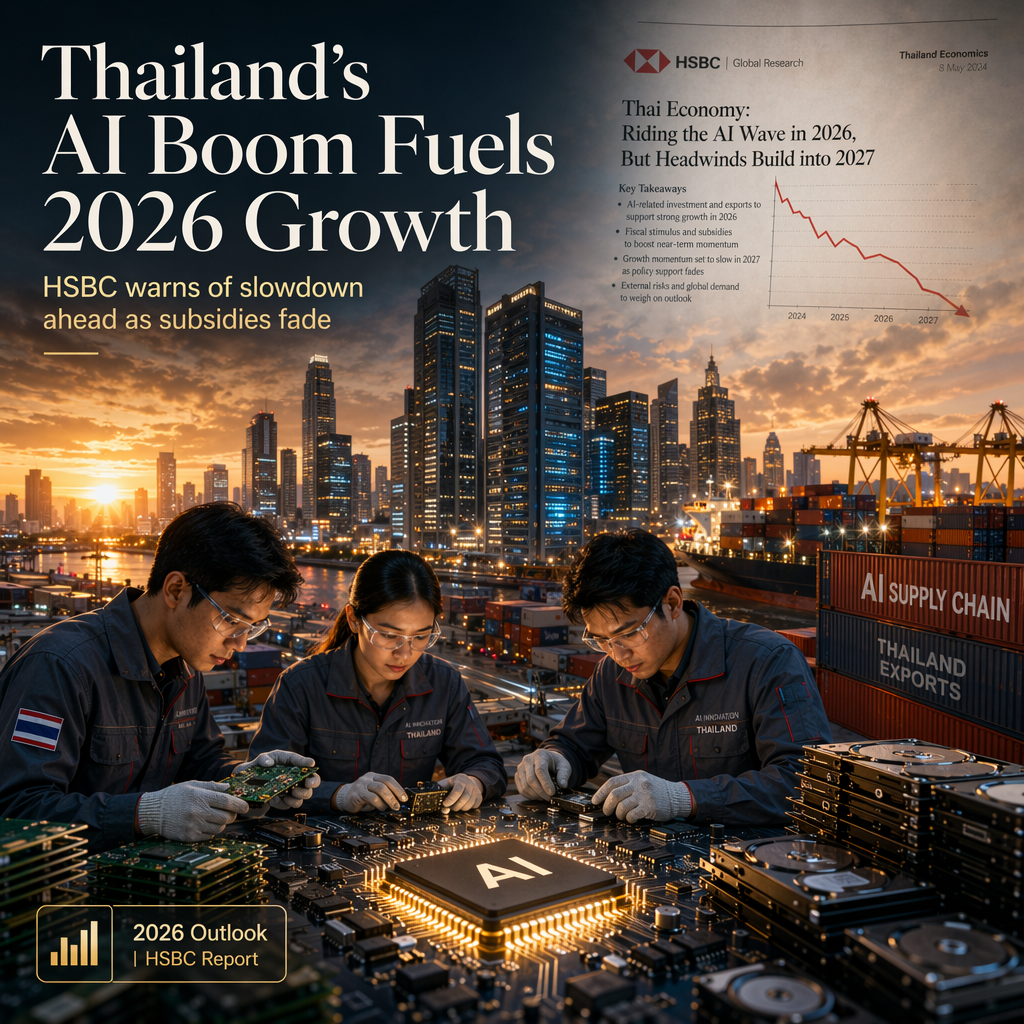
HSBC reports that Thailand's economic growth in the first quarter of 2026 exceeded expectations, accelerating to 2.8% year-on-year, despite ongoing turmoil in the Middle East [1]. This outperformance was largely attributed to strong electronics exports, which surged by 15.5% year-on-year—the fastest pace since the COVID-19 lockdown export boom—with particular strength in sectors linked to data centres and AI supply chains [1]. Thailand's role as a major producer of printed circuit boards and hard disk drives contributed significantly to this momentum [1].
Private investment and consumption also remained robust, supported by AI-related activity and fiscal stimulus measures. The government has issued a THB400 billion loan decree, equivalent to 2.1% of GDP, with half of the funds allocated to consumer subsidies [1]. HSBC notes that these factors have led to an upgraded growth outlook for 2026 [1].
However, HSBC cautions that non-AI sectors are facing increased competition from China, and consumption is expected to cool as subsidies fade [1]. As a result, the bank has revised its 2027 growth forecast downward to 1.7%, from a previous estimate of 2.6% [1]. Additionally, inflation is projected to ease below 2% year-on-year as early as the second quarter of 2027, due to challenges in passing higher costs on to consumers [1].
CONCLUSION
Thailand's economy is experiencing a short-term boost driven by AI-linked exports and fiscal stimulus, but HSBC warns of medium-term headwinds as subsidies diminish and competition intensifies. The outlook for 2026 has improved, but growth is expected to slow significantly in 2027, with inflation likely to remain subdued.