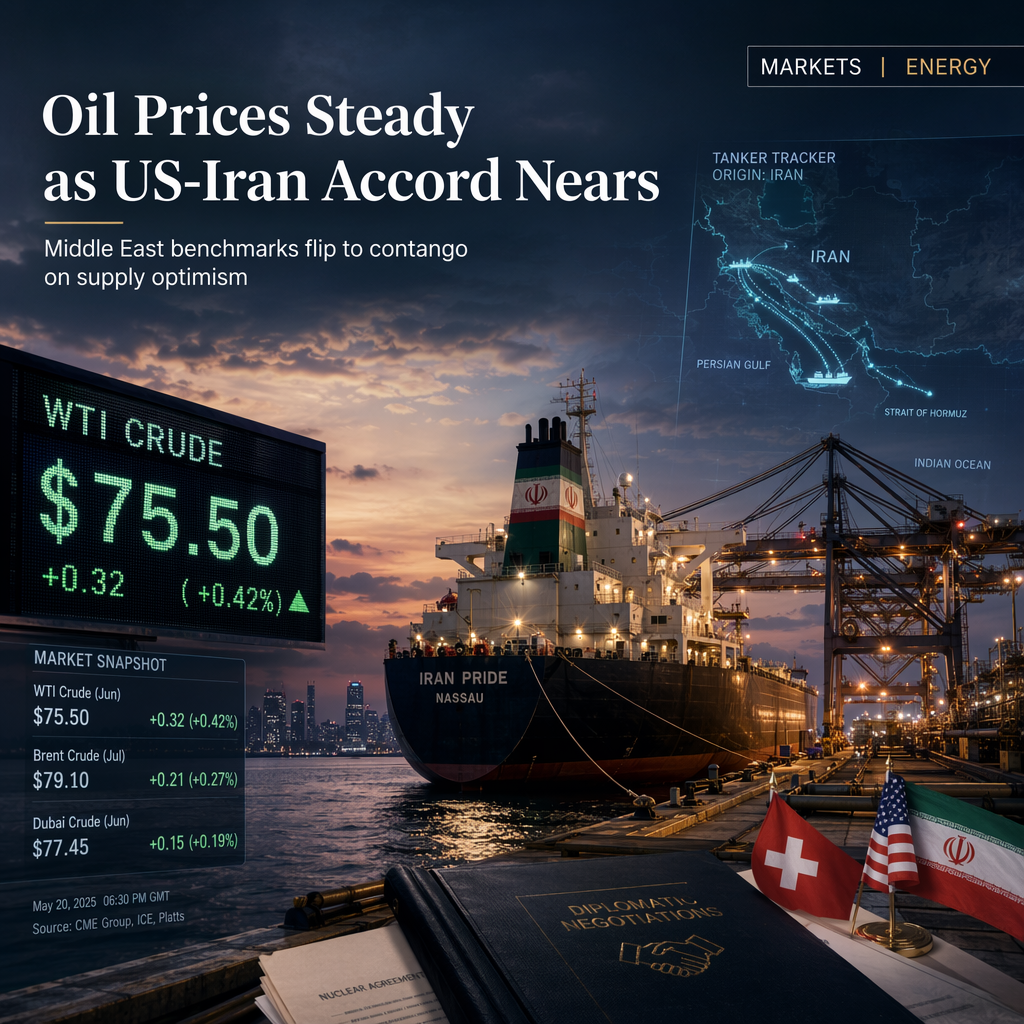
West Texas Intermediate (WTI) crude oil prices remained subdued for the fifth consecutive day, trading around $75.60 per barrel during European hours on Wednesday, as investors responded to easing supply concerns stemming from diplomatic progress between the United States and Iran [1]. The decline in crude prices was attributed to anticipation of an interim accord set to be signed in Switzerland this Friday, which will grant Tehran broad economic incentives and allow for the immediate resumption of Iranian oil exports [1]. Shipping data indicated that at least three tankers carrying Iranian oil have already breached the US naval blockade this week, with a fourth empty vessel en route to the Gulf of Oman [1].
Despite these developments, experts cautioned that a full physical recovery in oil flows would take time, as actual tanker traffic through the critical Strait of Hormuz has not yet returned to baseline levels [1]. While the market is broadly removing the geopolitical risk premium from oil prices, the normalization process remains complex [1].
The shifting supply outlook led to a sharp weakening in the broader Middle Eastern crude market this week. Key benchmarks slipped into deep discounts, with Reuters data showing Dubai's premium to swaps falling into a 46-cent discount on Tuesday, marking its first contango structure since January [1]. Spot Oman and Murban differentials also flipped into discounts of 67 and 49 cents, respectively [1]. This widespread move into contango—a market structure where prompt cargoes trade at a discount to later-dated ones—signals to investors that near-term global oil supplies are becoming more ample [1].
CONCLUSION
The anticipated US-Iran peace deal and early signs of resumed Iranian oil exports have led to a weakening in crude benchmarks and a shift to contango, reflecting expectations of increased near-term supply. While political progress is evident, experts note that a full recovery in physical oil flows will take time, keeping some uncertainty in the market.