
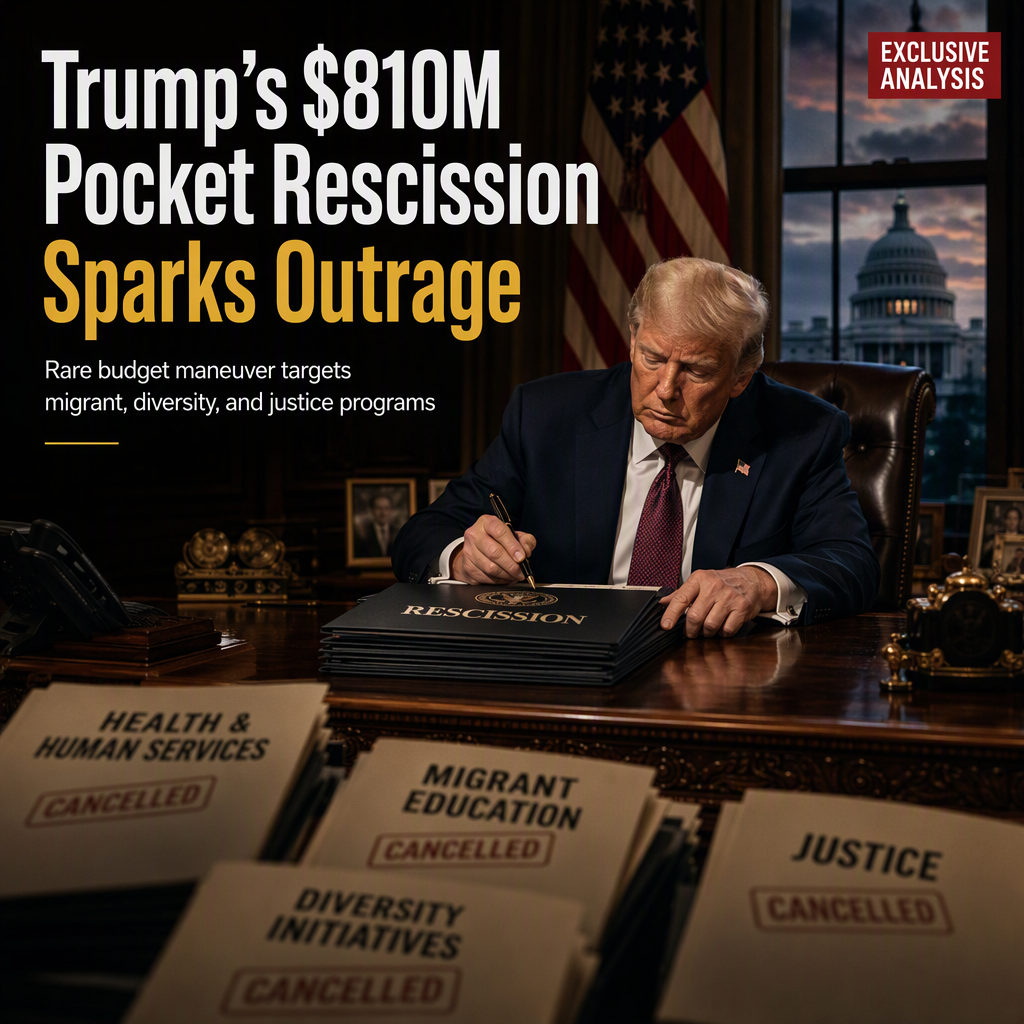
On September 26, the Trump administration announced the cancellation of $810 million in congressionally approved spending, targeting programs that serve illegal immigrants, diversity initiatives, and other efforts the administration argued do not benefit American citizens [1]. The maneuver used was a 'pocket rescission,' a rare budget tactic that the executive branch claims is within its authority, though Congress and the Government Accountability Office (GAO) dispute this, stating it exceeds presidential authority [1].
Of the rescinded funds, $567 million were directed at Health and Human Services programs supporting refugees, asylees, and other non-citizens [1]. Additional cuts included $25 million for education programs for migrant students, which the administration claimed supported activities such as an LGBT youth summit and therapy workshops for Latinx youth [1]. 'Woke International Education' programs, which bring foreign students and faculty to the U.S. and fund doctoral dissertations on queer and trans community building abroad, were targeted for $70 million in cuts [1]. Other affected programs included a Justice Department office focused on reducing racial tensions, a business development initiative for minority entrepreneurs, Housing and Urban Development counseling services, and Health and Human Services grants described by the administration as 'outright harmful and blatantly ideological' [1].
The White House noted that several organizations impacted by the cuts are led by former Obama administration officials [1]. Senator Susan Collins (R-Maine) condemned the rescissions, calling them an attempt by the Office of Management and Budget (OMB) to undermine Congress’s constitutional power of the purse [1]. Collins argued that the timing of the rescission—near the end of the federal fiscal year on September 30—was intentional, as unspent funds would expire before Congress's 45-day review period could be completed, especially with the House out of session through the November election [1].
Collins further cited the independent GAO's conclusion that pocket rescissions are unlawful and not permitted by the Impoundment Control Act, vowing to work with colleagues to address what she described as illegal actions [1]. The OMB under Trump, however, maintains that the Impoundment Control Act does not explicitly forbid such maneuvers [1].
CONCLUSION
The Trump administration's use of a pocket rescission to cancel $810 million in congressional funds has sparked controversy, with significant opposition from Congress and the GAO regarding its legality. The targeted cuts affect a range of programs supporting non-citizens and diversity initiatives, raising concerns about executive overreach and the undermining of congressional authority. The market impact is medium, as the move could influence future funding and political dynamics.