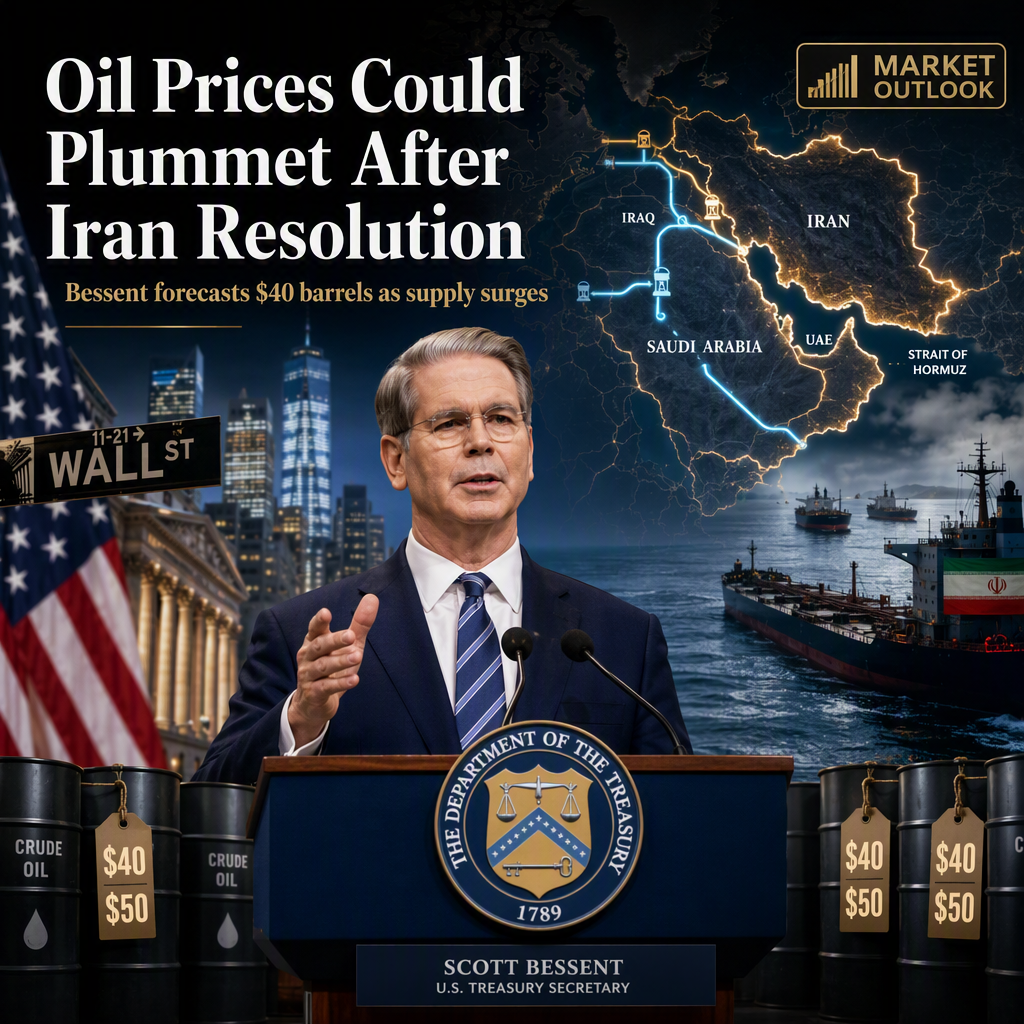
Treasury Secretary Scott Bessent forecasted that oil prices could fall to between $40 and $50 per barrel once the ongoing Iran conflict concludes, citing an anticipated surge in supply as constraints ease [1]. Bessent described the current energy supply shock as temporary and asserted that the United States remains an 'energy superpower,' leading in artificial intelligence and global computing power [1].
During an interview, Bessent emphasized the strength of the American economy, noting it is 'very strong' and experiencing a 'productivity burst' [1]. He stated that Americans are, on average, breaking even with inflation, with working-class Americans doing slightly better, though he acknowledged this was not sufficient [1]. Bessent expressed optimism that wage increases would continue, driven by a 'manufacturing renaissance' and 'construction renaissance,' and predicted these would translate into real wage gains as the conflict ends [1].
Bessent also commented on the geopolitical situation, highlighting that the recent U.S. strikes on Iranian tankers have not yet cooled tensions between Washington, D.C., and Tehran [1]. He predicted that the Strait of Hormuz would become less critical to global oil trade as Gulf nations develop alternative pipeline routes, thereby reducing Iran's leverage over oil flows [1]. Bessent characterized the current economic measures against Iran as 'the greatest economic isolation operation in the history of the world,' combining a blockade and sanctions as a powerful strategy [1].
Looking ahead, Bessent expressed confidence that the resolution of the Iran conflict would result in a safer world, an Iran unable to obtain nuclear weapons, and a global economy entering a 'lift-off phase' [1].
CONCLUSION
Treasury Secretary Bessent's remarks signal expectations of a significant drop in oil prices and continued economic strength for the United States once the Iran conflict is resolved. The anticipated increase in oil supply and ongoing wage growth could have substantial market implications, particularly for the energy sector. Bessent's outlook suggests optimism for both geopolitical stability and economic momentum in the near future.