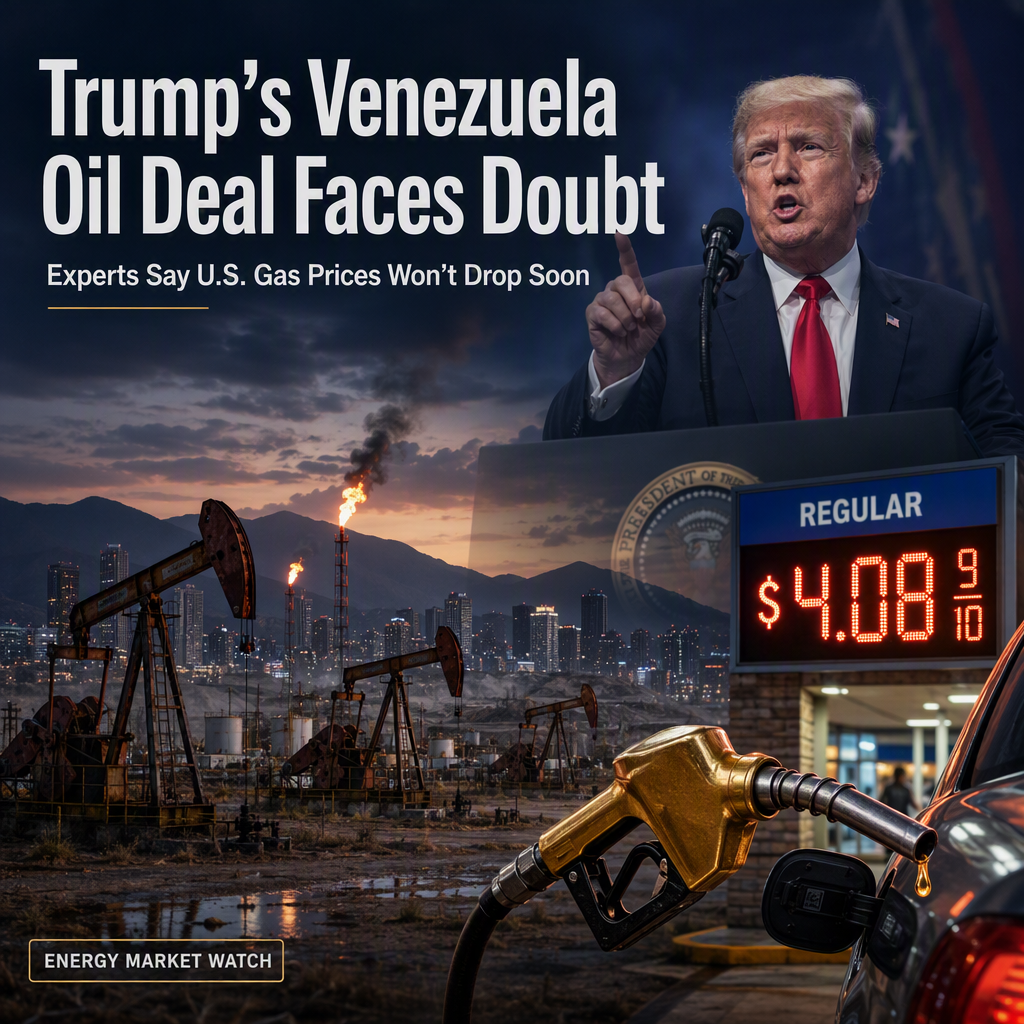
President Donald Trump announced that the United States has secured majority control over 65 billion barrels of Venezuela's proven oil reserves, representing approximately 20% of the South American nation's estimated 303 billion barrels of reserves [1]. Trump claimed the deal would 'substantially lower gas prices for all Americans, long into the future' [1]. However, experts cited in the article express skepticism about the deal's near-term impact on U.S. gasoline prices, citing Venezuela's dilapidated oil infrastructure and the need for significant investment and time to boost output [1].
As of Monday, U.S. drivers were paying an average of $4.08 per gallon for gasoline, nearly 30% higher than the same period last year, according to AAA data [1]. Market analysts attribute the current high prices to factors such as Ukraine's attacks on Russian refineries and supply disruptions in the Middle East due to the Iran war [1]. Patrick De Haan, head of petroleum analysis at GasBuddy, stated that it is almost certain gas prices will set a new all-time high for Labor Day, surpassing the previous record of $3.83 per gallon set in 2012 [1].
Venezuela is currently producing about 1.2 million barrels of oil per day, significantly below its late 1990s peak of 3.5 million barrels per day [1]. Rystad Energy estimated in January that approximately $180 billion in investment would be required through 2040 to restore Venezuela's oil production to peak levels [1]. Secretary of State Marco Rubio indicated that Trump's deal would bring nearly $100 billion of private sector investment to Venezuela [1].
Despite the scale of the agreement, experts such as David Goldwyn and Andy Lipow caution that the deal's legality and long-term viability remain uncertain, as the terms have not been disclosed and no official documentation has been published [1]. Goldwyn emphasized, 'This will have absolutely no impact on gasoline prices or Venezuelan production for that matter for years to come' [1]. It is also unclear which oil companies will participate in the investment and how extraction deals will be structured [1].
CONCLUSION
While President Trump has touted the Venezuela oil deal as a solution to high U.S. gas prices, experts and analysts cited in the article agree that any impact will be years away due to Venezuela's struggling oil sector and the need for massive investment. In the short term, U.S. drivers should not expect relief at the pump from this agreement. The market remains focused on ongoing supply disruptions and geopolitical risks.