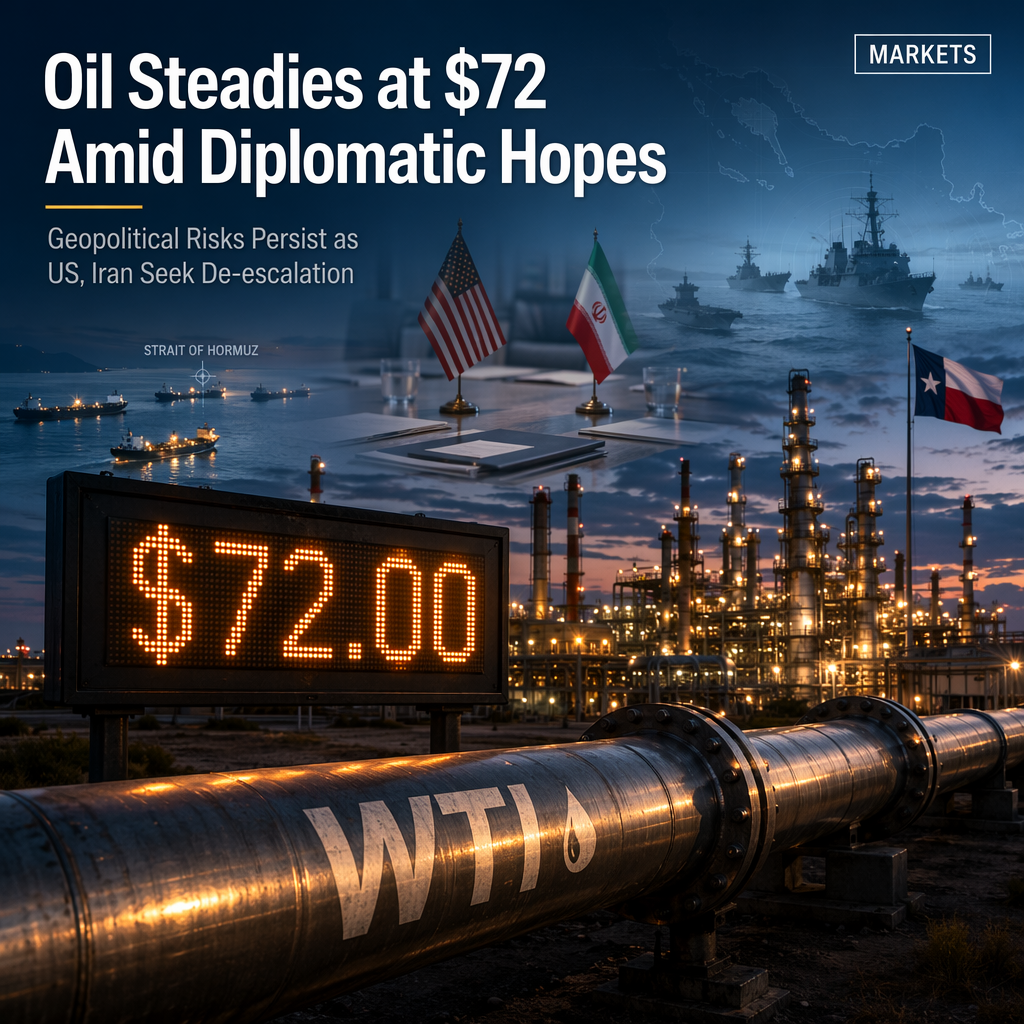
West Texas Intermediate (WTI) Oil traded around $72 on Friday, marking a 0.42% increase for the day, but remained in a consolidation phase after reaching a more than two-week high earlier in the week [1]. The market is currently balancing ongoing military tensions in the Middle East with renewed diplomatic efforts, as investors assess mixed signals from the region [1]. Market sentiment improved slightly following confirmation from a US official that technical talks with Iran are ongoing, despite US President Donald Trump's comments that the memorandum of understanding with Tehran was no longer in effect [1]. Additionally, Reuters reported that Qatari negotiators are in Iran to meet with Iranian officials, aiming to de-escalate tensions and create conditions for broader negotiations, in coordination with the United States [1].
The talks are reportedly focused on implementing the US-Iran memorandum of understanding and addressing disputes that have triggered recent escalations, including navigation issues in the Strait of Hormuz [1]. Despite these diplomatic efforts, the geopolitical risk premium remains, as strikes between the United States and Iran continue, maintaining concerns over potential energy supply disruptions [1]. Rabobank noted that oil traffic through the Strait of Hormuz remains significantly below normal levels, and war risk insurance costs are rising, both of which could limit further downside in oil prices [1].
On the supply and demand front, the International Energy Agency (IEA) projects that global oil demand will increase by 1.2 million barrels per day year-over-year in the fourth quarter [1]. The IEA also forecasts a significant increase in global oil supply this year if transit conditions improve, while lowering its outlook for Russian oil production due to attacks on the country's energy infrastructure [1].
Investors are also monitoring the outlook for the Federal Reserve, as higher interest rates for a prolonged period could weigh on global economic growth and limit oil demand. However, developments in the Middle East remain the primary driver of oil prices in the near term [1].
CONCLUSION
WTI oil prices are being shaped by a complex interplay of ongoing US-Iran tensions, diplomatic efforts, and fundamental supply-demand dynamics. While hopes for de-escalation have provided some support, persistent geopolitical risks and uncertain transit conditions continue to underpin the market. The outlook remains sensitive to both Middle East developments and broader economic factors such as US interest rates.