
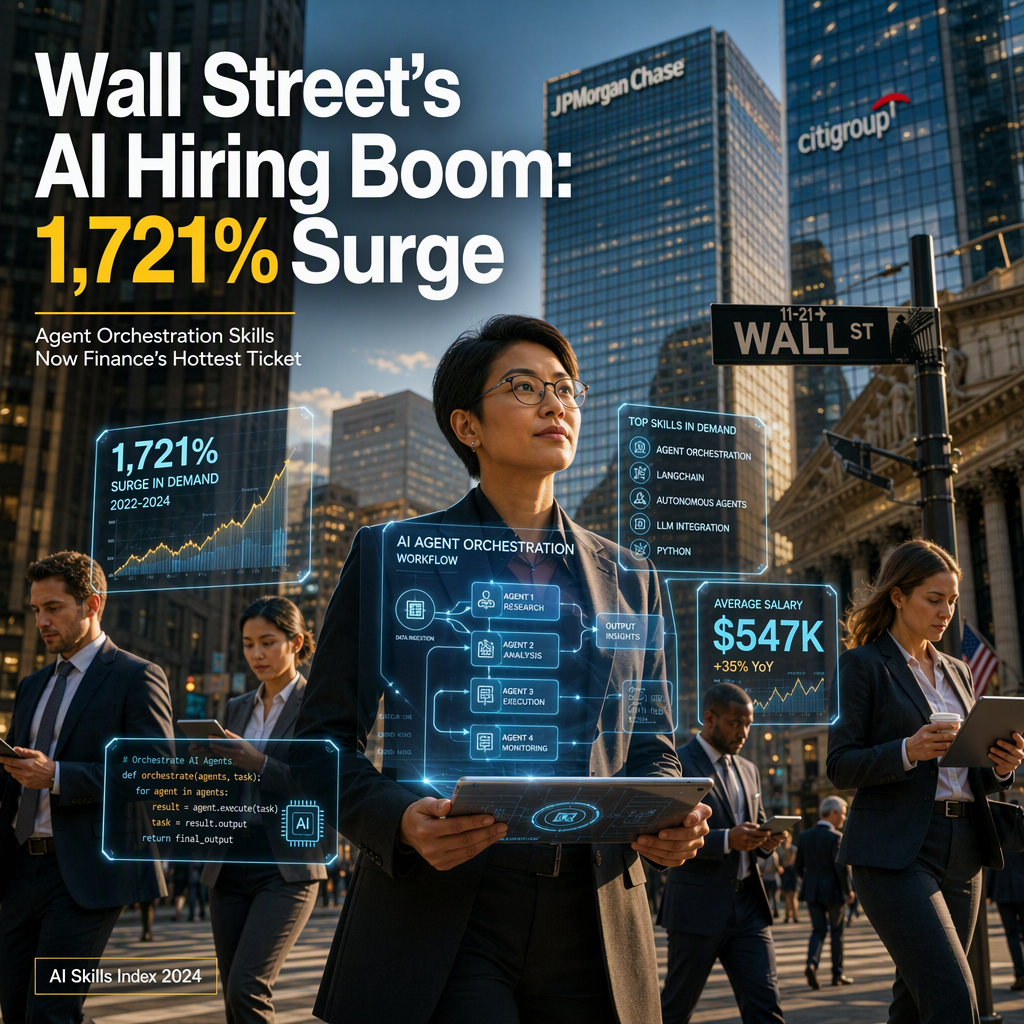
Wall Street is undergoing a significant transformation as artificial intelligence (AI) reshapes job roles and skill requirements across major banks. According to enterprise hiring data firm Draup, job postings referencing 'agent orchestration'—the ability to design and coordinate AI agents working together on tasks—have surged by 1,721% this year, making it the most sought-after technical skill in finance [1]. This hiring boom is not limited to traditional AI model builders; it now includes 'forward-deployed engineers' who integrate AI directly into trading desks, compliance units, and back-office operations [1].
The demand for AI-related roles at banks such as JPMorgan Chase, Citigroup, and Capital One increased by 49% compared to 2025, reaching 139,819 listings this year [1]. Generative AI and agent-related positions command higher salaries than other tech roles in finance, with generative AI managers earning a median base salary of about $190,000, according to Draup [1]. Draup CEO Vijay Swaminathan described agent orchestration as 'arguably the hottest skill on Wall Street,' emphasizing the need for professionals who understand both data and AI deployment within complex financial environments [1].
This trend signals a shift in Wall Street's AI strategy, moving beyond chatbots to deploying armies of AI agents that automate repetitive tasks and boost productivity. The new wave of hiring focuses on embedding AI directly into business lines, requiring a blend of technical expertise and domain-specific knowledge. Forward-deployed engineers are tasked with identifying which agents are needed, their functions, and the appropriate technologies to use, often navigating complex and sometimes hidden enterprise processes [1].
The rapid growth in agent orchestration skills and AI-related hiring reflects Wall Street's commitment to leveraging AI for operational efficiency and competitive advantage. This evolution has implications for executives, employees, and shareholders as banks continue to automate more functions and adapt to the changing technological landscape [1].
CONCLUSION
Wall Street's aggressive push into AI is driving unprecedented demand for agent orchestration skills, with job postings and salaries rising sharply. This shift highlights the financial sector's focus on embedding advanced AI capabilities across business lines to enhance productivity and automation. The market impact is high, as banks position themselves for a future increasingly reliant on AI-driven operations.