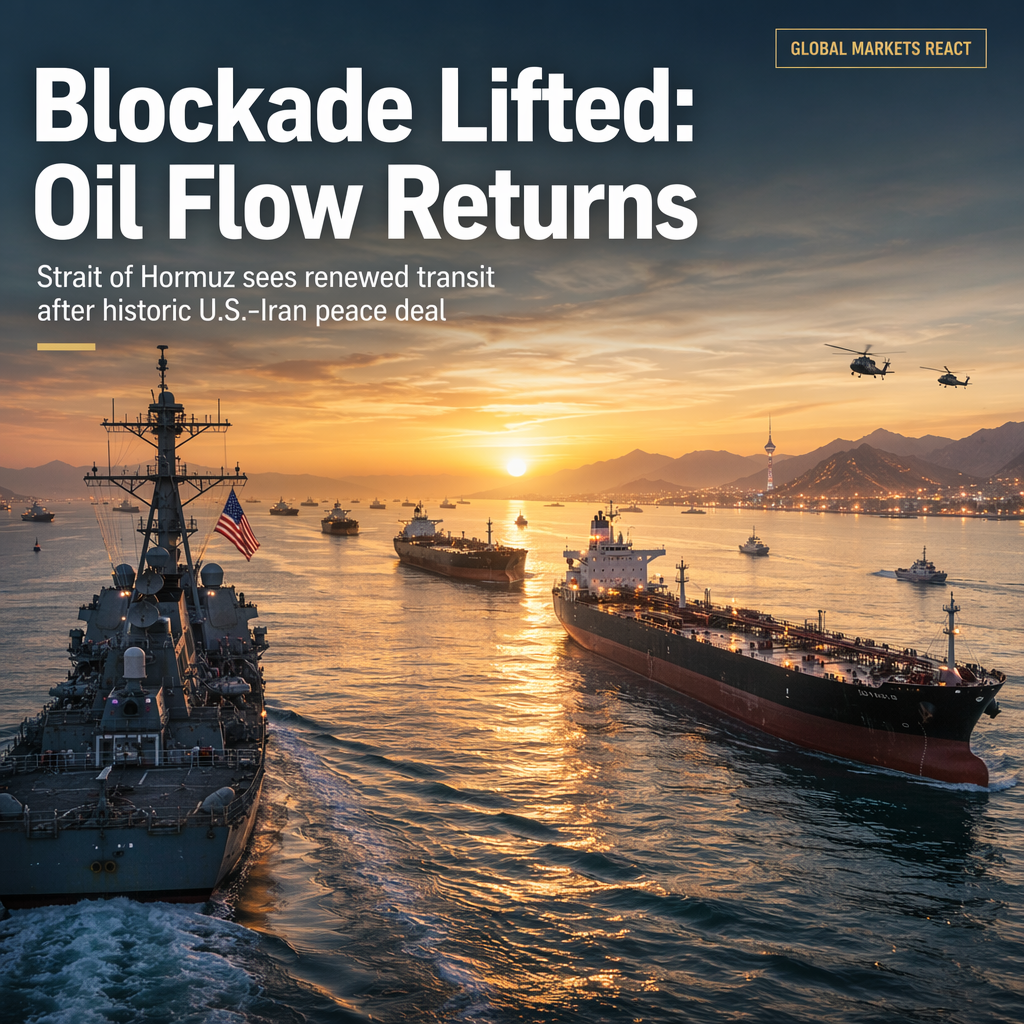
The U.S. Navy has officially ended its blockade of Iran's ports and coastal areas following the signing of a memorandum of understanding between President Donald Trump and Iranian President Masoud Pezeshkian, which aims to end the ongoing U.S.-Iran war [1]. According to U.S. Central Command, American forces are no longer impeding the transit of vessels to or from Iranian ports, and all military blockade enforcement efforts have ceased as of Thursday [1].
Under the terms of the agreement, Iran is required to allow commercial vessels to transit the Strait of Hormuz without paying tolls for a period of 60 days [1]. Vice President JD Vance reported that Iran has not fired on ships in the Strait of Hormuz for two consecutive nights, indicating that Iran is currently honoring its commitments under the deal [1].
The resumption of oil flows through the Strait of Hormuz is significant, with more than 12 million barrels of oil reportedly transiting the strait overnight, although CNBC could not immediately verify this figure [1]. Trade intelligence firm Kpler confirmed that three Saudi tankers carrying around 6 million barrels have crossed the strait [1]. Prior to the conflict, about 14 million barrels per day of oil and 6 million barrels per day of refined products moved through Hormuz, but these flows were severely disrupted following military actions earlier in the year [1].
Kpler forecasts that oil flows through Hormuz could reach nearly 50% of prewar levels within 30 days if the U.S.-Iran deal is fully implemented without any issues [1]. However, it remains uncertain when, or if, exports will return to prewar levels. Amrita Sen, founder of Energy Aspects, noted that the recovery will be gradual, with initially stuck ships moving out but not an immediate return to pre-conflict volumes [1].
CONCLUSION
The lifting of the U.S. Navy blockade marks a major step toward de-escalation in the region and has already enabled the partial resumption of oil flows through the Strait of Hormuz. While the market is likely to react positively to the increased supply, analysts caution that a full recovery to prewar export levels will take time and depend on continued compliance with the agreement.