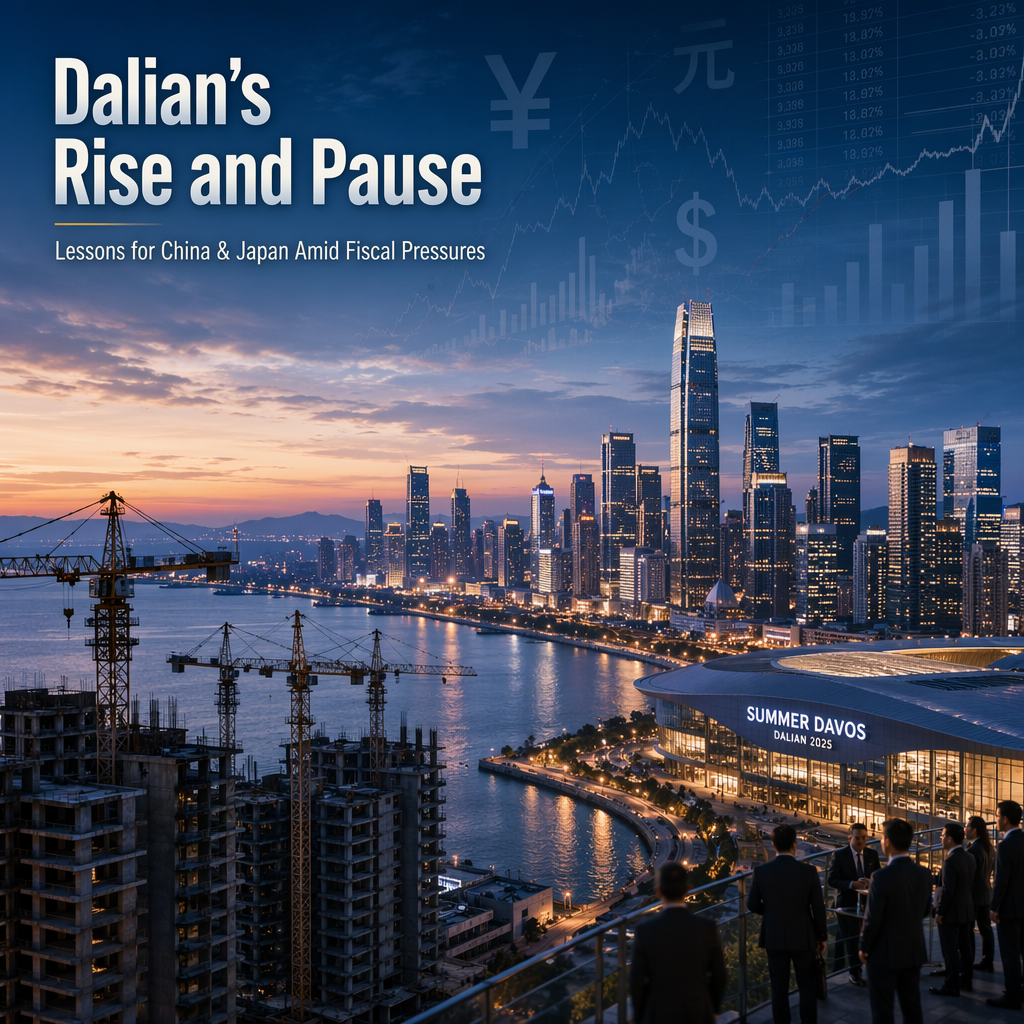
In late June, the World Economic Forum and the Chinese government jointly hosted the Summer Davos forum in Dalian, Liaoning province, a city that once aspired to become the 'Hong Kong of the north' [1]. The forum brought renewed attention to Dalian's development trajectory, which highlights the limitations of heavy-handed government intervention and the advantages of market-led policies [1]. Financial analysts cited in the article note that Dalian initially benefited from openness, foreign investment, and entrepreneurial activity, but its growth has since been hindered by shifts toward centralized control and reduced policy flexibility, especially when compared to Hong Kong's continued economic dynamism [1].
Forum participants discussed significant ongoing challenges in both China and Japan. In China, these include capital controls, turmoil in the real estate market, and mounting local government debt [1]. The article notes that the Chinese government has responded with state-directed absorption of local banks and increased intervention in the property sector, actions that aim to manage economic risks but also raise concerns about long-term growth prospects [1]. In Japan, fiscal sustainability is under scrutiny as bond yields reportedly approach 3%, reflecting escalating fiscal fears [1].
The article emphasizes that the experience of Dalian underscores the importance of market mechanisms over government direction for sustained economic growth. Both Beijing and Tokyo are encouraged to draw lessons from Dalian's rise and relative stagnation as they address their respective economic challenges [1].
CONCLUSION
Dalian's experience as the 'Hong Kong of the north' illustrates the risks of excessive government intervention and the benefits of market-driven development. Policymakers in China and Japan face mounting economic pressures and can learn from Dalian's trajectory as they seek to foster sustainable growth. The market response, including rising Japanese bond yields and concerns over China's property sector, underscores the urgency of these lessons.