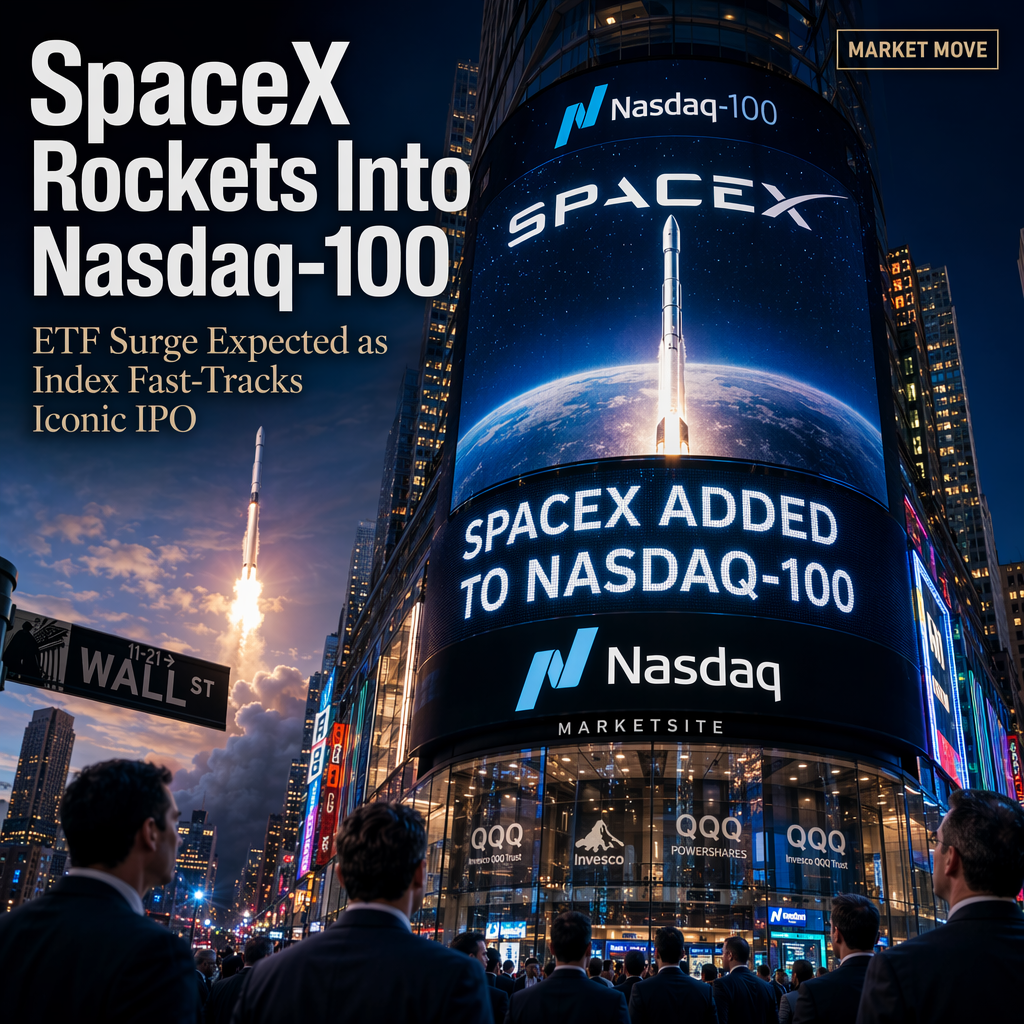
Nasdaq announced that Elon Musk’s SpaceX will be added to the Nasdaq-100 index, marking one of the fastest inclusions ever for a newly public company [1]. The aerospace and satellite company, which made its public debut on June 12, is expected to join the index with a weighting of less than 1% [1]. This move is enabled by Nasdaq's recently adopted fast-track inclusion framework, allowing large IPOs to become eligible for the Nasdaq-100 after just 15 trading days, compared to the historically longer waiting period [1].
Assuming SpaceX meets the exchange’s requirements, index-tracking funds such as the Invesco QQQ Trust (QQQ) and other product sponsors will begin purchasing shares after the market closes on July 6, with SpaceX officially joining the Nasdaq-100 before trading begins on July 7 [1]. More than $800 billion tracks the Nasdaq-100, including QQQ, which is one of the most actively traded securities and is viewed as a barometer for the artificial intelligence bull market [1].
The inclusion is expected to drive significant demand for SpaceX shares from passive investors, as index funds and ETFs tied to the Nasdaq-100 will need to buy shares to match the benchmark’s new composition [1]. Active managers who closely track the index may also adjust their positions accordingly [1]. Given that SpaceX’s publicly tradable float is small relative to its total market capitalization, even a modest index weighting could require meaningful purchases from passive investment vehicles [1].
Earlier in the month, S&P Dow Jones Indices declined to implement a similar fast-track process for the S&P 500, leaving SpaceX ineligible for that index due to separate profitability and seasoning requirements [1].
CONCLUSION
SpaceX’s rapid inclusion in the Nasdaq-100 is set to generate substantial buying demand from index funds and ETFs, potentially impacting the stock’s trading dynamics. The move highlights the significance of Nasdaq’s new fast-track framework and positions SpaceX as a key beneficiary among recent IPOs. However, SpaceX remains ineligible for the S&P 500 due to different index requirements.