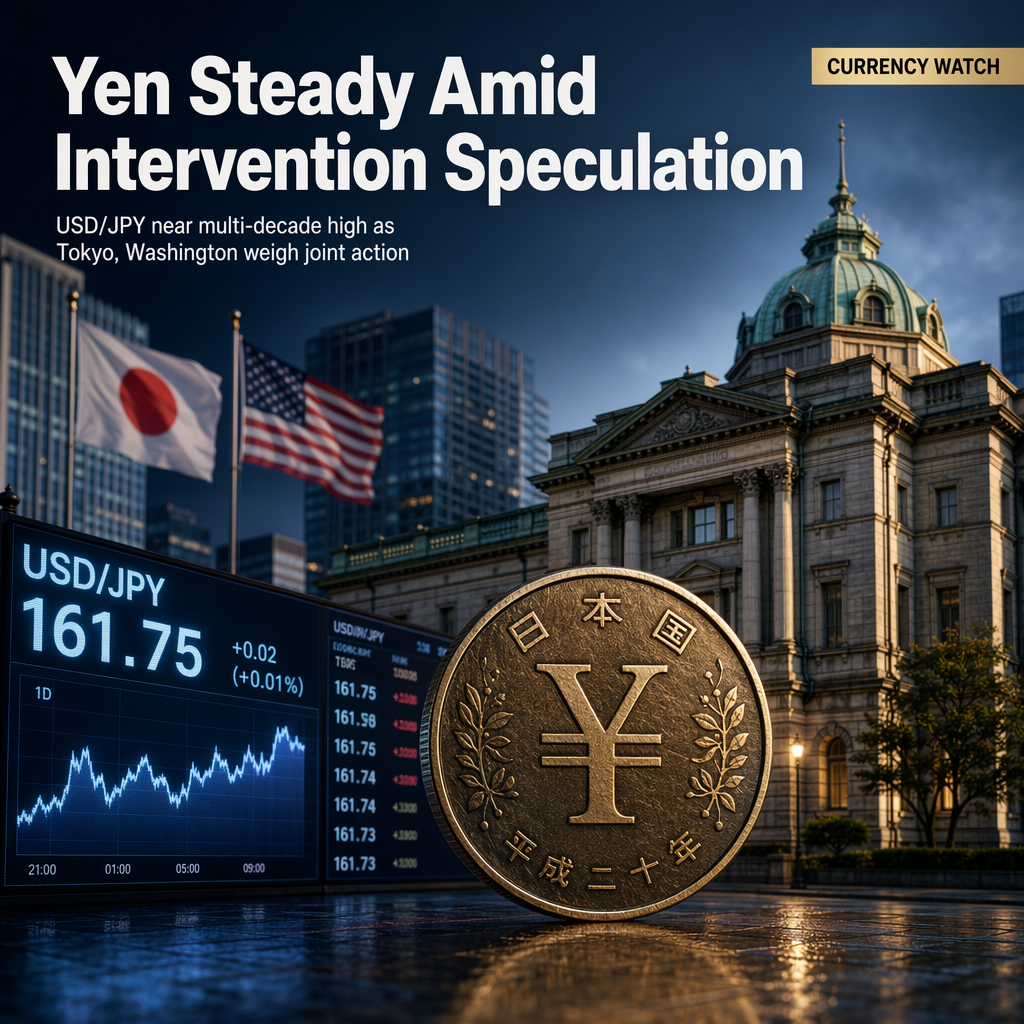
The Japanese Yen (JPY) remained stable against the US Dollar (USD), with the USD/JPY pair trading near a multi-decade high of approximately 161.75 during early Asian trading hours on Thursday [1]. This flat movement comes amid heightened speculation of imminent currency intervention by Japanese authorities, which has limited the upside potential for the pair [1]. The speculation was fueled by an agreement between Japan's Finance Minister Satsuki Katayama and US Treasury Secretary Scott Bessent to take steps on currencies if necessary, raising the possibility of a joint US-Japan intervention to support the Yen [1]. Additionally, Japan’s Chief Cabinet Secretary Minoru Kihara stated on Tuesday that appropriate action would be taken against foreign exchange moves if needed [1].
On the US side, hawkish signals from the Federal Reserve could bolster the Greenback. The Fed held its benchmark interest rate steady between 3.50% and 3.75% at its June policy meeting [1]. Kevin Warsh, in his first press conference as chairman, emphasized that “price stability” would be the Fed’s guiding principle [1]. Market expectations for a rate hike have increased, with a 34.2% chance of a 25 basis points hike at the July meeting, up from 8.5% a week ago, and a 66.4% chance for September, up from 29.1%, according to the CME FedWatch tool [1].
The Yen's value is influenced by several factors, including the performance of the Japanese economy, Bank of Japan (BoJ) policy, and the yield differential between Japanese and US bonds [1]. The BoJ has historically intervened in currency markets, typically to lower the value of the Yen, but such actions are infrequent due to political concerns [1]. The BoJ’s ultra-loose monetary policy from 2013 to 2024 led to Yen depreciation, but the gradual unwinding of this policy in 2024 has provided some support to the currency [1].
The widening policy divergence between the BoJ and the US Federal Reserve, particularly regarding the 10-year bond yields, has favored the US Dollar against the Yen [1]. However, the BoJ’s recent shift away from ultra-loose policy, combined with potential interventions, is creating uncertainty and volatility in the currency markets [1].
CONCLUSION
The Japanese Yen is holding steady near historic lows as traders remain alert for possible intervention by Japanese and US authorities. Market speculation of a joint intervention and shifting Fed rate hike expectations are driving volatility and limiting further downside for the Yen. The situation remains fluid, with policy decisions and potential actions likely to impact currency markets in the near term.