
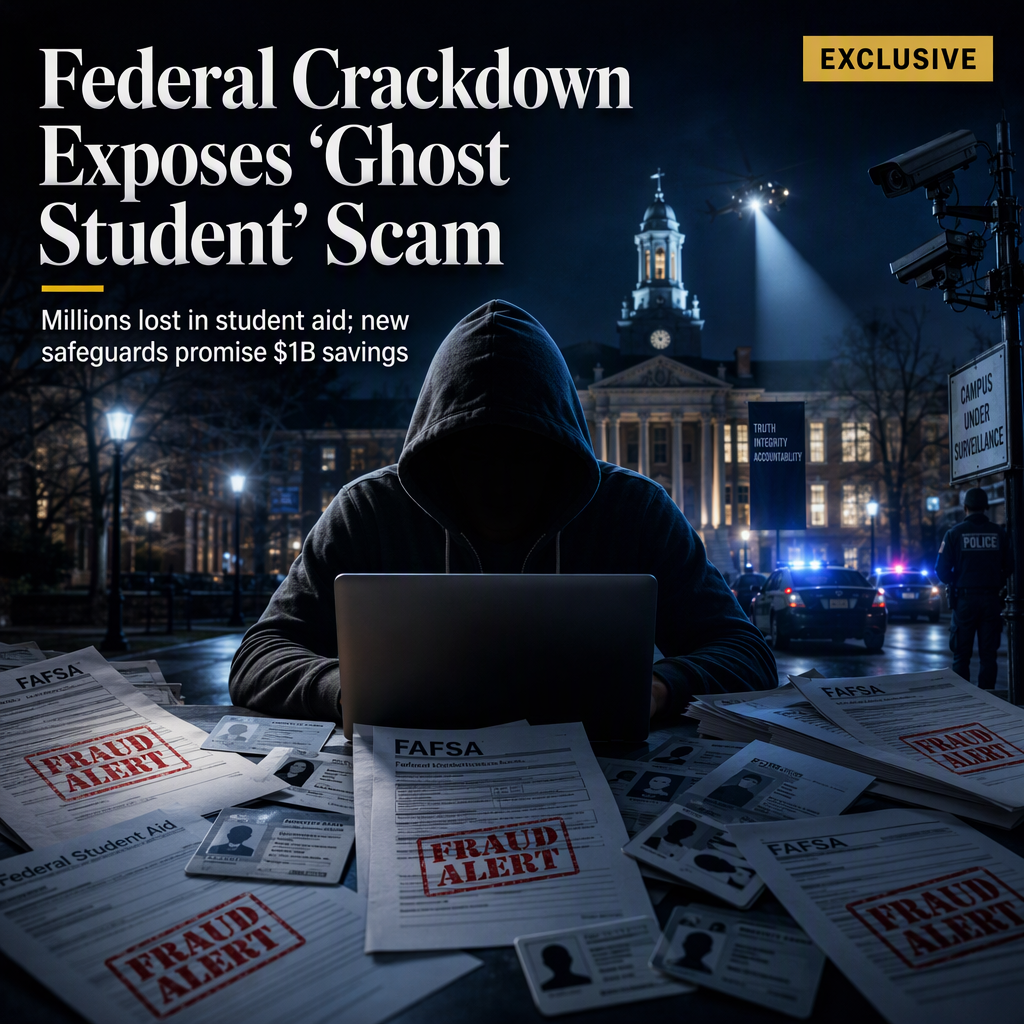
A multimillion-dollar scam involving 'ghost students' has been uncovered on college campuses, prompting a significant federal crackdown on student aid fraud. According to Mallory Wortman, a senior fraud investigator at Abrigo, fraudsters are fabricating identities—sometimes using artificial intelligence—to enroll in colleges and collect federal student aid intended for legitimate students. Wortman explained that these scams exploit vulnerabilities in the student loan system, which has historically had lax controls, especially during periods of increased government spending such as the COVID-19 pandemic era [1].
The Department of Education responded by integrating a new identity verification system into the online FAFSA application. In June, the department reported saving taxpayers nearly $200 million by requiring high-risk applicants to present government-issued identification when applying for federal student aid. Officials estimate that this measure will save taxpayers more than $1 billion in the current cycle [1].
The crackdown also addresses previous weaknesses in fraud safeguards. Department officials criticized the Biden administration for requiring less than 1% of students to verify their identity after submitting their FAFSA during the pandemic. The current administration has paired enhanced safeguards with new enforcement efforts, including Vice President JD Vance's recent announcement that over 870,000 borrowers linked to alleged COVID-era fraud will be suspended from future federal loan programs and could face federal prosecution [1].
Wortman emphasized that fraudsters are quick to exploit any opportunity where government funds are available, drawing parallels to unemployment fraud during COVID-19. She noted that the primary objective of these schemes is to obtain financial aid rather than pursue an education, with perpetrators often enrolling, collecting a financial aid refund, and then dropping out of classes [1].
CONCLUSION
The exposure of the 'ghost student' scam has led to strengthened identity verification and enforcement measures in the federal student aid system. With projected taxpayer savings exceeding $1 billion and the suspension of hundreds of thousands of fraudulent borrowers, the crackdown signals a more robust approach to combating student aid fraud. Market implications center on increased scrutiny and tighter controls in federal financial aid programs.