
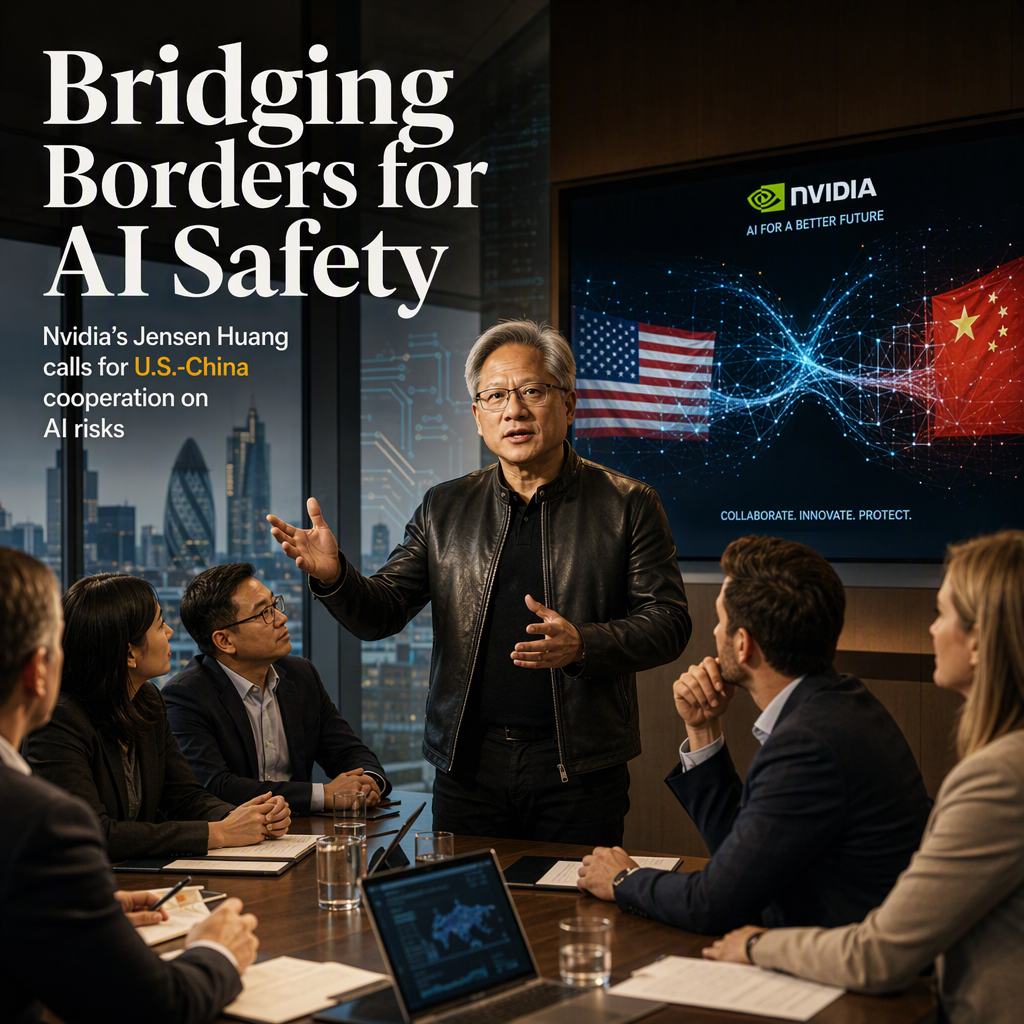
Nvidia CEO Jensen Huang emphasized the necessity for the chipmaker to collaborate with Chinese AI companies to monitor and address risks associated with 'potentially dangerous' artificial intelligence technology [1]. During a media briefing in London, Huang stated, 'We absolutely should work with each other so that we advance the technology safely,' highlighting the importance of dialogue between U.S. and Chinese AI researchers [1].
The discussion around AI safety has intensified recently, with researchers from labs such as OpenAI and Anthropic advocating for a slowdown in AI development and warning of existential risks to humanity [1]. While OpenAI's Sam Altman and Anthropic's Dario Amodei have called for increased regulation, Huang has positioned himself as a prominent voice against this approach, instead advocating for enhanced dialogue and cooperation [1]. He noted, 'We ought to enhance the dialogue. The United States should do it... I advocated that the U.K. do the same thing,' suggesting that the U.K. could play a key role as a convener of international AI safety discussions due to its intellectual capital [1].
AI safety has become a central topic in U.S.-China relations, with both governments considering how to address the risks posed by rapidly advancing AI technology [1]. In September, U.S. Treasury Secretary Scott Bessent discussed the possibility of a 'U.S.-China AI dialogue' with his Chinese counterpart, He Lifeng, including the establishment of a channel for incidents reaching a national security level [1]. According to a Chinese readout, President Xi Jinping expressed that while competition exists, there is also significant potential for cooperation in AI, and both sides can continue dialogue to exchange views on risks and benefits and jointly prevent misuse and abuse of AI [1].
CONCLUSION
Nvidia CEO Jensen Huang's call for collaboration with Chinese AI firms underscores the growing importance of international dialogue on AI safety. While some industry leaders advocate for stricter regulation, Huang favors enhanced cooperation and communication to address potential risks. The evolving discussions between the U.S., China, and the U.K. may shape future approaches to AI governance.