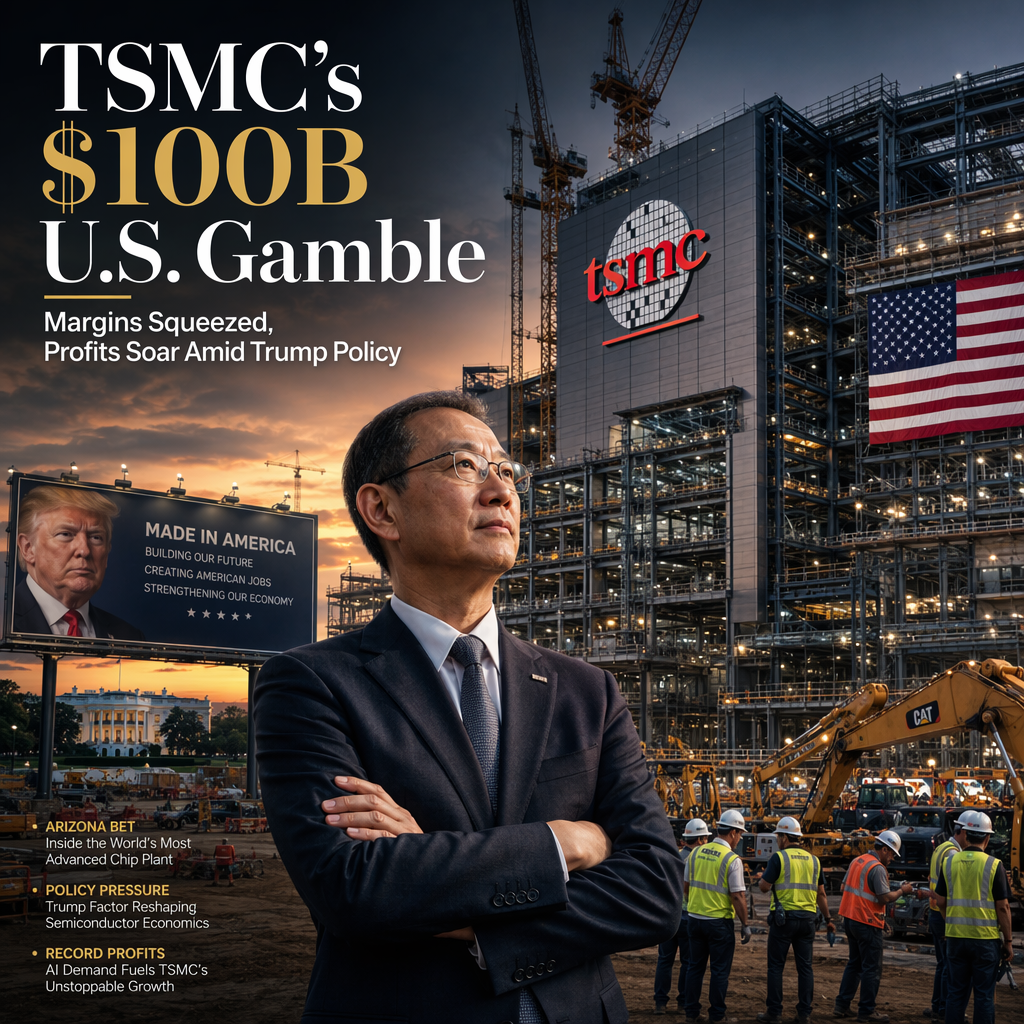
President Donald Trump's renewed push for American-made AI chips is significantly impacting TSMC, the world's leading contract chipmaker, by increasing production costs and squeezing margins [1]. Since Trump's return to power in 2025, he has repeatedly threatened tariffs on companies that do not manufacture their products in the U.S., prompting TSMC to announce a total of $200 billion in commitments to American manufacturing, including a recent $100 billion investment in advanced semiconductor facilities and packaging [1]. According to a White House spokesperson, these investments are a direct result of Trump's trade and economic policies, which have also led to a historic trade deal with Taiwan and renegotiated CHIPS program investments [1].
Despite the higher costs associated with U.S. expansion, TSMC reported a 77.4% year-on-year jump in second-quarter profit, surpassing estimates and marking another record-breaking quarter [1]. The company's market capitalization has risen more than 100% in the past 12 months, buoyed by the ongoing AI boom [1]. However, CFO Wendell Huang noted that while gross margin increased ahead of guidance, it was offset by dilution from overseas fabs, and margins are expected to be further diluted over the next several years as these projects ramp up [1].
Commerce Secretary Howard Lutnick stated that TSMC's additional $100 billion investment will create tens of thousands of American jobs and bring advanced semiconductor manufacturing back to America [1]. While other Asian chipmakers, such as SK Hynix, are also developing U.S. facilities, TSMC's commitment is by far the largest, exposing the company to higher production costs and potential headwinds for margins [1]. Senior equity analyst Phelix Lee of Morningstar estimated that TSMC's U.S.-produced chips cost 20-50% more than those made in Taiwan, depending on subsidy timing, tax credit recognition, and other cost fluctuations. Lee expects customers to bear more of these higher production costs [1].
TSMC is set to raise prices for both advanced and mature chips as it continues to expand aggressively in the U.S., driven by a "multi-year demand mega trend" from its customers and ongoing political pressure [1].
CONCLUSION
TSMC's aggressive U.S. expansion, spurred by President Trump's policies, is creating significant market impact through record profits and massive investment commitments. However, higher production costs and margin dilution pose ongoing challenges, with analysts expecting customers to absorb some of the increased expenses. The company's strategic moves are reshaping the global semiconductor landscape and U.S. manufacturing employment.