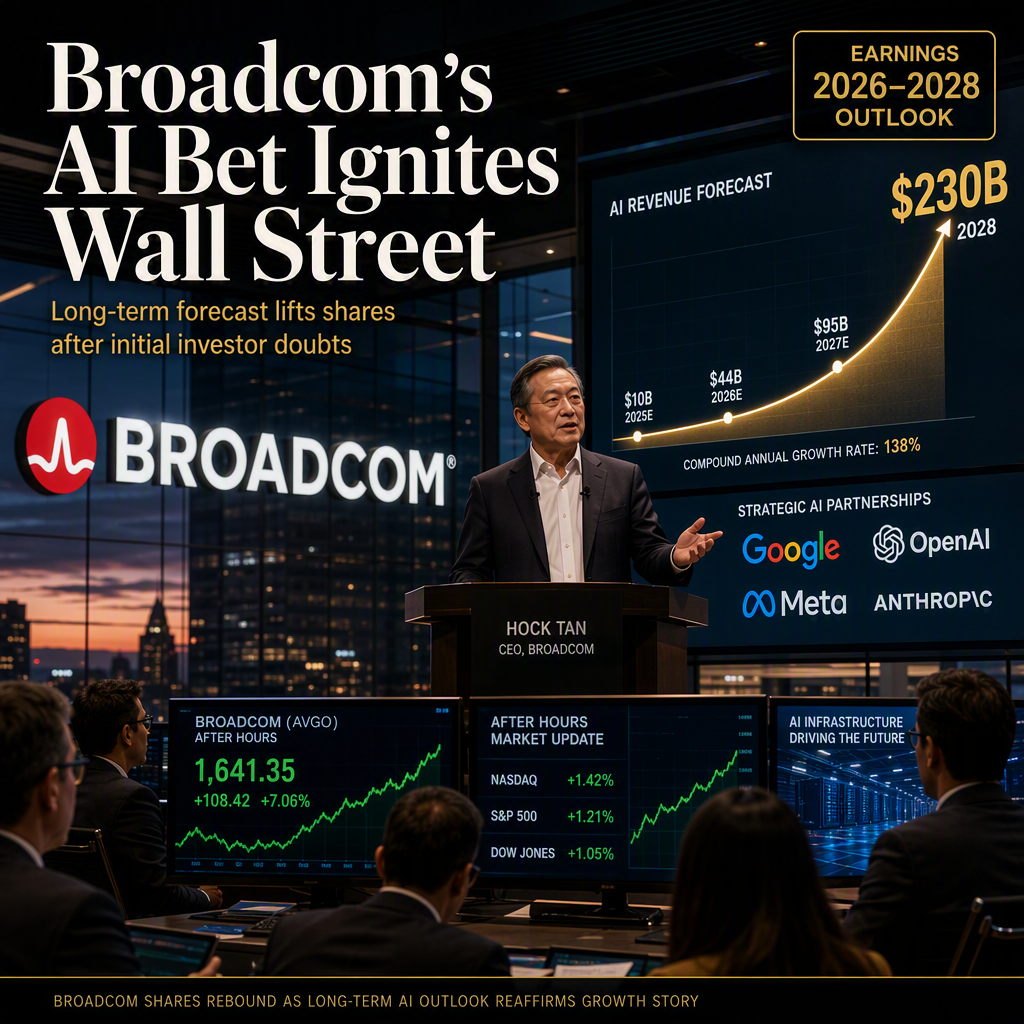
Broadcom reported fiscal third-quarter 2026 revenue of $29.59 billion, an 85% year-over-year increase, slightly surpassing the $29.36 billion consensus forecast compiled by LSEG. Adjusted earnings per share (EPS) rose 96% to $3.32, beating expectations of $3.24. Despite these beats, Broadcom shares initially fell as much as 7% in extended-hours trading, reflecting investor disappointment with the company's near-term guidance and recent stock performance, which is up only about 6% for the year [1].
CEO Hock Tan addressed concerns on the earnings call by updating Broadcom's AI revenue outlook. For fiscal year 2026, the company now expects $58 billion in AI revenue, up from its prior view of $56 billion. However, the market was more focused on projections for fiscal year 2027 and beyond. Tan raised the 2027 AI revenue forecast to $115 billion, constrained by supply, which was below some market expectations for a $20 billion to $25 billion increase. The real catalyst came when Tan projected AI revenue to double to $230 billion in fiscal year 2028, significantly above the FactSet consensus estimate of $177 billion [1].
On profitability, Tan stated that Broadcom is on track to exceed EPS of $30 in fiscal year 2028, well above the FactSet consensus of $26.38. This outlook factors in both chip supply and physical infrastructure constraints such as land, power, and data center shells. The company's AI revenue projections are underpinned by relationships with major technology firms including Alphabet's Google, Anthropic, OpenAI, and Meta Platforms. Addressing concerns about the partnership with Google, Tan emphasized Broadcom's strong intellectual property portfolio and leading-edge semiconductor technologies [1].
The market initially reacted negatively to the near-term guidance but turned positive after the long-term outlook was revealed, with the after-hours stock price climbing following Tan's comments about the 2028 AI revenue target [1].
CONCLUSION
Broadcom's latest earnings report beat expectations, but initial investor disappointment centered on near-term guidance and AI revenue projections for 2027. The market turned positive after CEO Hock Tan unveiled a robust long-term AI revenue outlook for 2028, signaling confidence in Broadcom's growth trajectory and partnerships with major tech firms.