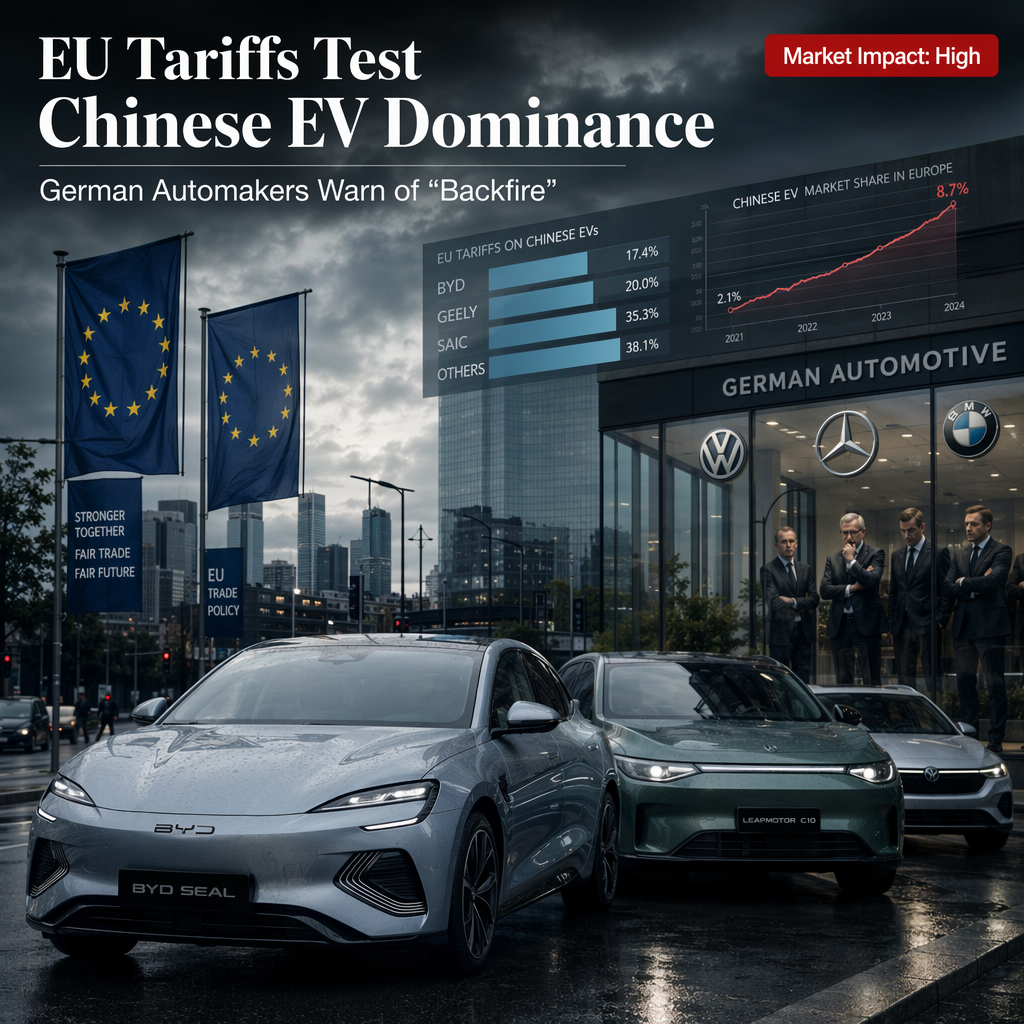
On July 4, 2024, the European Commission announced additional import tariffs on Chinese battery electric vehicles (BEVs), citing concerns that Chinese manufacturers have unfairly benefited from state subsidies. The move is intended to level the playing field for the domestic European automotive industry, which has faced increasing competition from Chinese brands such as BYD and Leapmotor [1]. Despite the tariffs, Chinese EVs and hybrids have become ubiquitous in Europe, with Chinese carmakers overtaking South Korean competitors in Western Europe for the first time [1].
German automakers and the German government have strongly opposed the new tariffs, arguing that they could harm their own exports to China and disrupt the global automotive supply chain. German automakers have expressed concern that "tariffs could backfire and damage the competitiveness of Europe’s own auto industry" [1]. Nevertheless, Chinese brands have continued to gain market share through aggressive pricing and marketing strategies, including Leapmotor's $57 monthly EV lease in Germany [1].
Industry experts report that the imposition of tariffs has not significantly slowed the momentum of Chinese automakers in Europe. Price competitiveness, rapid model rollouts, and favorable leasing programs have supported sales, even in the face of policy headwinds. Chinese e-trucks are also poised to dominate the nascent EU market, and Spain is emerging as BYD's European launchpad, highlighting the broader strategy of Chinese manufacturers [1].
In response, the EU is considering launching a compact EV class to cut costs and counter China’s price advantage. Some countries, such as Turkey, have halted tax breaks for BYD and warned of possible clawbacks if investment targets are not met. The UK market is also seeing Chinese EV makers like BYD benefit from new pay-per-mile taxation schemes, further supporting their position in Western Europe [1].
CONCLUSION
The European Commission's new tariffs on Chinese EVs mark a significant policy shift aimed at protecting domestic industry, but Chinese brands continue to expand their market share through competitive pricing and innovation. German automakers warn of potential negative consequences for Europe's own industry, while the EU and individual countries explore further policy responses. The market impact is high, as Chinese automakers remain resilient and Western rivals are forced to adapt.