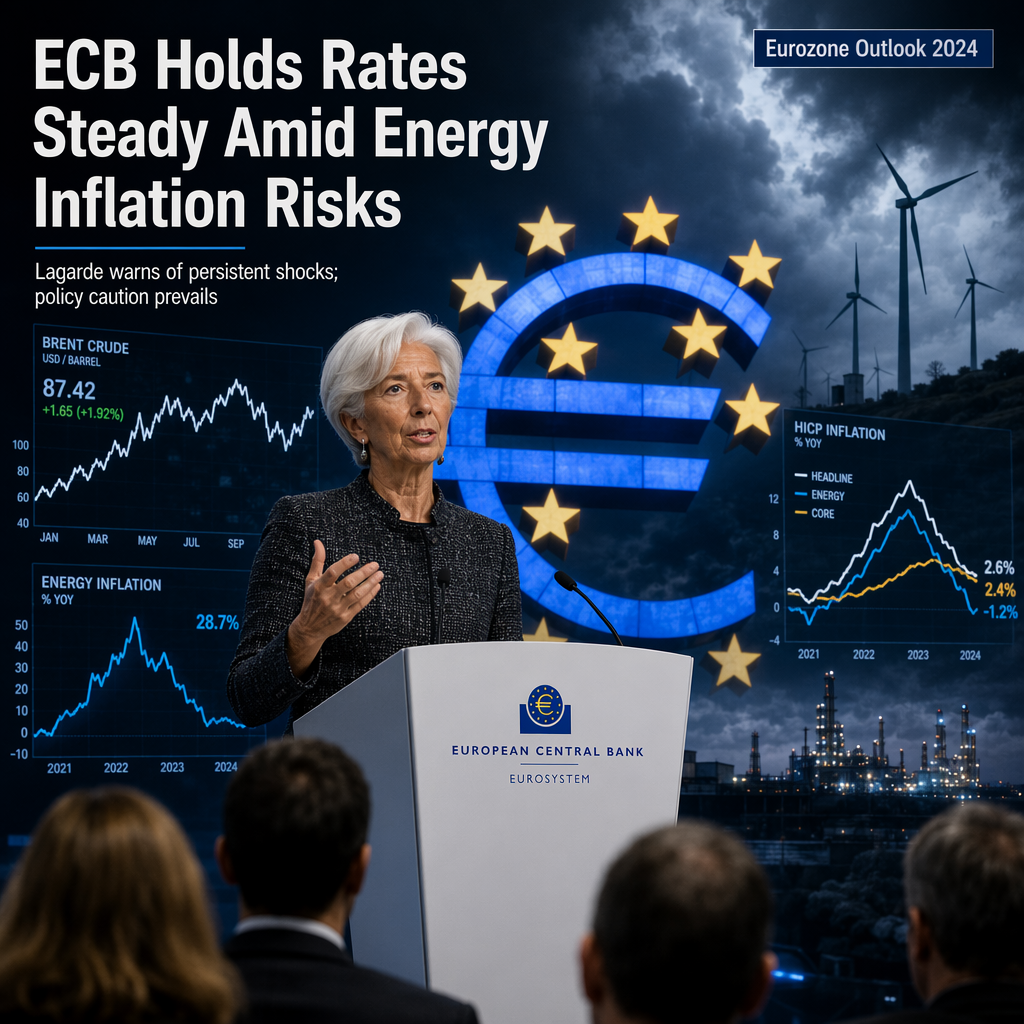
Christine Lagarde, President of the European Central Bank (ECB), announced that the ECB decided to leave key interest rates unchanged at its July policy meeting, citing ongoing economic uncertainty and persistent inflation risks [1][2]. Lagarde noted that recent data shows some improvement in economic activity, with a partial recovery in services and robust digital services, partly driven by AI. However, she emphasized that overall economic activity is expected to remain modest, and both firms and households anticipate a weaker labor market compared to pre-conflict levels [1].
A central theme in Lagarde's remarks was the impact of the ongoing energy shock. She highlighted that energy prices are feeding into higher overall prices, and firms expect to raise selling prices as a result [1]. Lagarde warned that the energy shock could intensify further, and the longer energy prices remain elevated, the more likely it is that second-round effects will occur, potentially driving up inflation further [2]. She also pointed to the risk that extreme weather events and the climate crisis could push food prices higher [2].
While underlying inflation is described as contained and wage growth as moderate, Lagarde stated that rising labor productivity is only partly offsetting unit labor cost growth [1]. Most measures of longer-term inflation expectations remain anchored around 2%, but energy inflation is likely to keep overall inflation well above the ECB's target into the first half of 2027 before declining [1]. The ECB's FXS Speechtracker score of 5.6/10, slightly above the historic baseline, reflects a mildly more impactful and cautiously hawkish tone [1].
Lagarde acknowledged some relatively benign developments since the June decision, including a quicker-than-anticipated drop in Brent crude prices following the post-MOU period [2]. However, she reiterated that risks to inflation are tilted to the upside, and the conflict remains a major source of uncertainty for the Eurozone economy [1][2]. The ECB sees risks to growth as tilted to the downside, with higher energy prices expected to weigh on real incomes [1].
No specific forward-looking policy actions were announced, but the emphasis on persistent inflation risks and the potential for further energy shocks suggests limited scope for rapid policy easing in the near term [1][2].
CONCLUSION
The ECB's decision to keep rates unchanged reflects ongoing concerns about persistent inflation risks, particularly from energy shocks, despite modest improvements in economic activity. Lagarde's comments signal a cautious and hawkish stance, with inflation expected to remain above target for an extended period. Market participants should anticipate continued vigilance from the ECB, with limited prospects for near-term policy easing.