
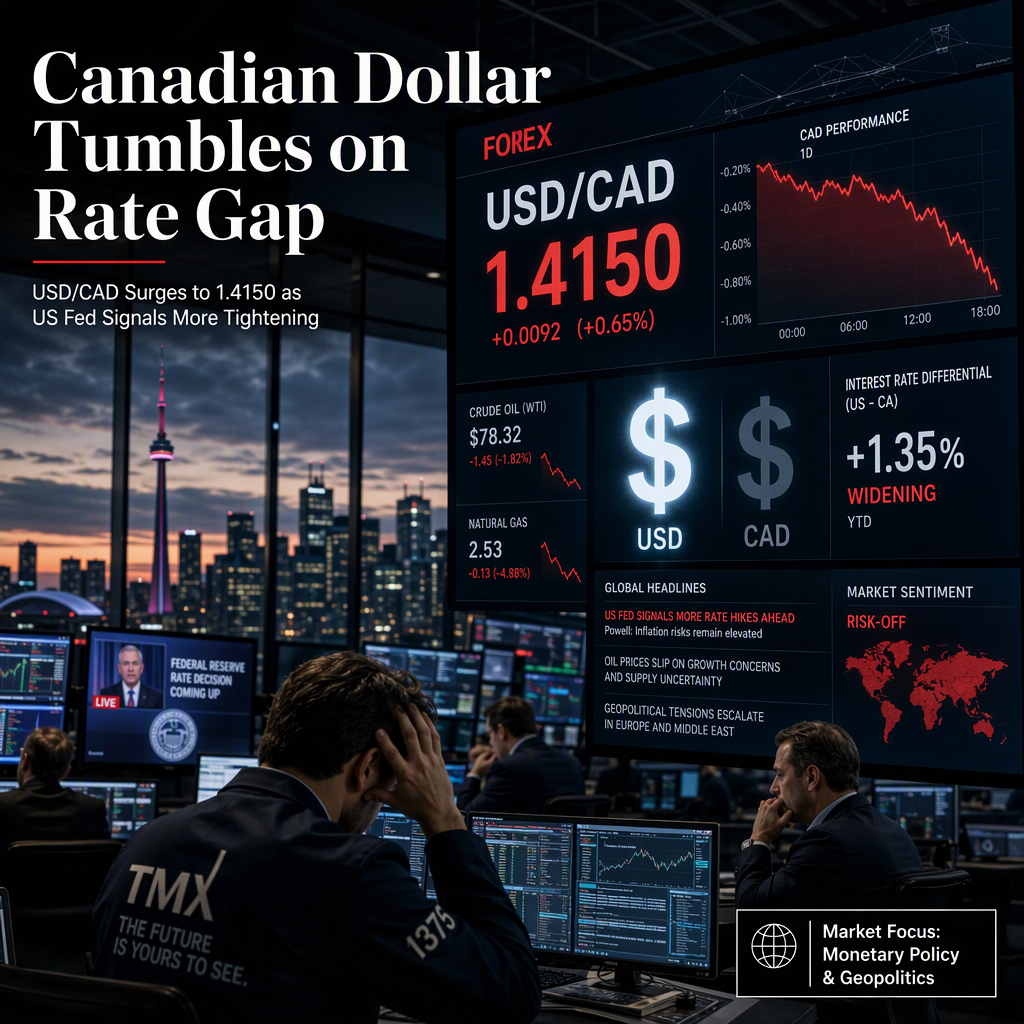
The Canadian Dollar (CAD) continued its decline against the US Dollar (USD), with USD/CAD extending gains for the sixth consecutive day and trading around 1.4150 during Asian hours on Monday [1]. This movement is attributed to expectations of a widening interest-rate differential between the United States and Canada, following the Bank of Canada’s (BoC) decision to keep its key policy rate unchanged at 2.25% during its September meeting [1].
Strategists at Scotiabank noted that the broader US-Canada interest rate spread has been a significant headwind for the CAD in recent weeks, causing it to underperform against the USD and lag most G10 currencies. However, they also suggested that the move may be 'somewhat stretched,' with limited scope for further tightening in Federal Reserve (Fed) expectations and the BoC potentially being underpriced, implying that the recent CAD underperformance could be overdone [1].
Elevated oil prices are adding upward pressure to Canadian inflation, while traders remain attentive to geopolitical developments in the Middle East. Market sentiment is influenced by US President Donald Trump’s rejection of Iran’s latest proposal to reopen the Strait of Hormuz, though negotiations are expected to resume this week. President Trump also expressed confidence that the conflict with Iran would conclude soon, while not ruling out further military action before the midterm elections [1].
The Federal Reserve recently raised its federal funds target range, reinforcing the USD’s advantage over the CAD. Money markets are now pricing in a 65.9% chance of another Fed rate hike at the October meeting, up from 57.6% a week ago and 9.4% a month ago [1]. Traders are now focused on upcoming US employment data and the Fed’s preferred inflation gauge to assess the future path of monetary policy. Last week, Cleveland Fed President Beth Hammack and Philadelphia Fed President Anna Paulson both signaled that further tightening may be warranted to prevent elevated prices from becoming entrenched [1].
CONCLUSION
The Canadian Dollar remains under pressure due to a widening US-Canada interest rate gap and strong US monetary policy expectations. While strategists see the move as potentially overdone, market focus is now on upcoming US economic data and Fed policy signals. Elevated oil prices and geopolitical risks add further uncertainty to the outlook.