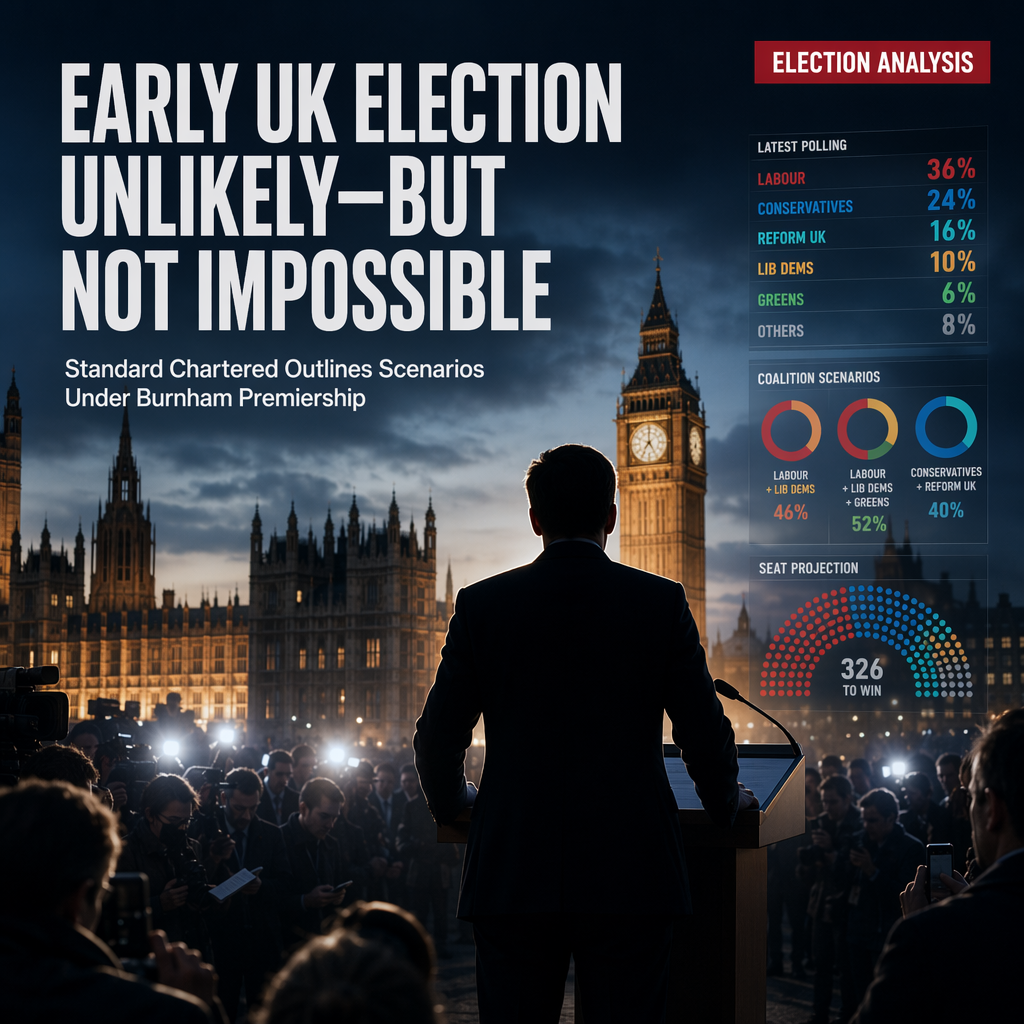
Standard Chartered analysts Christopher Graham and Saabir Salad have examined the potential for an early UK general election if Andy Burnham were to become prime minister. According to their analysis, Burnham has explicitly ruled out holding an early general election, indicating that the next election would not occur until close to the latest possible date in August 2029 [1].
The report highlights Labour's current polling position, noting that the party is polling 13 percentage points below its 2024 election victory share. If an election were held today, Labour could lose more than 200 seats in parliament, potentially resulting in a Reform UK-Conservative coalition government, as projected by Electoral Calculus [1].
Despite Burnham's stated position, Standard Chartered identifies three conditional scenarios that could still trigger an early vote: a significant upswing in Labour’s national polling, a major divergence between Burnham’s policy platform and the 2024 Labour manifesto (especially regarding fiscal policy), or mounting political legitimacy pressures from opposition parties and the public over a mid-term leadership change [1].
The analysis suggests that while an early election remains unlikely, these factors could create strategic or legitimacy-driven incentives for Burnham to seek a new mandate before 2029 [1].
CONCLUSION
Standard Chartered's analysis indicates that an early UK general election under Andy Burnham is unlikely, but not impossible, with specific scenarios potentially prompting a snap vote. Labour's current weak polling and the risk of significant seat losses underscore the political sensitivity around election timing.