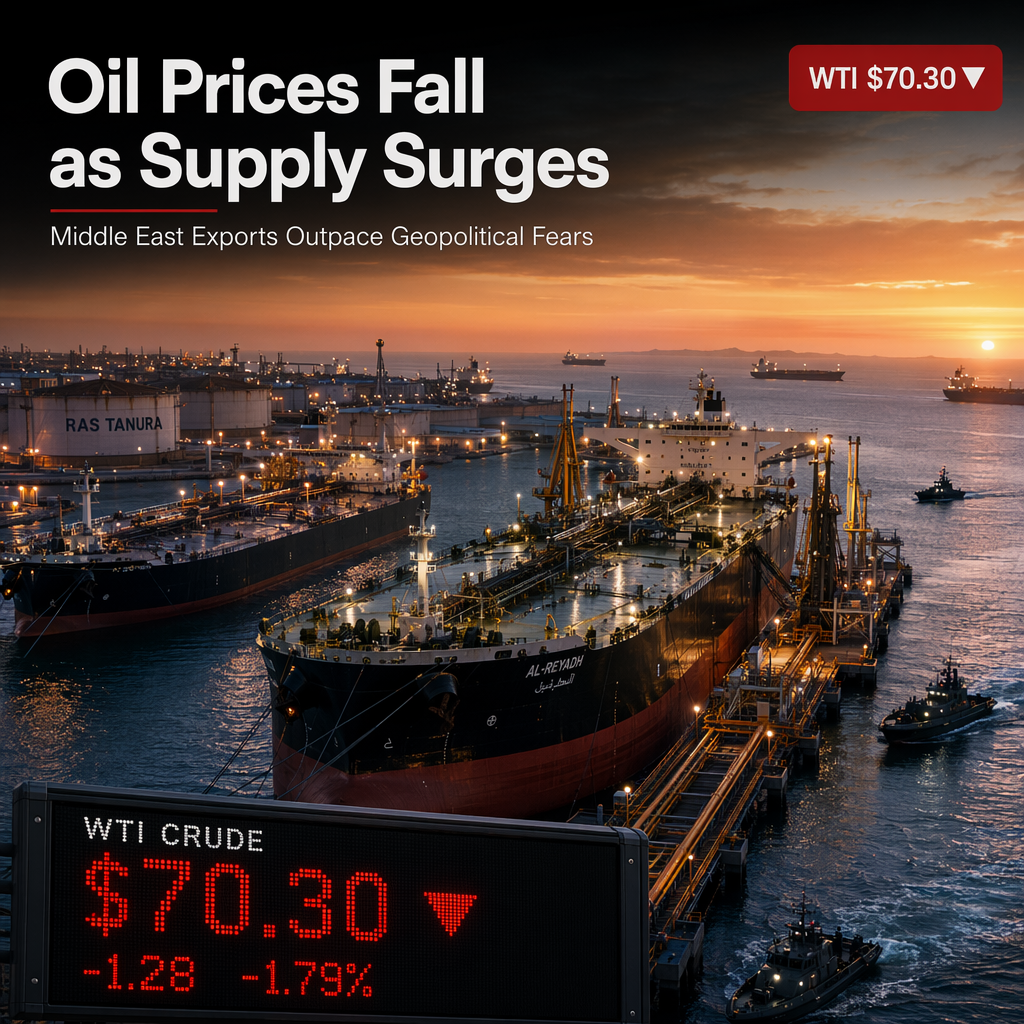
West Texas Intermediate (WTI) crude oil prices fell below $70.50 per barrel, trading around $70.30 during Asian hours on Friday, after previously gaining over 2% the day before [1]. The decline was driven by a significant increase in oil supply from the Middle East, which outweighed concerns about geopolitical instability following a recent tanker attack near the Strait of Hormuz [1].
QatarEnergy issued a tender for al-Shaheen, Qatar Marine, and Qatar Land crude for July-to-August loading, marking its first such move since the US-Iran conflict began. The tender allows buyers to load or lift supplies via ship-to-ship transfers between Fujairah and Sohar, adding substantial volumes to the market. This comes in addition to recent July-loading tenders from Iraq's SOMO and Kuwait Petroleum Corp [1].
Saudi Aramco resumed oil loading at its Ras Tanura terminal after a nearly four-month halt, with LSEG tracking data showing two Very Large Crude Carriers (VLCCs), each capable of carrying 2 million barrels, actively loading and a third waiting nearby. Abu Dhabi National Oil Co also sold at least 48 million barrels of crude across three tenders this month. These developments have reinforced the perception among traders that physical oil supply is secure, despite ongoing military risks in the region [1].
Initially, oil prices spiked during early Asian trading hours after a suspected projectile attack on a cargo vessel off the coast of Oman, which halted United Nations evacuation efforts and heightened fears over global energy security. The situation escalated when US officials reported that Iranian forces fired on the cargo ship, leading Iranian authorities to warn that they would no longer guarantee the safety of vessels outside designated shipping lanes [1].
CONCLUSION
Despite initial price spikes due to geopolitical tensions, the surge in Middle Eastern oil supply has reassured traders about market stability, pushing WTI prices lower. The resumption of exports from key regional producers and new tenders have overshadowed security concerns, resulting in a bearish market reaction.