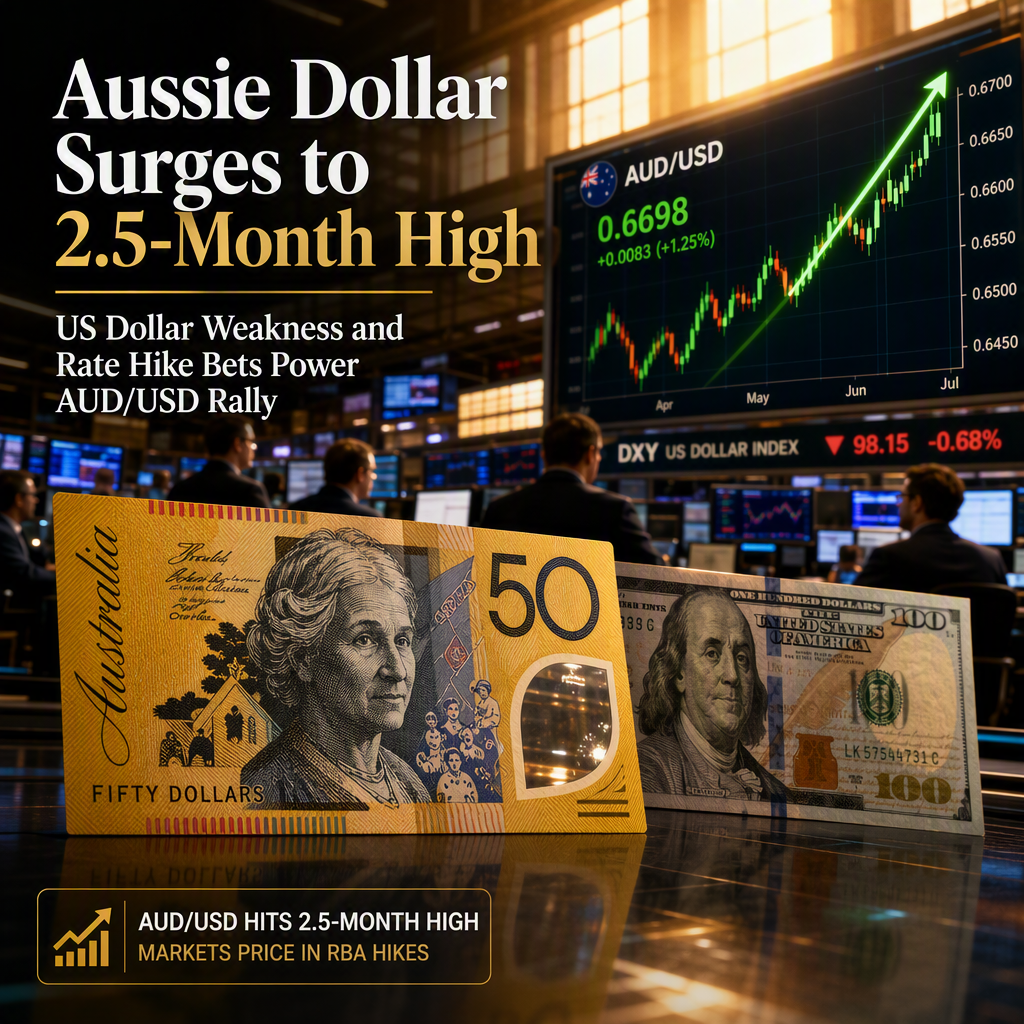
The AUD/USD currency pair reached a two-and-a-half-month high on Wednesday, trading around 0.7118, up 0.43% on the day, and hitting an intraday peak of 0.7129. This upward movement is attributed to broad US Dollar (USD) weakness, with the US Dollar Index (DXY) falling to 98.90, down 0.75% on the day and marking its lowest level since May 29 [1].
Technical indicators suggest further upside for AUD/USD. The pair is trading above its 21-, 50-, 100-, and 200-day Simple Moving Averages (SMAs), which are clustered between 0.6946 and 0.7065. The Relative Strength Index (RSI) is near 65, indicating strong but not overbought momentum, while the MACD remains slightly positive, signaling that buyers maintain control in the short term. Key resistance is identified in the 0.7150-0.7200 region, with a potential retest of this year’s peak near 0.7270 if this zone is breached. On the downside, immediate support lies at 0.7118, followed by the 100-day SMA at 0.7065 and the 21-day SMA at 0.7036 [1].
Strategists at Rabobank anticipate a shallow uptrend in AUD/USD into next year, supported by the risk of a November rate hike by the Reserve Bank of Australia (RBA) and expectations that the Federal Reserve will avoid tightening policy this year. The upcoming Australian employment report, due Thursday, is expected to provide further direction, with forecasts for a 15,000 job increase in July and the unemployment rate remaining steady at 4.4% [1].
No immediate market reactions or analyst opinions beyond Rabobank’s outlook are provided, but the technical and fundamental backdrop points to continued positive momentum for the Australian Dollar [1].
CONCLUSION
AUD/USD has strengthened on the back of US Dollar weakness and expectations of a potential RBA rate hike, with technical indicators supporting further gains. The upcoming Australian employment report is seen as a key event that could influence the pair’s direction. Overall, sentiment remains positive for the Australian Dollar in the near term.