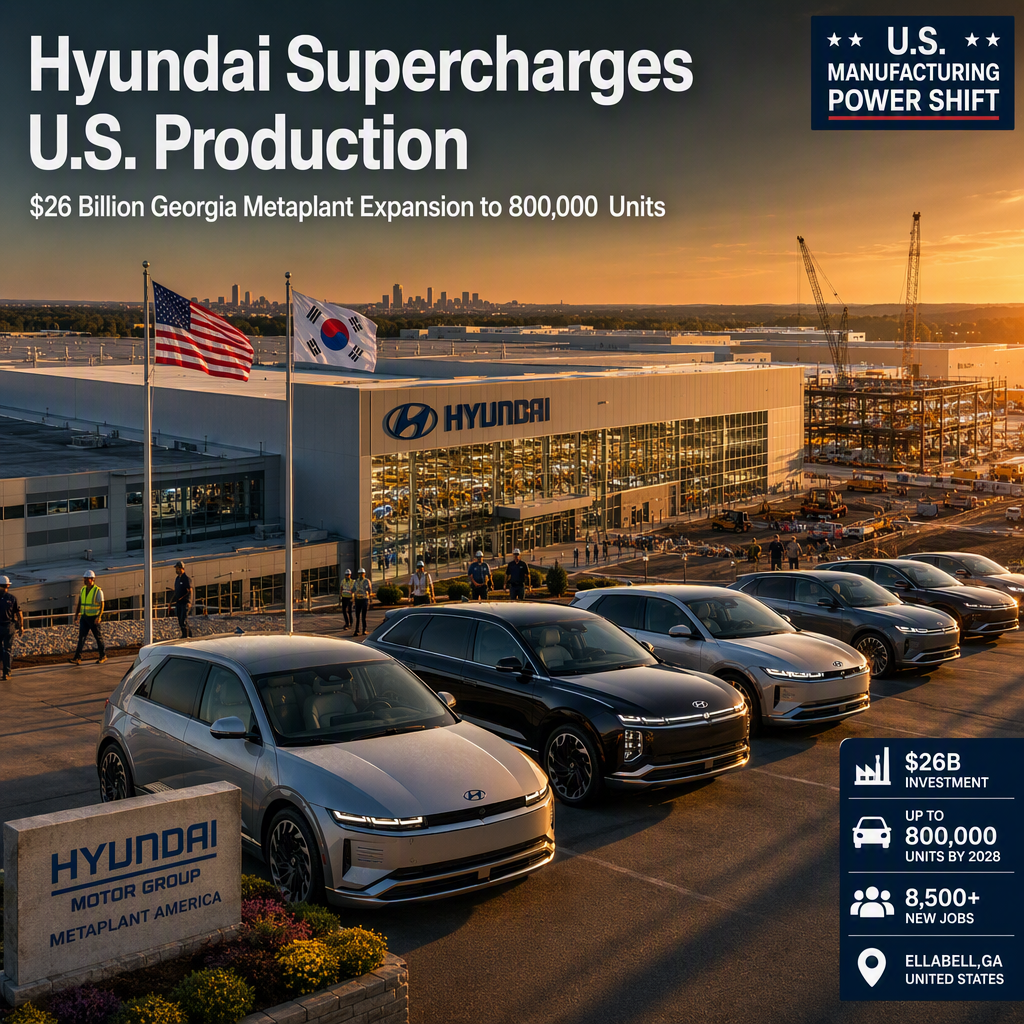
Hyundai Motor CEO José Muñoz announced that the company will increase the planned production capacity of its Georgia Metaplant from 500,000 units to between 700,000 and 800,000 units by 2028, a significant expansion from previous disclosures. This capacity boost is part of Hyundai's broader strategy to invest $26 billion in the United States through 2028, aiming to launch dozens of new products and increase the proportion of vehicles produced domestically for the U.S. market from roughly 40% in 2024 to at least 80% by 2028 [1].
The Georgia Metaplant, initially announced in 2022 with a $7.6 billion investment, is designated to produce hybrid and all-electric vehicles for Hyundai, Genesis, and Kia. The facility currently manufactures the all-electric Hyundai Ioniq 5 and Ioniq 9, as well as the Kia Sportage hybrid. The expansion could make the Metaplant the largest vehicle assembly operation by capacity in the U.S., surpassing facilities operated by Tesla and Toyota Motor [1].
Muñoz cited the impact of President Donald Trump's 15% tariffs on imports from South Korea as a factor accelerating Hyundai's U.S. localization plans, stating, "Tariffs are helping accelerate our localization plan. That's very, very simple." He emphasized that Hyundai had already begun increasing U.S. production before the tariffs were announced, but the policy has further hastened these efforts [1].
The company is also evaluating additional investments for capacity outside the Georgia Metaplant, particularly for body-on-frame vehicles such as trucks and SUVs, though no further details were disclosed. The current plan for 500,000 units included more than 8,500 employees at the Georgia site and an additional 6,900 at offsite suppliers. Hyundai has experienced significant U.S. sales growth this decade, even before the Metaplant became operational [1].
CONCLUSION
Hyundai's decision to expand its Georgia Metaplant underscores the company's commitment to the U.S. market and its strategy to localize production in response to trade policies. The substantial increase in capacity and investment is poised to reshape the competitive landscape of U.S. auto manufacturing, with potential implications for employment and market share.