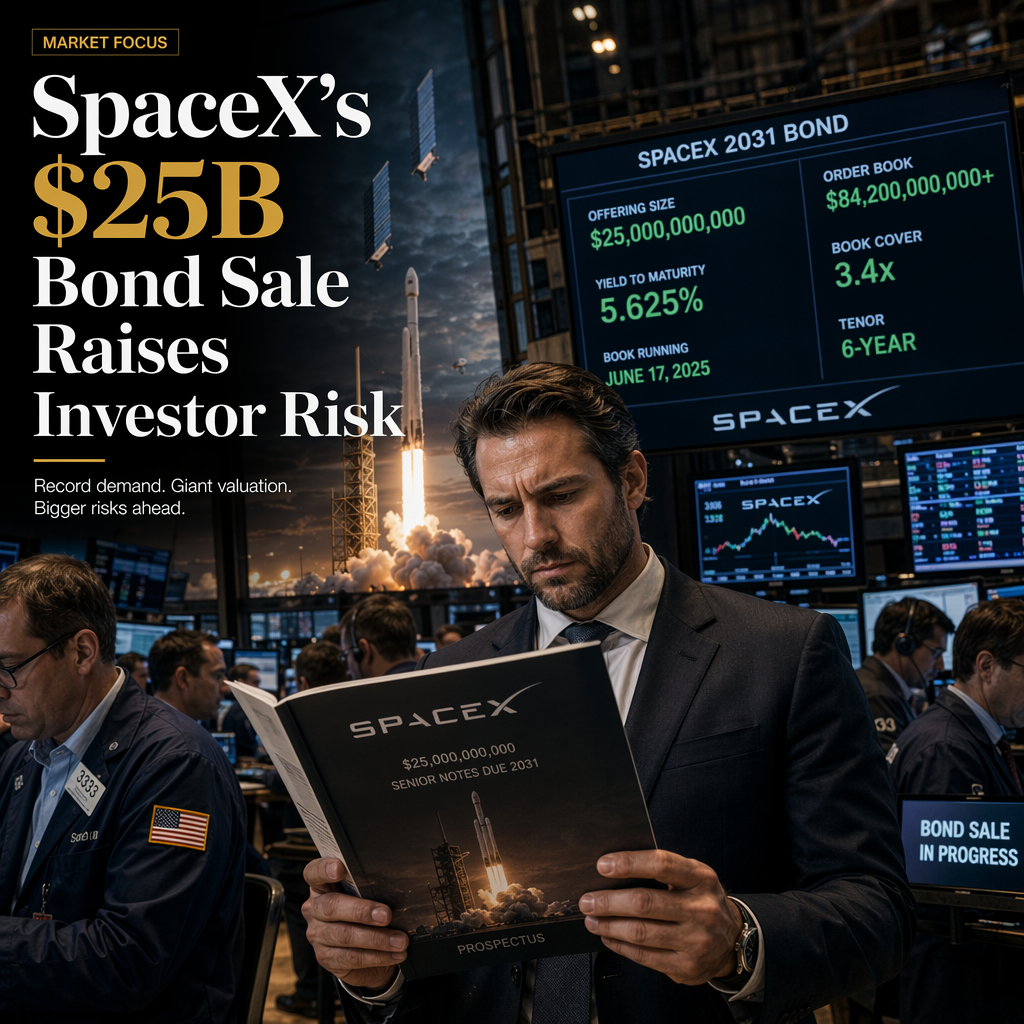
SpaceX executed a significant move in the debt markets on June 22, announcing a senior unsecured notes offering that was initially targeted at $20 billion but ultimately increased to $25 billion due to strong demand. According to sources familiar with the fundraising, SpaceX received nearly $90 billion in orders for the bond sale, making it one of the largest AI-related bond issuances to date and coming less than two weeks after SpaceX's IPO [1]. The company stated that the proceeds would be used to fully repay its bridge loan facility, cover related fees and expenses, and for general corporate purposes [1].
Despite the robust demand from bond investors, the equity market reacted negatively, with SpaceX shares falling more than 13% for the week following the announcement, after an initial strong post-IPO performance [1]. Analysts highlighted that the timing of the debt issuance, so soon after the IPO and while carrying a $5 billion net loss and more than doubled year-over-year capital expenditures, underscores SpaceX's intense financing needs and future refinancing obligations [1]. Christopher Della Fave of Post Oak Group noted that while high losses and capex are not unusual for capital-intensive growth companies, the real concern is the concentration risk for investors holding both SpaceX equity and bonds, as both are exposed to the same execution risks related to Starlink and Starship [1].
Chris Beauchamp, chief market analyst at IG, commented that SpaceX will need to work harder to attract investor attention amid competition from more profitable companies. He acknowledged that while the timing of the bond sale was not ideal, the market has historically absorbed such issuances, and brief periods of panic tend to pass [1].
The multi-billion-dollar bond issuance has resulted in many investors being exposed to SpaceX through both equities and fixed income, raising questions about true diversification and portfolio construction, as both instruments are tied to the same underlying risks [1].
CONCLUSION
SpaceX's $25 billion bond sale was met with overwhelming demand, but it has heightened concerns about investor concentration and the company's substantial financing needs. The negative equity market reaction and analyst warnings suggest that, while the market may ultimately absorb the issuance, investors should be cautious about exposure to SpaceX across multiple asset classes.