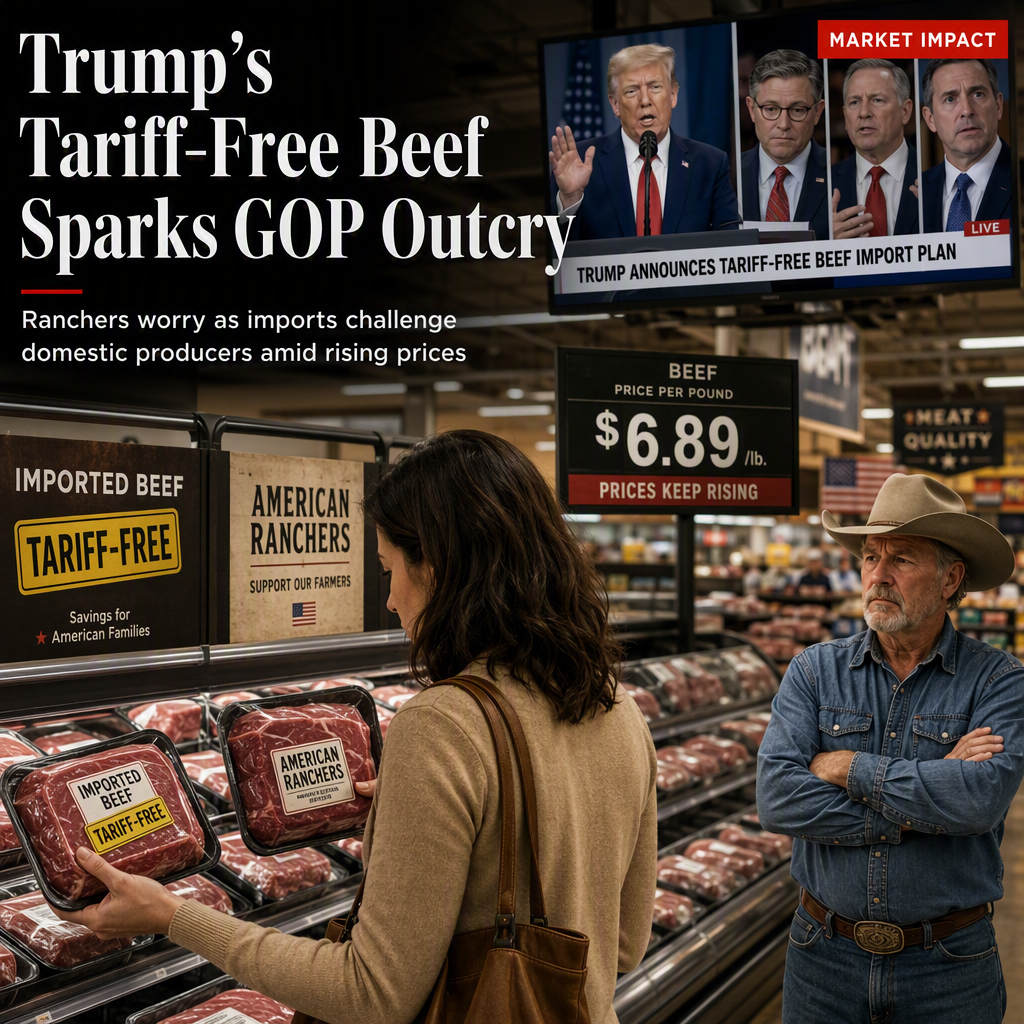
President Donald Trump announced on Friday via Truth Social that the United States will permit up to 300,000 metric tons of ground beef to enter the country tariff-free over the next 90 days, aiming to reduce consumer grocery costs and provide American ranchers time to rebuild the national herd [1]. This policy comes as beef prices have steadily increased since the pandemic, with the average price per pound reaching $6.89 last month, according to the Federal Reserve Bank of St. Louis [1].
The announcement has sparked significant opposition from Republican lawmakers representing ranching states. Senator Mike Rounds (R-S.D.) criticized the move, stating, 'American cattle producers have been disadvantaged for far too long,' and argued that the market needs a stable, America-First national policy that promotes domestic beef rather than relying on foreign imports as a 'quick fix' [1]. Rounds further contended that the current lack of country-of-origin labeling for beef exacerbates the problem, making it difficult for consumers to distinguish between American and foreign products, and ultimately harming domestic producers [1].
Representative Julie Fedorchak (R-N.D.) echoed these concerns, warning that lowering grocery prices should not come 'on the backs of North Dakota ranchers and producers.' She emphasized that importing foreign beef tariff-free and selling it below market price undercuts domestic producers, especially at a time when many are investing heavily to rebuild their herds and bringing feeder cattle to market [1].
The policy has highlighted a divide within the GOP, with lawmakers from ranching regions warning that the measure could undermine efforts to increase domestic beef production and create instability for American ranchers and consumers who prefer American-made beef [1].
CONCLUSION
Trump's decision to allow tariff-free beef imports is intended to address high grocery prices but has triggered strong opposition from GOP lawmakers in ranching states. Critics argue the move could harm domestic producers and destabilize the market, raising questions about the long-term impact on American ranchers and beef supply.