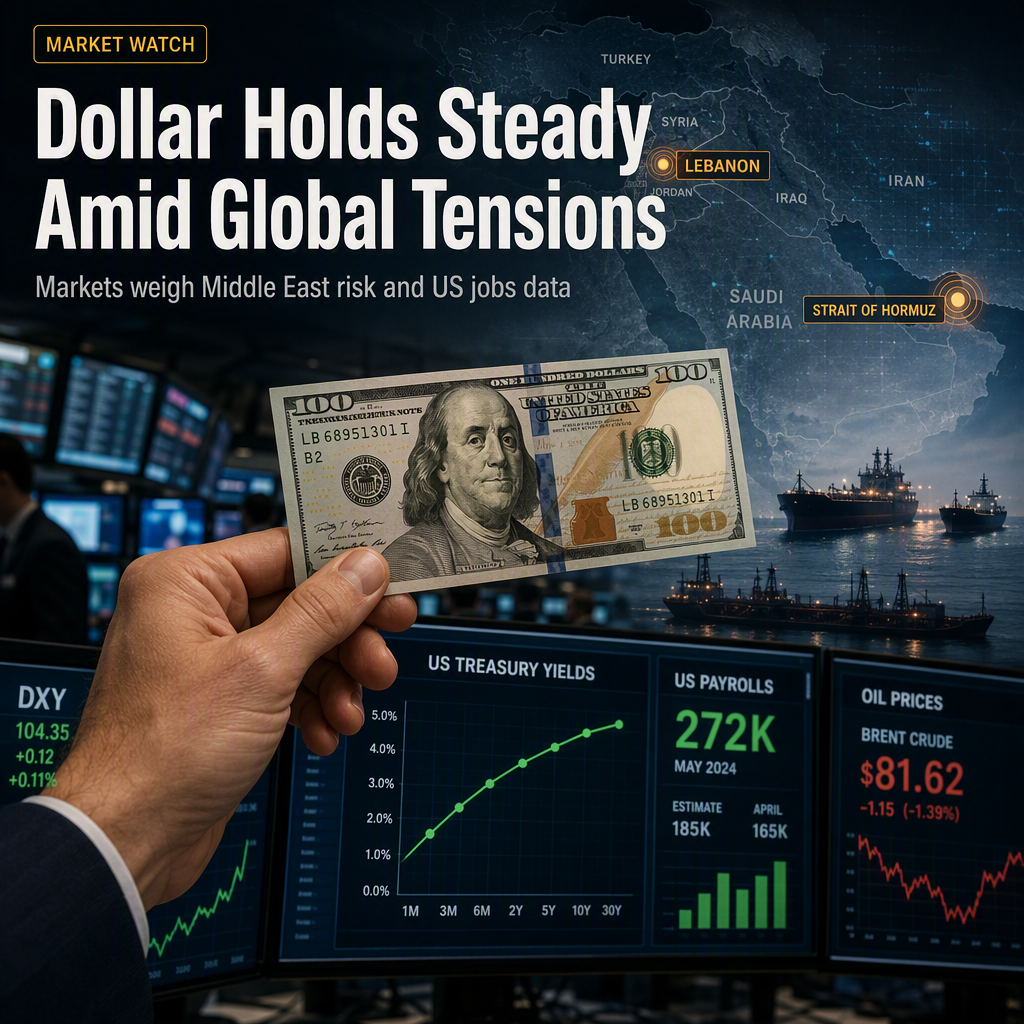
The US Dollar Index (DXY) rebounded on Thursday, trading around 99.80 during the European session, following renewed safe-haven demand after an Israeli airstrike in southern Lebanon killed one person and injured 11, marking one of the deadliest incidents since the June ceasefire took effect [1]. The Greenback's gains came after two days of losses, with market participants also monitoring a pending maritime agreement between Iran and Oman to establish a temporary two-to-four-month shipping route through the Strait of Hormuz, aimed at increasing Middle Eastern energy flows [1][2][3][4]. Tehran clarified that this measure does not signal a full reopening of the strategic waterway, but the prospect of increased energy flows has tempered fears of severe supply disruptions [2].
On the economic front, US macro data delivered mixed signals. ADP private-sector payrolls expanded by just 44,000 in July, a sharp slowdown from June's revised 95,000 and well below the 70,000 consensus forecast [1][2][3]. The ISM Services PMI edged up to 54.1 from 54.0 in June, slightly missing the expected 54.5, while the services employment subindex dropped to 47.5, pointing to mild downside risks for the upcoming Nonfarm Payrolls (NFP) report [2][3]. ING analysts highlighted that the softer ADP and ISM data reinforce a cautious market stance ahead of Friday's payrolls release [2][3].
In the bond market, shorter-dated Treasury yields edged higher, with the 2-year note yield rising more than 1 basis point to 4.1977%, reflecting sensitivity to potential Federal Reserve rate decisions [4]. The 10-year and 30-year Treasury yields remained steady at 4.6208% and 5.1711%, respectively [4]. Minneapolis Fed President Neel Kashkari stated that "now is the time" for policymakers to consider raising rates, citing strong corporate earnings and robust consumer and labor market sentiment [4]. Meanwhile, Fed Governor Lisa Cook emphasized inflation risks and maintained the option for further rate hikes if disinflation does not reappear, though she acknowledged the possibility that additional hikes may not be necessary [1].
Oil prices were volatile, with West Texas Intermediate (WTI) crude recovering to near $74.90 per barrel after three days of losses, supported by supply concerns following the Israeli airstrike [2]. WTI futures for September delivery were down 0.25% at $75.05, while Brent crude was up almost 0.1% at $79.49 [4]. The Canadian Dollar (CAD) gained support from rebounding oil prices, causing USD/CAD to lose ground for the second consecutive day, trading around 1.4010 [2].
Looking ahead, markets are in a wait-and-see mode ahead of Friday's key US payrolls data, which is forecast to show an increase of 83,000 jobs and an unchanged unemployment rate at 4.2% [4]. ING's FX strategist noted that, despite improved Gulf-related risk sentiment weighing slightly on the Dollar, stable Fed rate expectations and the upcoming payrolls report are likely to keep the Dollar in a broad range [3].
CONCLUSION
Markets are currently balancing geopolitical tensions in the Middle East, mixed US economic data, and evolving Federal Reserve policy expectations. While the US Dollar and Treasury yields have shown resilience, upcoming US payrolls data and further developments in the Iran-Oman shipping agreement remain key catalysts for future market direction.