
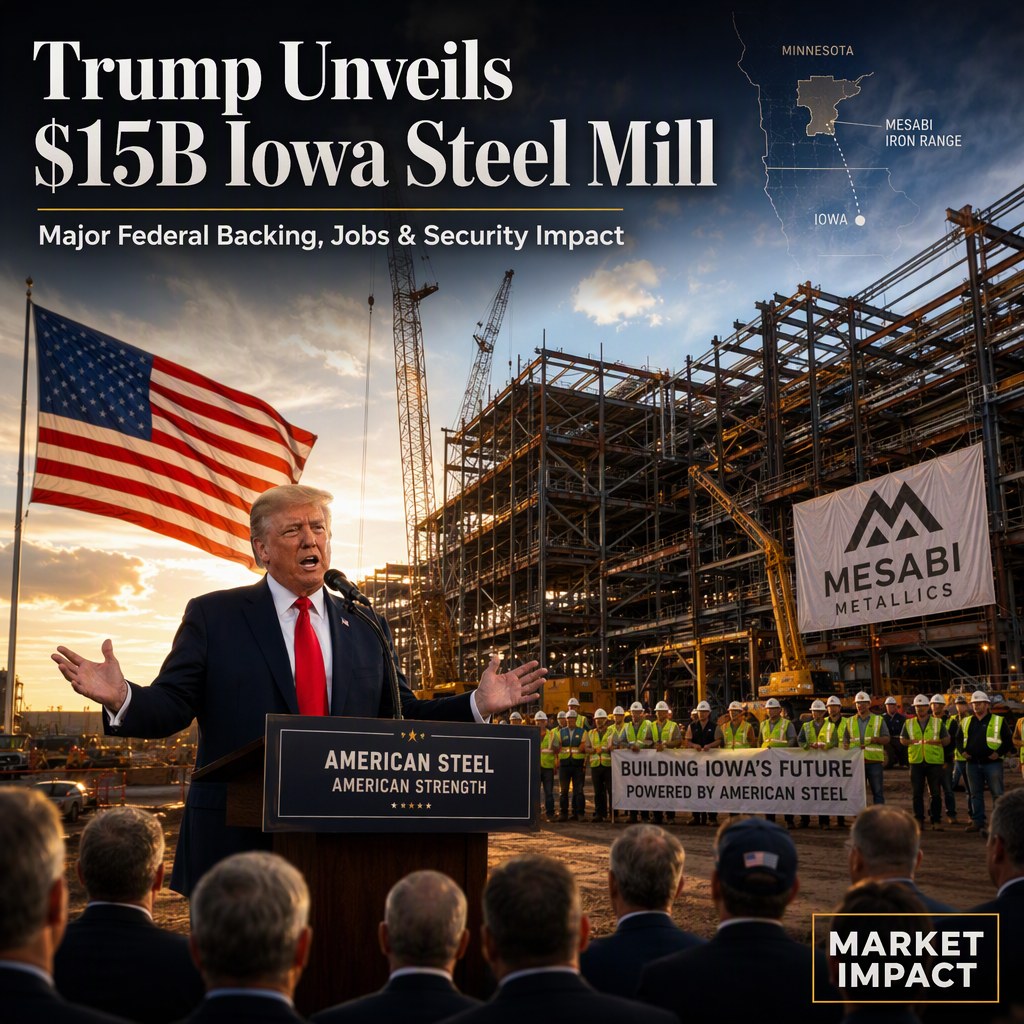
President Donald Trump is set to announce plans for a $15 billion steel mill in Iowa, a project spearheaded by Mesabi Metallics and aimed at commencing production by 2030, according to a White House official. The facility is projected to produce 10 million tons of steel annually and create up to 1,750 permanent jobs in Iowa. The plant will also support defense sector requirements for high-grade steel, highlighting its strategic importance to national security [1].
The steel mill will source iron ore from a newly constructed mine in Minnesota’s Mesabi Iron Range, an area historically significant for U.S. iron ore production. Mesabi Metallics invested $2.5 billion in the mine, which is expected to come online in the coming weeks, producing approximately 7.5 million tons of iron per year and generating about 350 jobs in Minnesota. This will be the first new iron mine in the U.S. in 50 years, according to the U.S. Geological Survey [1].
The project is receiving substantial federal support, with the Export-Import Bank of the United States set to provide up to $10 billion in financing for Mesabi Metallics’ expansion. The announcement event will feature President Trump, Commerce Secretary Howard Lutnick, Mesabi Metallics CEO Joe Broking, and Export-Import Bank Chairman John Jovanovic, who recently visited the mine [1].
This initiative aligns with Trump’s broader agenda to revitalize American manufacturing and the steel industry, in part through maintaining tariffs on imported steel and aluminum. Despite the Supreme Court striking down many of Trump’s tariffs earlier in the year, a 50% tariff on most steel imports remains in place. Steel industry groups have urged the administration to uphold these tariffs, warning that any weakening could jeopardize domestic investments and associated economic and national security benefits [1].
CONCLUSION
The announcement of a $15 billion steel mill in Iowa, supported by significant federal financing and new domestic iron ore production, marks a major step in the Trump administration’s efforts to bolster U.S. manufacturing and steelmaking. With thousands of jobs projected and tariffs remaining in place, the initiative is expected to have a high market impact and reinforce the administration’s commitment to reshoring industry and strengthening supply chains.