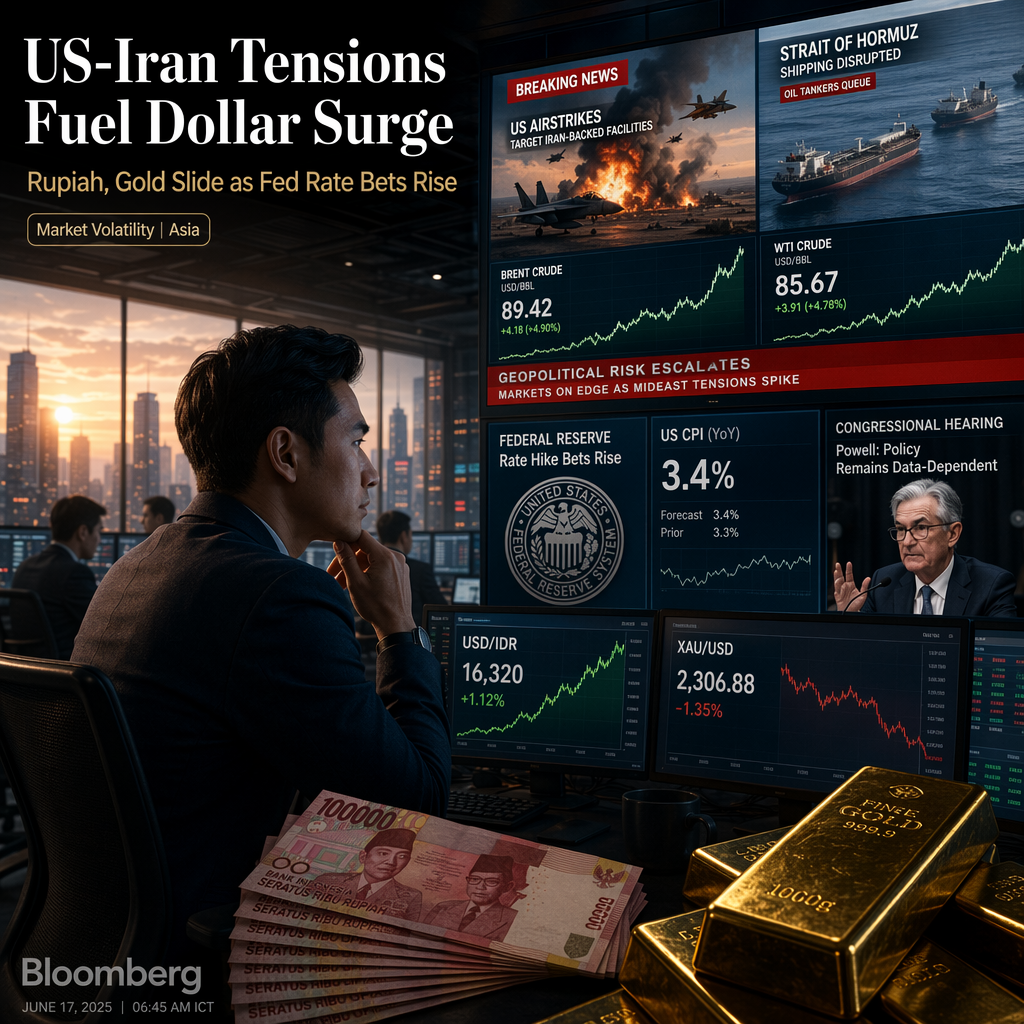
Escalating geopolitical tensions between the US and Iran have triggered significant market movements, with the US Dollar (USD) strengthening against both the Indonesian Rupiah (IDR) and gold (XAU/USD) during Asian trading on Monday [1][2]. The USD/IDR pair climbed to around 18,180 after previous losses, as investors sought safe-haven assets in response to increased risk aversion [1]. This shift was fueled by a series of US airstrikes targeting Iranian assets, with over 300 Iranian targets hit over three nights, including 140 on Saturday alone, according to Bloomberg and Reuters [1]. Iran responded with missile attacks on US military bases in the Gulf and announced the closure of the Strait of Hormuz, further heightening uncertainty in global energy markets and pushing crude oil prices higher [2].
The surge in oil prices has revived inflation fears, prompting market participants to anticipate a prolonged high-interest-rate environment in the US [1][2]. According to the CME Group's FedWatch Tool, traders are now pricing in a nearly 90% chance of a Federal Reserve rate hike by year-end [2]. June's headline US Consumer Price Index (CPI) is projected to decline by 0.1% month-on-month, while core CPI is expected to rise by 0.3% [1]. Investors are closely watching for Tuesday's CPI release and Fed Chair Kevin Warsh's first official congressional testimony for further policy signals [1][2].
The risk-off sentiment has pressured gold prices, with XAU/USD dropping nearly 1.40% to just above $4,050, as higher US Treasury yields and a stronger dollar drive flows away from non-yielding bullion [2]. Technical indicators for gold remain bearish, with the price below its 200-day Simple Moving Average and the Relative Strength Index near 40 [2]. The first notable support for gold is at the $4,000 psychological mark, with further downside risk toward $3,942 and $3,782.83 if selling persists [2].
Despite the IDR's weakness, Indonesian equities rallied for a second consecutive day, buoyed by gains in cyclicals, infrastructure, basic materials, and energy sectors [1]. Robust investment momentum in Indonesia's special economic zones has attracted foreign capital, providing some structural support for the Rupiah as foreign investors convert currency to purchase local shares [1]. However, the broader market remains focused on global risk sentiment and US monetary policy developments.
CONCLUSION
Heightened US-Iran tensions and expectations of a US rate hike have strengthened the US Dollar, pressuring both the Indonesian Rupiah and gold. While Indonesian equities saw gains due to domestic investment momentum, the overall market sentiment remains cautious ahead of key US inflation data and Fed Chair Warsh's testimony. The prevailing risk-off environment and inflation concerns are likely to keep markets volatile in the near term.