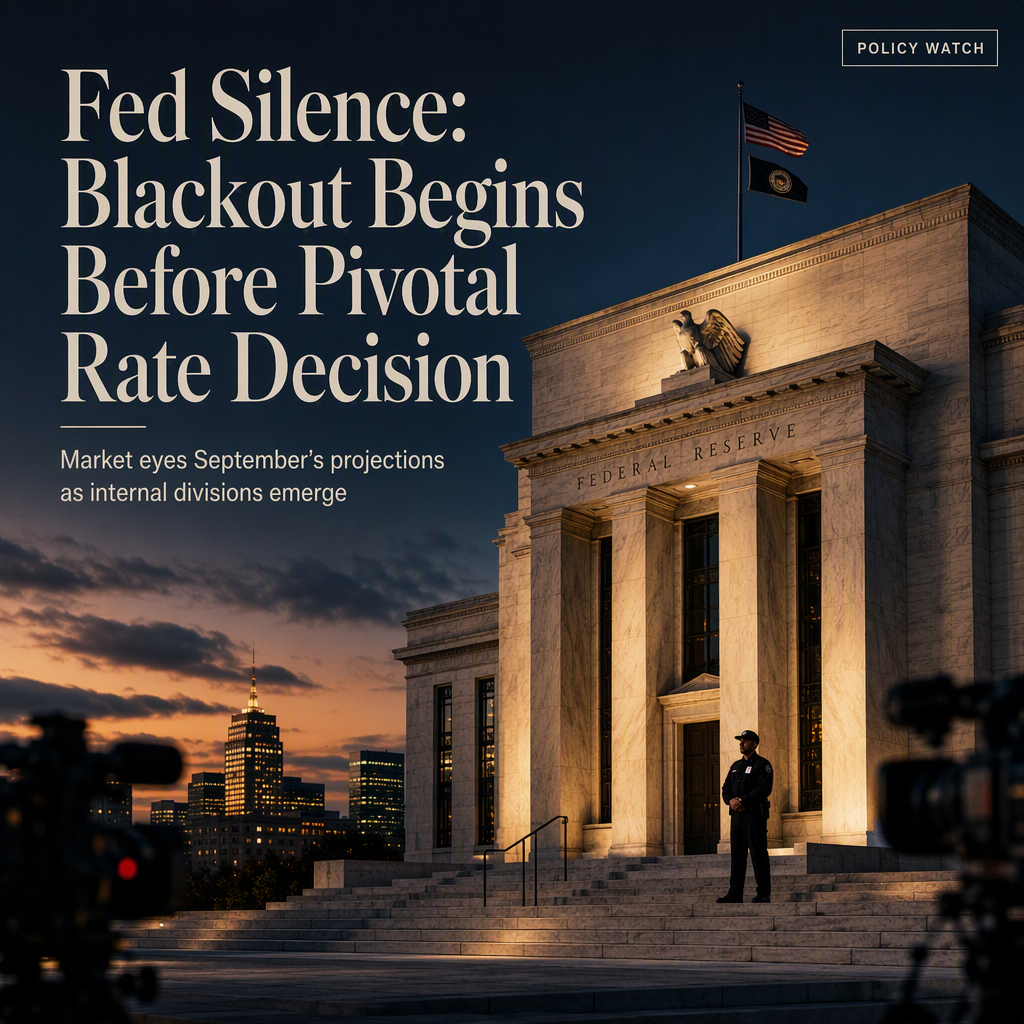
The U.S. Federal Reserve has entered its formal blackout period, which began at midnight on Saturday, September 5, and will last through September 17, covering the days leading up to and following the September 15-16 Federal Open Market Committee (FOMC) meeting [1]. During this time, all Fed officials—including the Chair, governors, regional bank presidents, and relevant staff—are prohibited from making public statements, interviews, or speeches to prevent market participants from gaining an unfair information advantage and to protect the integrity of internal policy discussions [1].
In the days before the blackout, Fed officials used their final public remarks to steer market expectations. Chair Warsh delivered a hawkish keynote at the Jackson Hole symposium on August 28, which increased the odds of a rate hike from approximately 30% to 48% in a single session [1]. Governor Barr echoed this sentiment, stating the Fed should act decisively if inflation does not moderate [1]. However, Governor Waller advocated for holding rates steady, citing encouraging progress in core inflation over the past three months and urging to "give disinflation a chance" in comments to Reuters on September 3 [1]. Waller's remarks pulled rate hike odds back toward 50%, but this move was largely reversed after August payrolls rose by 162,000, nearly four times the forecast of 42,000 [1].
As the blackout began, divisions within the committee were evident. The hawks may push for a rate hike if upcoming inflation data is strong, while Waller appears willing to wait if price pressures continue to ease [1]. This blackout period is particularly significant because the September meeting will include the release of an updated Summary of Economic Projections and a new dot plot, revealing each official's interest rate forecast [1]. Traders are closely watching for both the rate decision and the projections, which could significantly impact market expectations [1].
CONCLUSION
The Fed's blackout period has commenced ahead of a pivotal September meeting, with officials' last remarks highlighting internal divisions on rate policy. Market participants are bracing for both the rate decision and updated economic projections, which are expected to drive significant market reactions once the blackout lifts. The outcome will depend heavily on forthcoming inflation data and the committee's consensus.