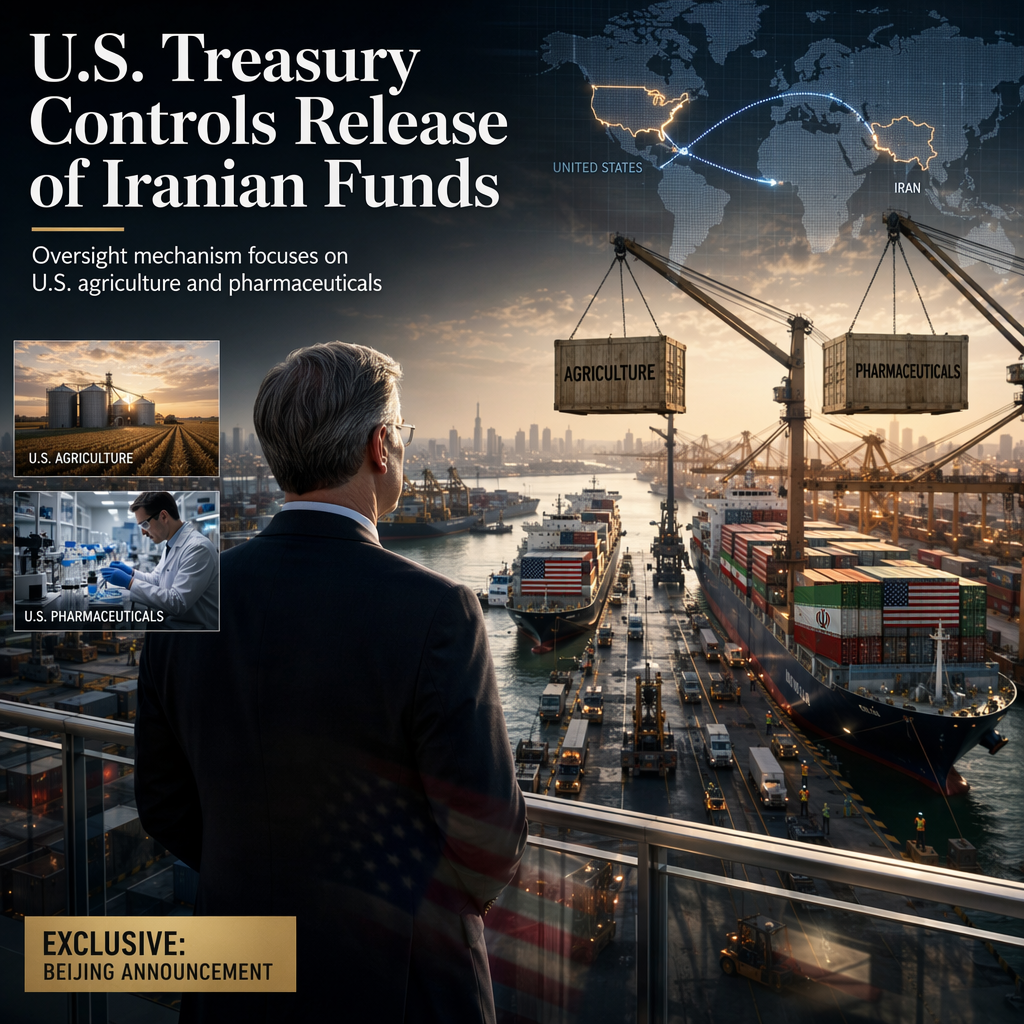
The U.S. Treasury will oversee the release of Iran's frozen assets, according to Treasury Secretary Scott Bessent, who spoke on CNBC's 'Squawk Box' on May 14th, 2026, from Beijing, China [1]. Bessent stated that once the funds are released, a very large percentage will be used to purchase U.S. agricultural and pharmaceutical products, with the intention of channeling the money back to U.S. farmers, food producers, and pharmaceutical companies [1]. President Donald Trump also confirmed that the funds would be used primarily for these purposes [1].
However, Bessent did not specify the exact amount of money to be released, the location where the funds would be held, the mechanisms for enforcement, or the extent of Iran's role in directing the purchases [1]. The Treasury's oversight will be based in the Middle East, indicating an effort to maintain control over the use of the funds, which is a politically sensitive aspect of the agreement [1].
The announcement comes amid criticism from some congressional Republicans, who argue that the deal provides Iran with excessive sanctions relief and access to frozen funds in exchange for only a temporary negotiating window [1]. Administration officials, on the other hand, contend that the interim deal is intended to halt hostilities and create a 60-day window for negotiating a broader agreement [1]. Vice President JD Vance defended the arrangement, emphasizing that no U.S. taxpayer money is being sent to Iran and that Tehran will only receive economic benefits if it complies with the terms of the deal [1].
While the arrangement could benefit U.S. agricultural and pharmaceutical sectors, the lack of clarity regarding enforcement and the total amount of funds involved leaves some uncertainty about the full market impact [1].
CONCLUSION
The U.S. Treasury's oversight of released Iranian funds, with a focus on purchasing U.S. goods, could provide economic benefits to American producers. However, the absence of details on enforcement and fund amounts introduces uncertainty, and political debate continues over the scope and security implications of the deal.