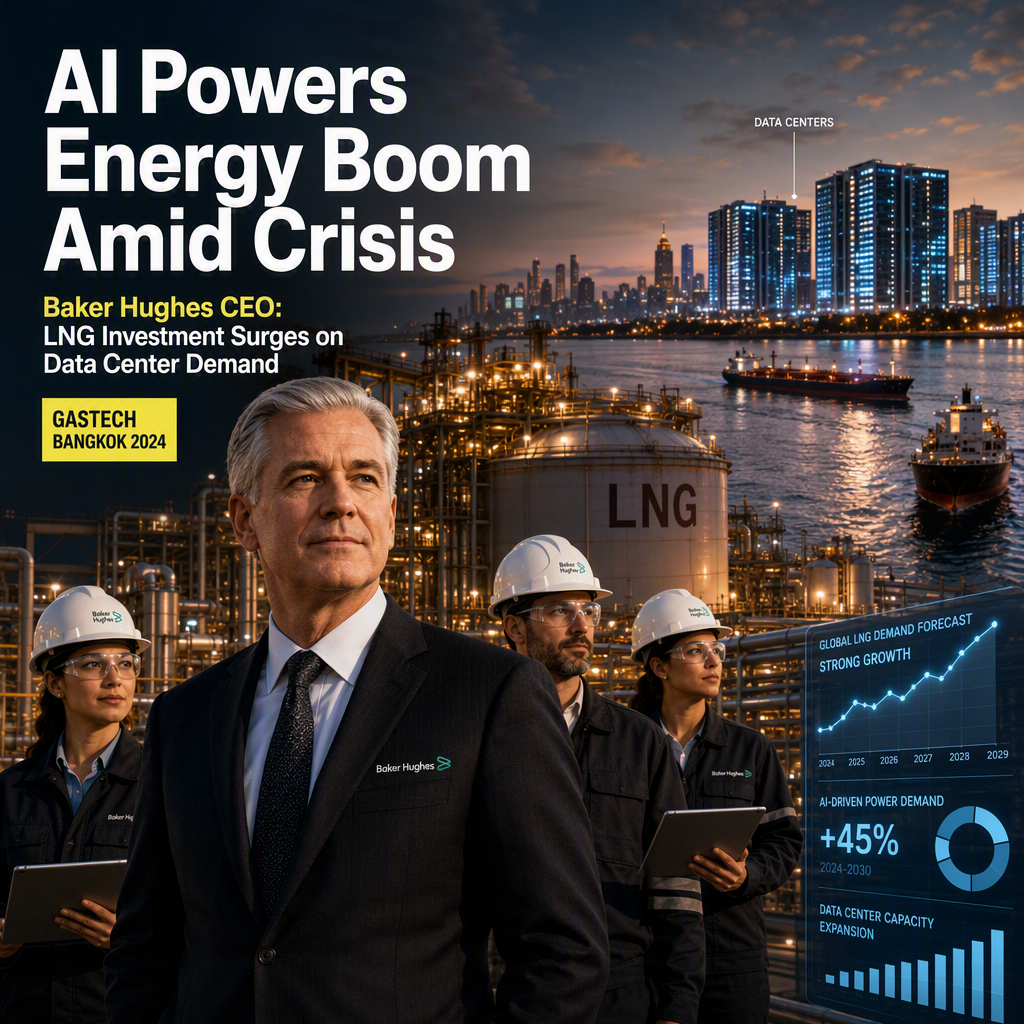
Baker Hughes CEO Lorenzo Simonelli stated at the Gastech conference in Bangkok that the company has not observed a slowdown in major energy project investments, despite higher borrowing costs. Simonelli attributed this resilience to robust demand for natural gas and electricity, fueled by the global expansion of artificial intelligence infrastructure and data centers [1]. He emphasized that energy demand remains strong due to population growth, industrial activity, and the increasing linkage between data centers and energy supply, noting, 'We haven't seen a slowdown, and the bankability is really based on the offtake agreements that are in place, as well as the outlook of energy demand' [1].
The ongoing Iran war has disrupted Middle Eastern energy flows, pushing oil prices above $100 a barrel and raising concerns about inflation and borrowing costs. The conflict has also affected natural gas markets, with restrictions on shipping through the Strait of Hormuz threatening LNG supplies from Qatar, one of the world's largest exporters [1]. Simonelli remarked that high prices can incentivize investment, which will eventually bring additional supply to the market, stating, 'It's 'full steam ahead' with the aspect of looking beyond the short term, and obviously high pricing also leads to investment today, which will lead to supply coming in tomorrow' [1].
Baker Hughes projects that installed LNG capacity will need to reach 900 million tons per annum by 2035 to meet future demand, and the company does not foresee a prolonged glut from the upcoming wave of LNG supply. Simonelli highlighted that AI and data centers are emerging as significant drivers of energy demand, and Baker Hughes is increasing its capacity to meet this growth. In Southeast Asia, grid constraints are prompting some data-center operators to adopt distributed power generation, an area where Baker Hughes provides equipment [1].
Simonelli underscored the central role of natural gas in meeting rising electricity needs, describing it as a 'destination fuel' rather than a transition fuel. Baker Hughes currently has just over $37 billion in backlog, including demand tied to gas infrastructure, data-center power generation, and LNG [1].
CONCLUSION
Baker Hughes remains optimistic about continued investment in energy projects, driven by strong demand from AI and data centers, despite higher borrowing costs and geopolitical disruptions. The company sees natural gas as central to future energy needs and is expanding its capacity to meet projected demand. Market sentiment is positive, with high prices expected to spur further investment and supply growth.