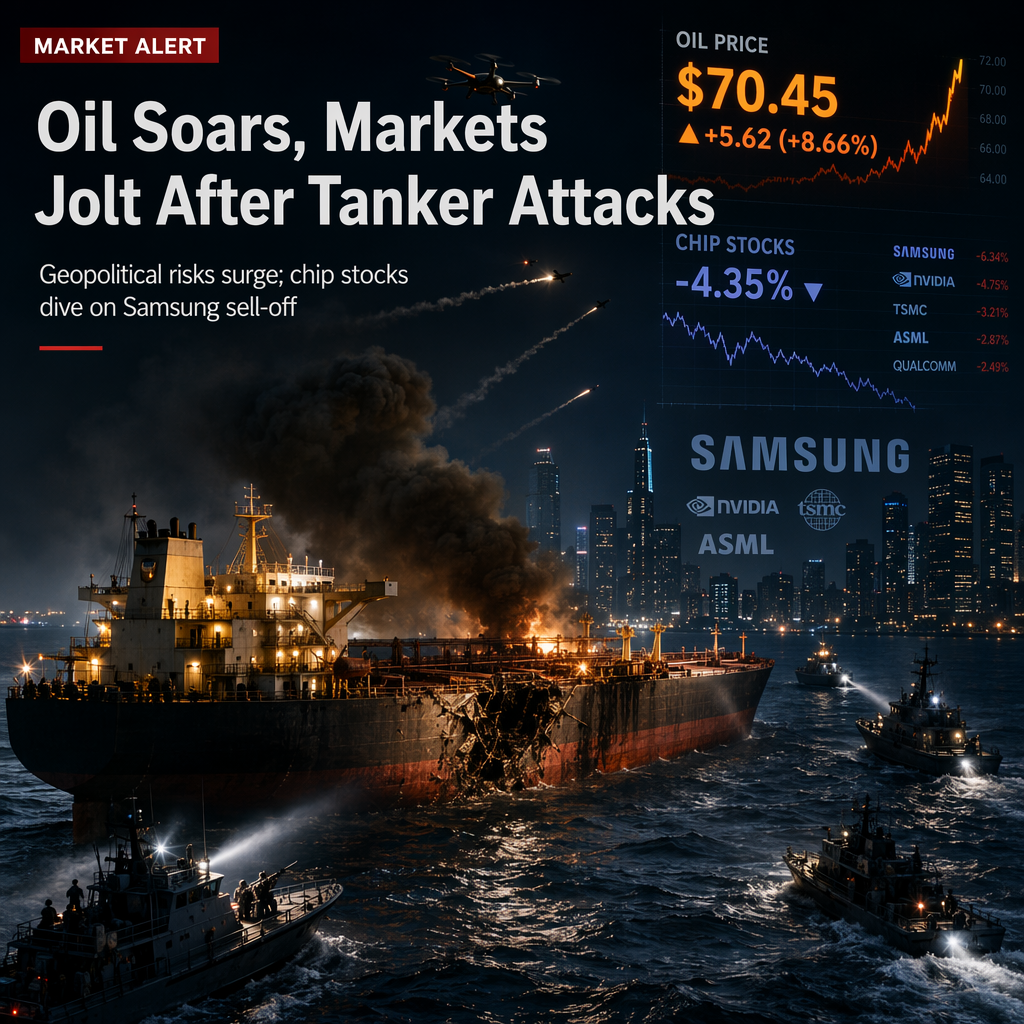
Oil prices surged on Tuesday, reaching their highest levels since late last week, following reports that two tankers transiting the Strait of Hormuz were hit by unknown projectiles, reviving safety concerns in a critical global shipping lane [1]. U.S. crude oil climbed more than 3% to above $70 per barrel for the first time since July 1, while international Brent crude also rose 3% to over $74 per barrel [1]. The U.K.’s Maritime Trade Operations center reported two attacks: one vessel was struck by an unknown Uncrewed Aerial Vehicle, and another by an unidentified projectile, resulting in structural damage [1]. Additionally, a third ship off the coast of Oman caught fire after an attack, according to UKMTO [1].
A U.S. official confirmed these incidents, stating that Iran’s Islamic Revolutionary Guard Corps fired missiles at two ships and struck a third commercial vessel with at least one drone. The U.S. military responded by shooting down additional drones launched by Iran [1]. Reuters reported that one of the affected ships, the LNG tanker Al Rekayyat, was at risk of exploding due to an engine room fire, though NBC News could not independently verify this claim [1].
The attacks triggered a rise in U.S. Treasury yields, with the 20- and 30-year yields surpassing 5% and the 10-year yield reaching its highest level since early June [1]. Equity markets reacted negatively, with the S&P 500 falling as much as nearly 1% before rebounding to a 0.3% decline in early afternoon trading. The Nasdaq 100 index experienced a sharper drop of up to 2%, largely due to heavy selling in chip stocks and tech companies after Samsung shares plunged 7% overnight [1].
Samsung, one of the world’s largest chip and memory manufacturers, reported better-than-expected earnings, but the earnings beat was only 6% ahead of estimates, which disappointed some investors and led to profit-taking [1]. Joe Mazzola of Charles Schwab noted that Samsung’s stock decline sent shockwaves through the U.S. market, particularly affecting volatile chip names [1]. Jim Reid of Deutsche Bank highlighted that Samsung’s results, while positive, were not enough to sustain recent market euphoria around tech stocks [1].
CONCLUSION
The attacks in the Strait of Hormuz have reignited concerns over energy supply security, driving oil prices and Treasury yields higher. Meanwhile, the tech sector, especially chip stocks, faced significant pressure following Samsung’s earnings and subsequent share sell-off. Market sentiment remains cautious amid heightened geopolitical risks and volatile earnings reactions.