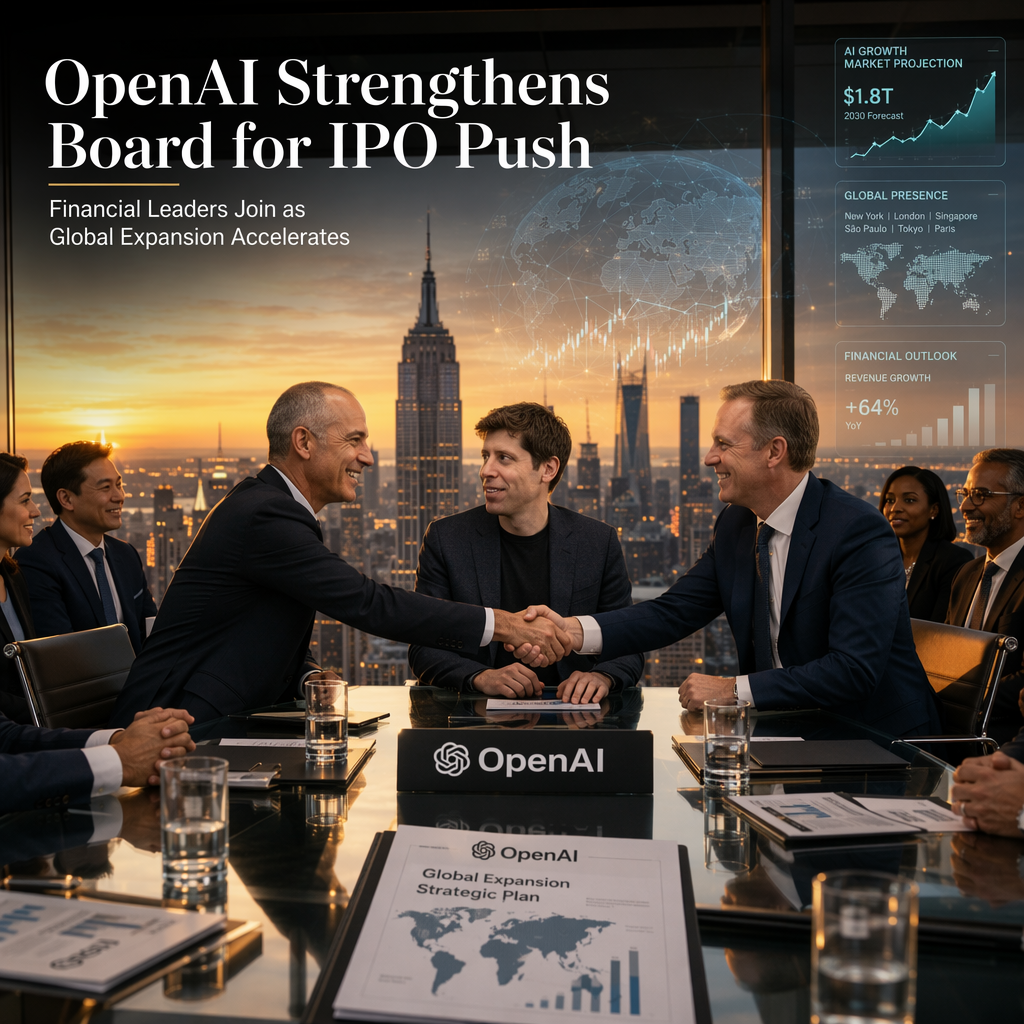
OpenAI announced the appointment of David Vélez, CEO of Nubank, and Robin Vince, CEO of BNY, to both its nonprofit and for-profit boards of directors as the company advances toward a potential initial public offering (IPO) [1]. The company, currently valued at more than $850 billion, confidentially filed its prospectus with the Securities and Exchange Commission in June, though no official IPO timeline has been disclosed [1].
The addition of Vélez and Vince is intended to bring complementary perspectives on how technology can reshape industries and drive economic growth, according to OpenAI's statement [1]. Bret Taylor, chair of the OpenAI Foundation and OpenAI Group PBC Boards, emphasized that their leadership and experience in leveraging technology within financial services will be invaluable as OpenAI expands its reach globally [1].
These appointments follow OpenAI's October recapitalization, which solidified its structure as a nonprofit (OpenAI Foundation) holding a controlling stake in its for-profit business (OpenAI Group PBC). At the time, the nonprofit's equity was valued at around $130 billion, positioning OpenAI as one of the most well-resourced nonprofits globally [1].
Vélez and Vince join a board that includes Bret Taylor, OpenAI CEO Sam Altman, Quora CEO Adam D'Angelo, Dr. Sue Desmond-Hellmann, Zico Kolter, Paul Nakasone, Adebayo Ogunlesi, and Nicole Seligman. Notably, Kolter is the only member who does not serve on the for-profit board [1]. OpenAI previously stated that within a year of the recapitalization, a second foundation director would transition to serving exclusively on the Foundation Board and as a non-voting observer to the Group board [1].
The company also referenced the 2023 incident when Sam Altman was briefly ousted as CEO due to concerns about his candor, before being reinstated in March 2024 after negotiations [1].
CONCLUSION
OpenAI's addition of two prominent financial executives to its board underscores its preparations for a potential IPO and ongoing global expansion. The appointments are expected to strengthen the company's governance and strategic direction as it seeks to ensure AI benefits a broad range of stakeholders.