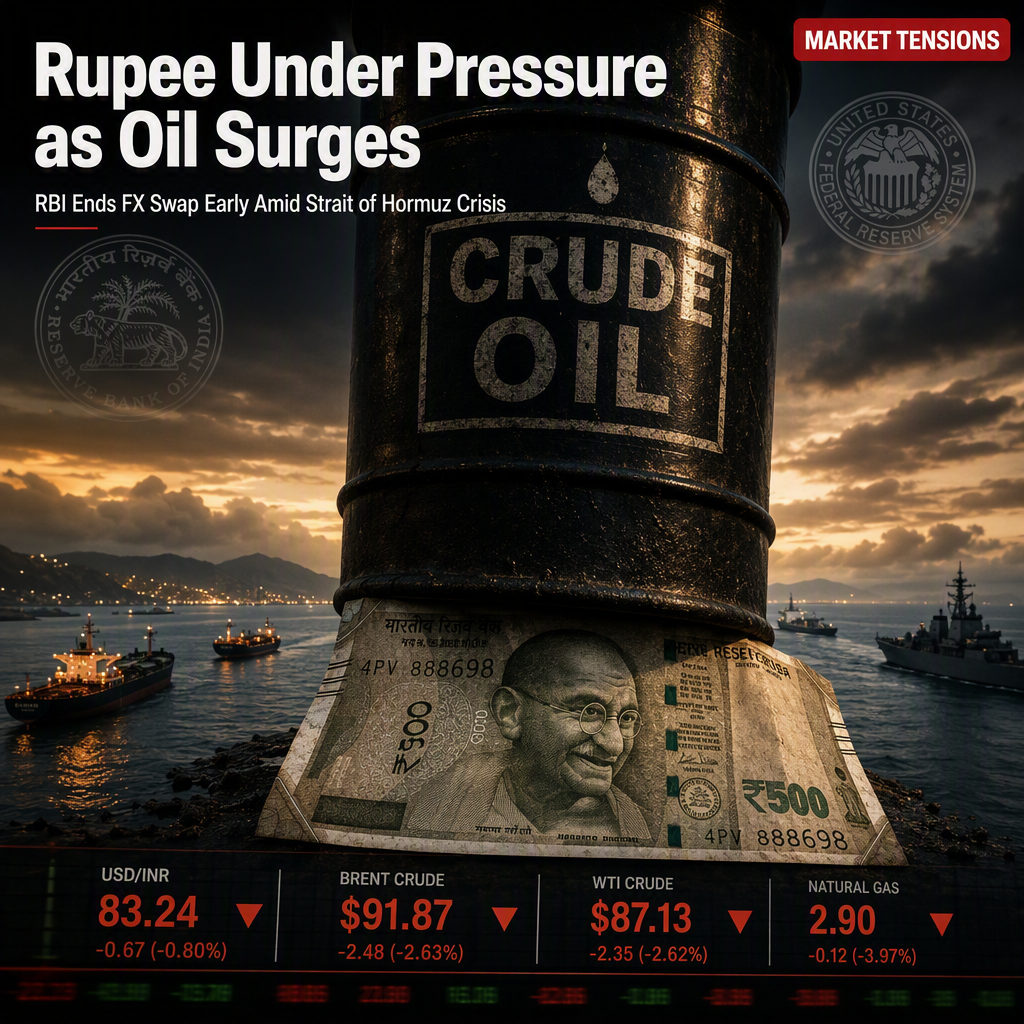
The Indian Rupee (INR) opened flat against the US Dollar (USD) but remains near its two-week low at around 95.75, as the USD/INR pair continues to face pressure from elevated oil prices and ongoing geopolitical tensions in the Middle East [1]. The MCX Crude Oil contract expiring on August 19 traded 0.6% higher near Rs. 8,130, close to its three-week high of Rs. 8,170 posted on Tuesday [1]. Higher oil prices are particularly impactful for India, which relies heavily on oil imports, often leading to underperformance of the rupee in such environments [1].
The persistent standoff over the Strait of Hormuz, a key chokepoint for nearly one-fifth of global energy supply, has kept oil prices elevated. According to analysts at BNY, hopes for a rapid reopening of the strait have faded, with US President Donald Trump stating he will not seek to revive the expired US–Iran truce, leaving the conflict unresolved [1]. Washington is demanding unrestricted passage, while Iran insists on joint management with Oman, resulting in heavily disrupted shipping activity and fresh attacks near the strait, which have reinforced supply concerns [1]. BNY notes that these tensions are keeping crude prices high and adding supply-driven inflation risks to already stretched long-end markets [1].
In a separate development, the Reserve Bank of India (RBI) announced an early closure of its concessional FX swap facility for Foreign Currency Non-Resident (Bank) [FCNR(B)] deposits on 31 August, a month ahead of the original deadline [1]. The RBI cited stronger-than-expected take-up, with Indian banks attracting USD52.3 billion of FCNR(B) deposits as of 13 August [1]. Analysts at Commerzbank suggest the early closure reflects diminishing benefits relative to rising liquidity and balance-sheet costs, as the sizeable inflows have generated substantial rupee liquidity and supported demand for shorter-dated government bonds, though the scheme is not costless [1].
Looking ahead, Commerzbank expects the RBI to rely primarily on spot and other market operations to manage liquidity, as the unresolved Middle East tensions and elevated oil prices continue to pose risks for the rupee and broader Indian markets [1].
CONCLUSION
The Indian Rupee remains under pressure due to elevated oil prices and ongoing tensions in the Strait of Hormuz, while the RBI's early closure of the FX swap window reflects strong inflows but rising costs. Market participants are likely to remain cautious as geopolitical risks and inflationary pressures persist.