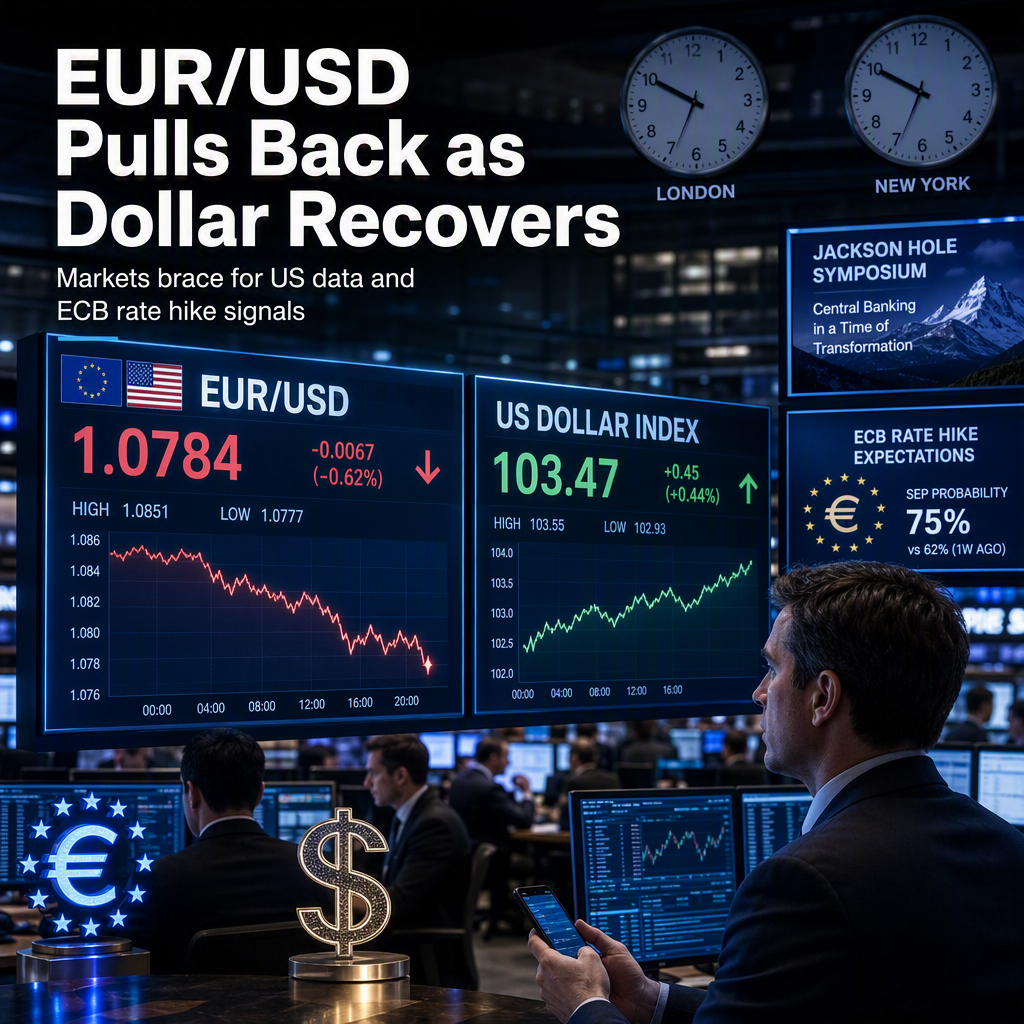
The EUR/USD currency pair traded marginally lower on Tuesday, extending its corrective move from a four-day high of 1.1711 to near 1.1655 during the European trading session, as the US Dollar (USD) continued its recovery. The US Dollar Index (DXY), which measures the Greenback against six major currencies, was up 0.1% to approximately 99.07 at press time, reflecting cautious market sentiment ahead of the upcoming US Personal Consumption Expenditure Price Index (PCE) data for July and the Jackson Hole Symposium [1].
Strategists at Scotiabank noted that significant calendar and event risk this week could lead to moderate short-term gains for the USD as investors adjust their positions. However, they cautioned that the broader technical backdrop for the dollar remains fragile, with technical trends still bearish and no clear reversal evident, despite some moderation in the dollar's decline [1].
On the Euro side, expectations remain firm for a European Central Bank (ECB) interest rate hike in September. Analysts at Nomura anticipate the ECB will raise rates next month, citing resilient Eurozone activity data that may alleviate concerns among more dovish policymakers. The latest ECB Consumer Expectations Survey showed that three-year ahead median inflation expectations declined by 0.1 percentage points to 2.7% in July, while five-year ahead expectations remained unchanged at 2.4% [1].
Technically, EUR/USD is trading around 1.1654, maintaining a bullish near-term bias as it stays above the 20-day Exponential Moving Average (EMA) at 1.1577. The Relative Strength Index (14) is in positive territory near 67, indicating strong but not extreme upside momentum. Key support levels are at the June 15 high of 1.1622 and the 20-day EMA at 1.1577, while resistance is seen at the August high of 1.1711 and the May high near 1.1800 [1].
CONCLUSION
EUR/USD is experiencing a corrective pullback as the US Dollar recovers ahead of key US economic data and the Jackson Hole Symposium. Despite short-term USD strength, the broader trend remains bearish for the dollar, while expectations for a September ECB rate hike continue to support the Euro. Market participants are closely watching upcoming events for further direction.