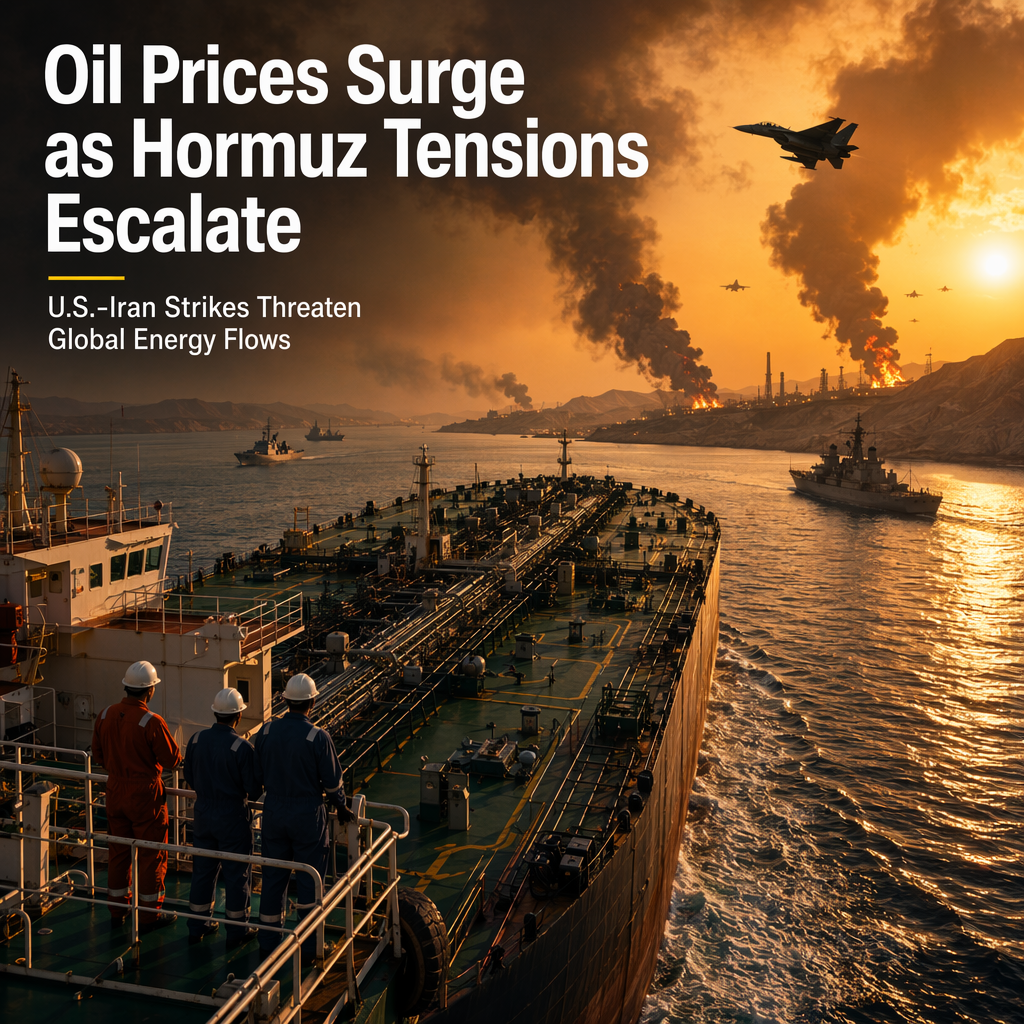
On July 12, 2026, oil prices rose sharply as the United States and Iran exchanged military strikes over control of the Strait of Hormuz, a critical trade route for global energy supplies [1]. U.S. crude oil futures increased by 3.4% to $73.87 per barrel, while Brent futures climbed 3.5% to $78.67 by 6:03 p.m. ET [1]. The escalation began after the U.S. military launched another wave of strikes against Iran, targeting 140 sites on Saturday, in response to an attack by the Islamic Revolutionary Guard Corps on a container ship transiting Hormuz [1]. Iran retaliated with strikes on U.S. military facilities in Jordan, Kuwait, Bahrain, and Oman, according to Iranian state news agency Tasnim [1].
Iranian state media claimed the Revolutionary Guard had closed the Strait of Hormuz until further notice, but the U.S. military disputed this assertion. U.S. Central Command stated that the strait was open to "all vessels seeking to lawfully transit," and President Donald Trump reiterated in an NBC News interview that Hormuz was open [1]. Maritime intelligence firm Windward tracked nine ships transiting the strait on Saturday, and the Joint Maritime Information Center confirmed that the southern route through Oman's waters remained open to inbound and outbound traffic [1]. However, the security situation remains severe, with mariners advised to exercise "extreme vigilance" [1].
The weekend airstrikes marked the fourth time in a week that the U.S. has bombed Iran in retaliation for attacks on commercial ships in the southern corridor protected by the U.S. military [1]. Iran is demanding that ships use a northern route through its territorial waters, asserting control over the strait [1]. The conflict stems from differing U.S. and Iranian interpretations of an interim peace deal signed on June 17 regarding the reopening of Hormuz [1].
Prior to the recent hostilities, about 20% of the world's oil supplies transited Hormuz. Traffic dropped significantly after Iran began attacking ships in early March, but had started to recover following the interim deal between Washington and Tehran [1].
CONCLUSION
The ongoing military confrontation between the U.S. and Iran over the Strait of Hormuz has led to a significant spike in oil prices and heightened security risks for global energy trade. Despite conflicting claims about the strait's status, key routes remain open, though mariners face severe security concerns. The situation continues to pose high market risks and uncertainty for oil supply and transit.