
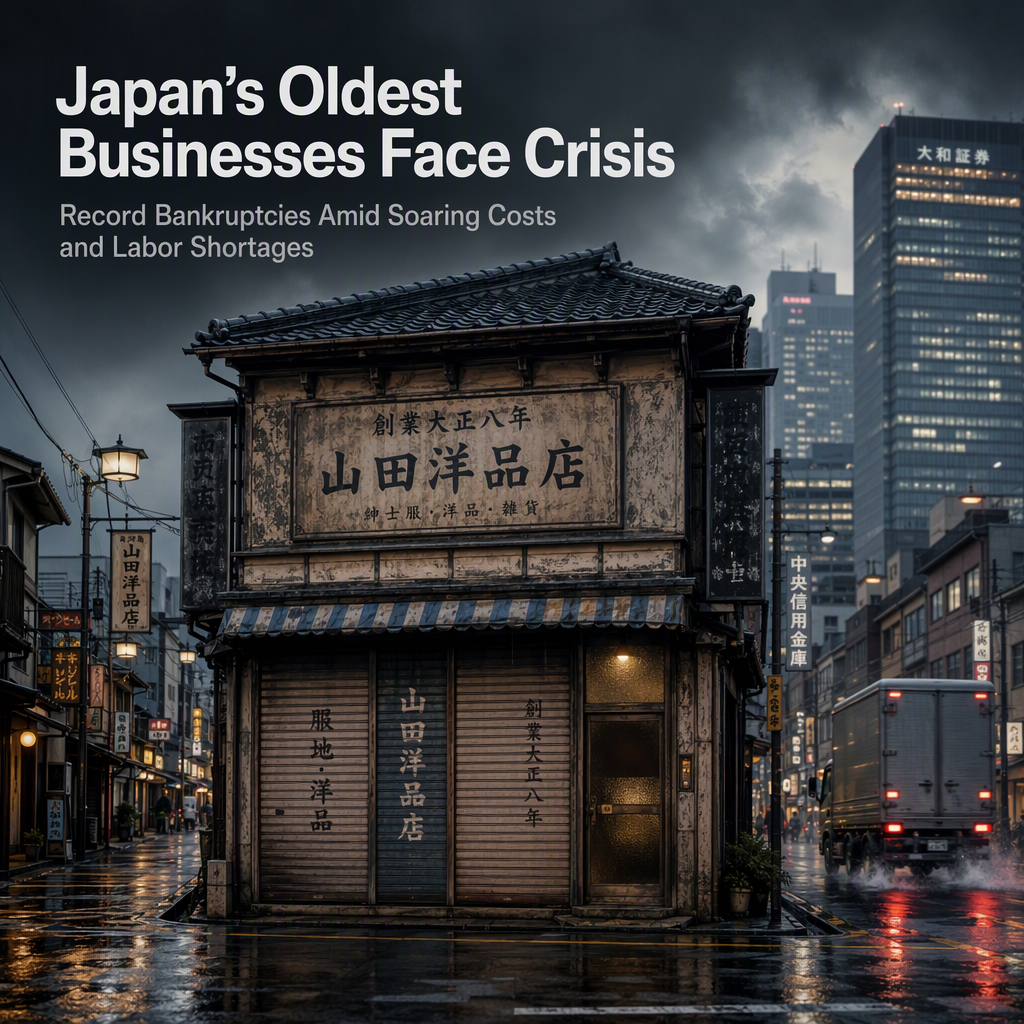
Japan's century-old businesses are experiencing a record pace of bankruptcies in 2026, driven by rising costs, labor shortages, a shrinking domestic market, and succession challenges, according to Teikoku Databank data cited by CNBC World [1]. In the first eight months of 2026, 112 Japanese companies with more than 100 years of history filed for bankruptcy, marking an unprecedented rate for this segment [1].
Kadoya Sesame Mills, a company founded in 1858 and listed on the Jasdaq Securities Exchange since 2004, is set to go private through a tender offer backed by Japanese private equity firm Integral. This strategic move comes as the company faces rising raw-material costs and heightened geopolitical risks [1]. Another example is Sube Shoten, a tofu maker established in 1877, which ceased operations in May 2026 and began preparing for bankruptcy due to low profit margins and a recent surge in raw-material costs [1].
Economists note that while Japan's long-established businesses have historically benefited from family ownership, strong community ties, and prudent financial management, they are now increasingly concerned about their ability to sustain high profits in the long term. Shigeto Nagai, head of Japan economics at Oxford Economics, highlighted that these companies fear gradual decline despite their sound balance sheets and stable profit margins [1].
Harumi Taguchi, principal economist at S&P Global Market Intelligence, explained that although inflation has made it somewhat easier for companies to pass on costs, many still cannot fully reflect higher expenses in sales prices. Smaller and domestically focused businesses are particularly vulnerable due to their weaker sales bases, making pricing power a critical factor for survival [1]. Bankruptcies linked to higher prices rose 23.8% to 556 in the first half of 2026, while labor-shortage bankruptcies increased 12.4% to 227 [1].
CONCLUSION
Japan's century-old businesses are under significant pressure from rising costs, labor shortages, and a shrinking market, leading to a record number of bankruptcies in 2026. The situation underscores the urgent need for adaptation and strategic change among these historic companies, with market implications likely to remain high as these trends persist.