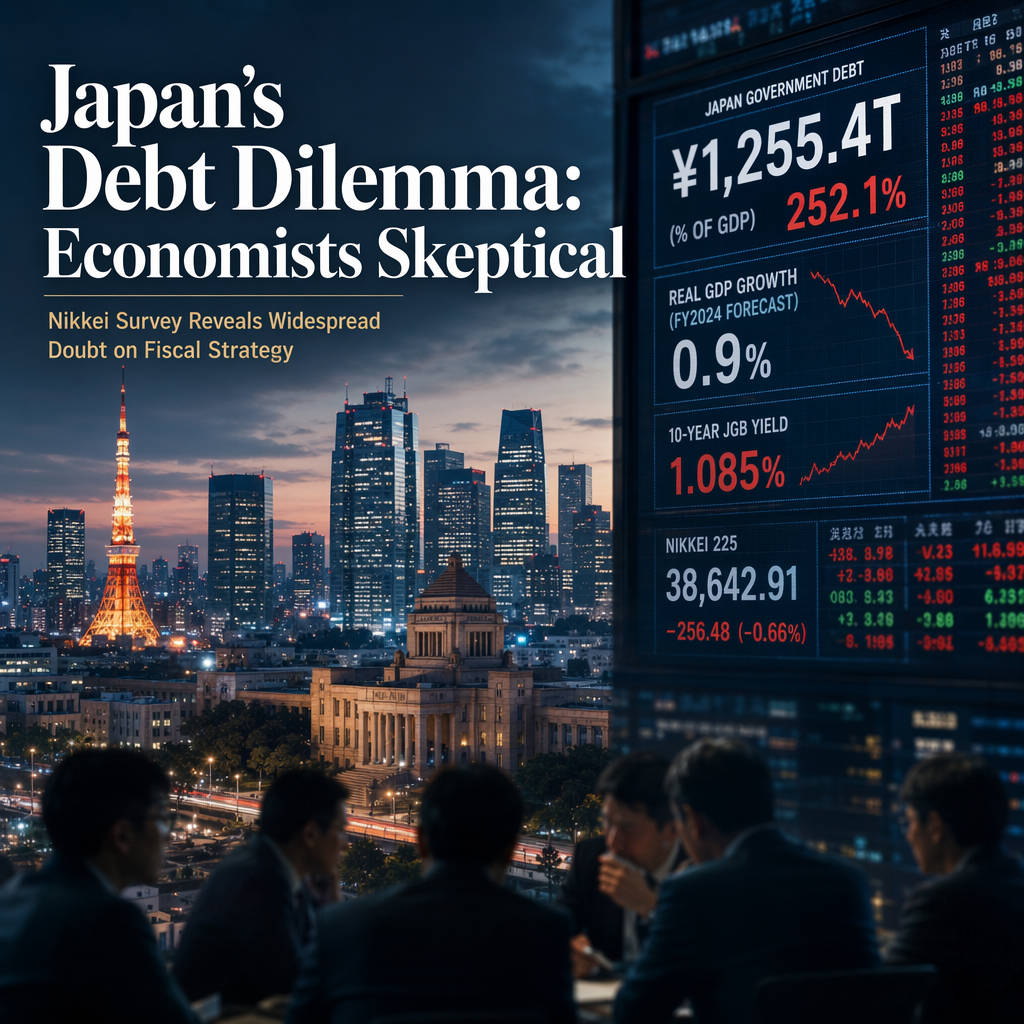
A recent Nikkei survey reveals that economists are largely skeptical about the Japanese government's ability to reduce its debt-to-GDP ratio through its current growth-focused fiscal strategy [1]. The government's plan centers on fostering economic expansion, particularly through public-private investment, as a means to address Japan's substantial debt load [1]. However, the surveyed economists express doubts that these investment measures are adequate to achieve the goal of steadily lowering the country's debt relative to GDP [1].
The survey underscores widespread concern among experts that the government's fiscal measures may fall short, despite official optimism about the potential for economic growth to resolve Japan's debt challenges [1]. No specific figures, percentages, or named entities beyond the general reference to economists and the Japanese government are provided in the article [1].
Market implications are implied by the skepticism of economists, suggesting that confidence in the government's fiscal trajectory may be limited among market participants [1]. There are no explicit forward-looking statements or analyst opinions beyond the general sentiment of doubt regarding the effectiveness of the current strategy [1].
CONCLUSION
Economists surveyed by Nikkei express significant doubt that Japan's current growth-driven fiscal plan will be sufficient to reduce its debt-to-GDP ratio. The findings highlight persistent concerns about the adequacy of public-private investment and the overall effectiveness of the government's approach.