
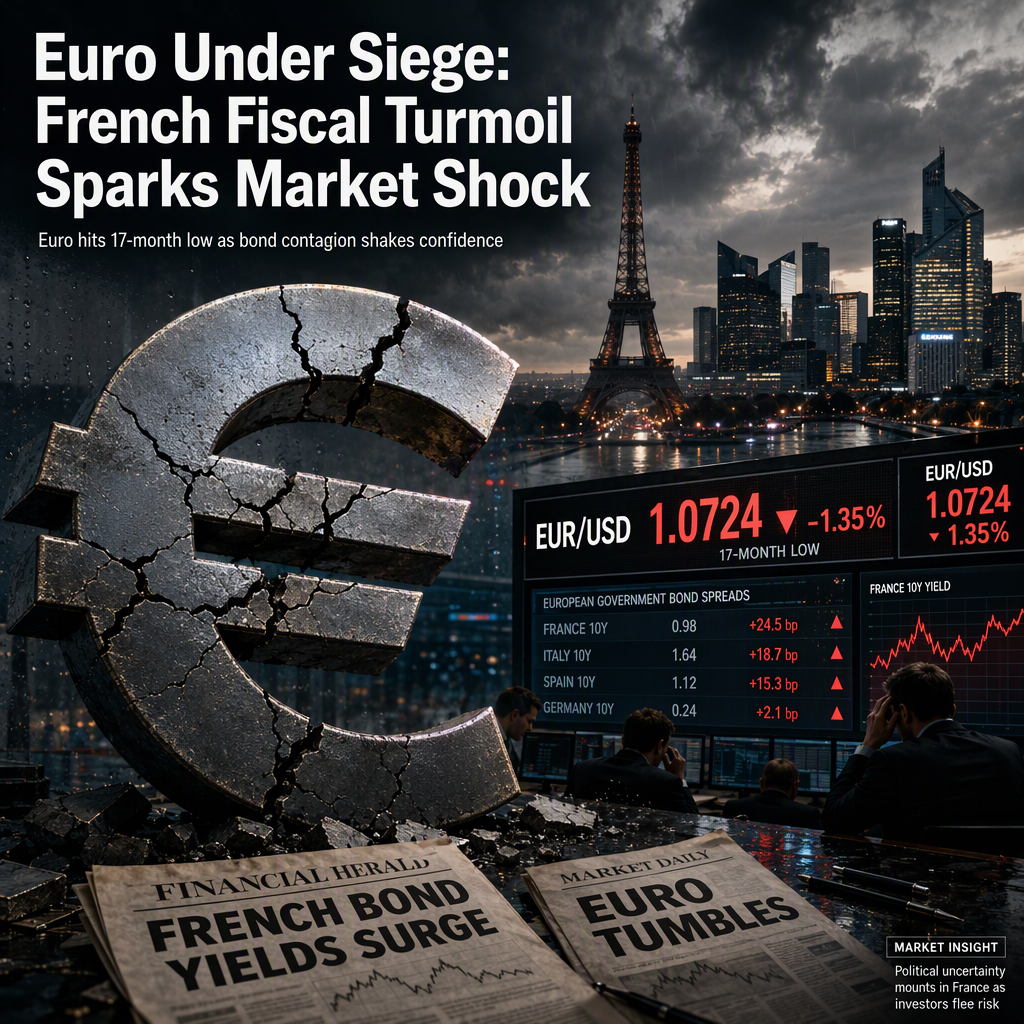
The Euro (EUR) has come under significant pressure, with EUR/USD slipping to fresh 17-month lows near 1.1160, as escalating political and fiscal uncertainties in the Eurozone—particularly France's deepening budget crisis—drive volatility in European sovereign bond markets [2]. The sell-off in French government bonds is causing contagion across the Eurozone, widening yield spreads against German Bunds and tightening financial conditions, which complicates potential European Central Bank (ECB) intervention [2]. While Spain's announcement of a snap election on November 29 adds to the political noise, analysts emphasize that the primary risk to the Euro stems from the French bond market, not the Spanish election [2].
Strategists from OCBC and Brown Brothers Harriman (BBH) note that the turbulence in European bond markets is fueling expectations of a more dovish ECB policy path, while the US Dollar (USD) remains supported by resilient US economic data and expectations for further Federal Reserve (Fed) tightening [1][4]. Markets are currently pricing in slightly more than three Fed hikes over the next 12 months, though OCBC strategists believe this is too aggressive given recent softer US labor market data and moderating wage growth [1]. Expectations for an October Fed rate hike have fallen sharply after several Fed officials signaled a preference to pause and assess incoming data, with any further tightening likely deferred until later in the year [1].
Technical analysts at UOB highlight that unless EUR/USD reclaims resistance at 1.1285, the pair remains vulnerable to further downside, with support levels at 1.1145 and potentially 1.1111 if the fiscal crisis and bond market contagion persist [2]. The US Dollar's strength is further underpinned by robust September ISM services and manufacturing indexes, which point to resilient US growth and intensifying inflation pressures, supporting the Fed's tightening bias [4].
Looking ahead, institutional strategists suggest that the Euro's performance into year-end will depend largely on the fallout from the French government bond market sell-off and the extent of contagion to other Eurozone debt markets, with risks currently skewed towards further Euro weakness [2]. Unless volatility in European bond markets escalates significantly, OCBC expects only a moderate USD rally into year-end rather than an aggressive move [1].
CONCLUSION
The Euro faces heightened downside risks as France's fiscal crisis and bond market contagion overshadow other political developments in the Eurozone. With the ECB constrained and the Fed maintaining a tightening bias, market sentiment remains negative for the Euro, and further declines toward key technical support levels are possible if fiscal and bond market stresses persist.