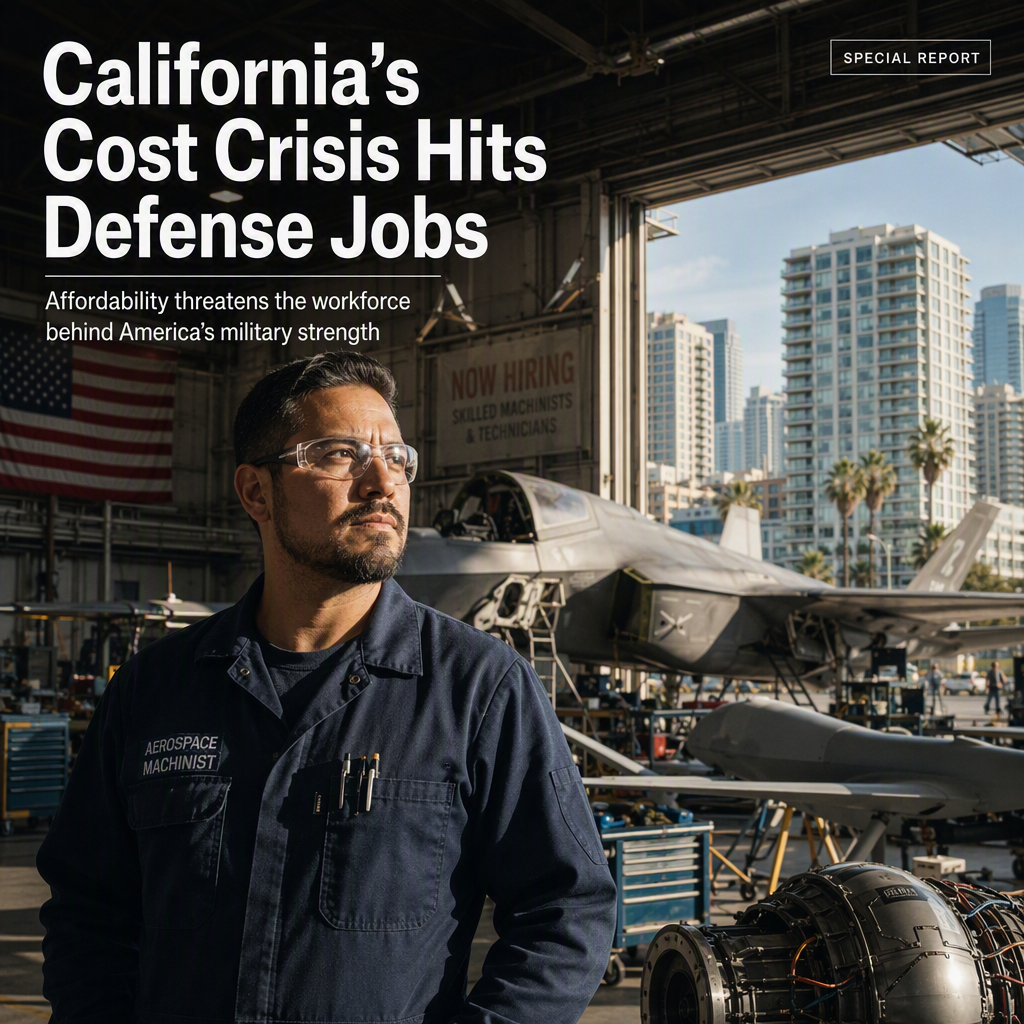
California, home to over 30 major defense installations and a significant aerospace and defense ecosystem, is facing a critical workforce shortage due to the state's affordability crisis [1]. While skilled trades in these industries offer competitive salaries—often between $90,000 and $100,000 annually without requiring a four-year degree—rising costs for rent (approaching $3,000 per month), gasoline, electricity, insurance, food, and taxes are eroding the purchasing power of workers and making homeownership increasingly unattainable [1].
The article highlights that the defense industrial base is already challenged by an aging workforce and a shortage of skilled tradesmen, with millions of manufacturing jobs potentially going unfilled nationwide as experienced workers retire and too few young Americans enter these fields [1]. The author argues that California's high cost of living exacerbates this challenge by driving workers out of the state, threatening the ability to build and maintain advanced defense systems such as ships, aircraft, missiles, autonomous systems, and satellites [1].
To address these issues, the article advocates for a shift away from the "college for all" mentality, emphasizing the value of skilled trades and apprenticeships that allow young workers to earn while they learn, avoiding student debt and entering the workforce earlier than many college graduates [1]. The Trump administration is noted as taking steps to reduce barriers to career and technical education and expand apprenticeships at the national level [1].
The article also notes that while artificial intelligence may disrupt some white-collar professions, it cannot replace the essential hands-on work performed by machinists, welders, mechanics, and technicians in the defense sector [1].
CONCLUSION
California’s affordability crisis is undermining its ability to attract and retain the skilled workforce essential for the nation’s defense industrial base. Without addressing the high cost of living and promoting alternative career pathways, the state risks exacerbating workforce shortages and jeopardizing critical defense manufacturing capabilities.