
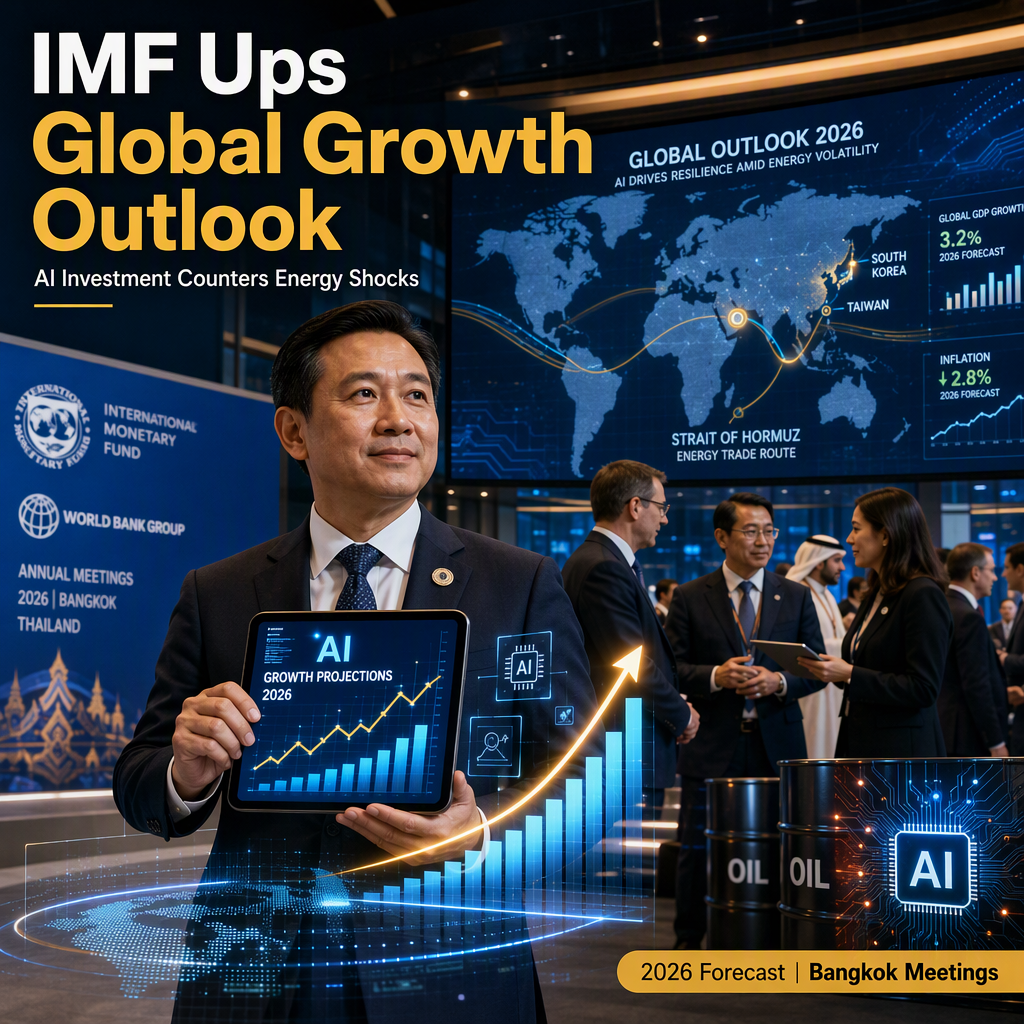
The International Monetary Fund (IMF) has revised its global economic growth forecast for 2026 upward, citing a surge in artificial intelligence (AI) investment that is helping to counterbalance the negative effects of rising energy costs and ongoing geopolitical tensions [1]. The IMF now expects the global economy to grow at 3.1% in 2026, an improvement from its July estimate of 3%, though still slower than the 3.5% growth rate recorded last year [1]. For 2027, the IMF maintained its growth forecast at 3.4% [1].
Inflation is projected to rise to 4.7% this year, driven by higher energy costs and the AI investment boom, before easing to 4.1% in 2027. This is slightly above the 3.9% inflation rate the IMF projected in July [1]. The IMF also updated its outlook on the Strait of Hormuz, now expecting it to reopen in March 2027 with conditions returning to pre-war levels by October 2027. Gulf crude exports have recovered to 88% of pre-conflict levels as of September, reflecting increased traffic through the region [1].
The IMF's report was released during the annual meetings of the IMF and World Bank in Bangkok, where finance ministers and central bank governors from 191 member countries are discussing issues such as geopolitical tensions, rising public debt, and the impact of artificial intelligence [1]. The IMF noted that AI-related investment has provided a "demand impulse" that supported economic activity in the first half of the year, despite challenges from the Middle East war and trade tensions. Financial markets have remained largely stable, which the IMF attributes in part to "AI-related exuberance" [1].
However, the IMF cautioned that the economic buffer provided by measures such as diversifying fuel sources and tapping strategic reserves is "rapidly narrowing." Global oil reserves are being depleted at a rate of about 2.7 million barrels per day, approaching levels that could trigger sharp price increases and potentially undermine the AI-driven economic momentum [1]. The IMF also highlighted growing concerns about government fiscal health as an additional headwind [1].
Growth is becoming increasingly uneven across countries. Thirty-two economies now account for 95% of global growth, down from 54 in April. Economies less exposed to war-related supply shocks and those benefiting from AI-driven demand are performing better. For example, Taiwan is forecast to grow 10.7% this year and South Korea 3.3%, up from 1.1% in 2025, largely due to strong semiconductor demand [1].
CONCLUSION
The IMF's latest outlook highlights the positive impact of AI investment on global growth, even as energy shocks and geopolitical risks persist. While inflation remains elevated and economic buffers are thinning, select economies tied to AI and technology are outperforming. The market response has been relatively calm, but risks remain if energy constraints worsen or fiscal pressures intensify.