
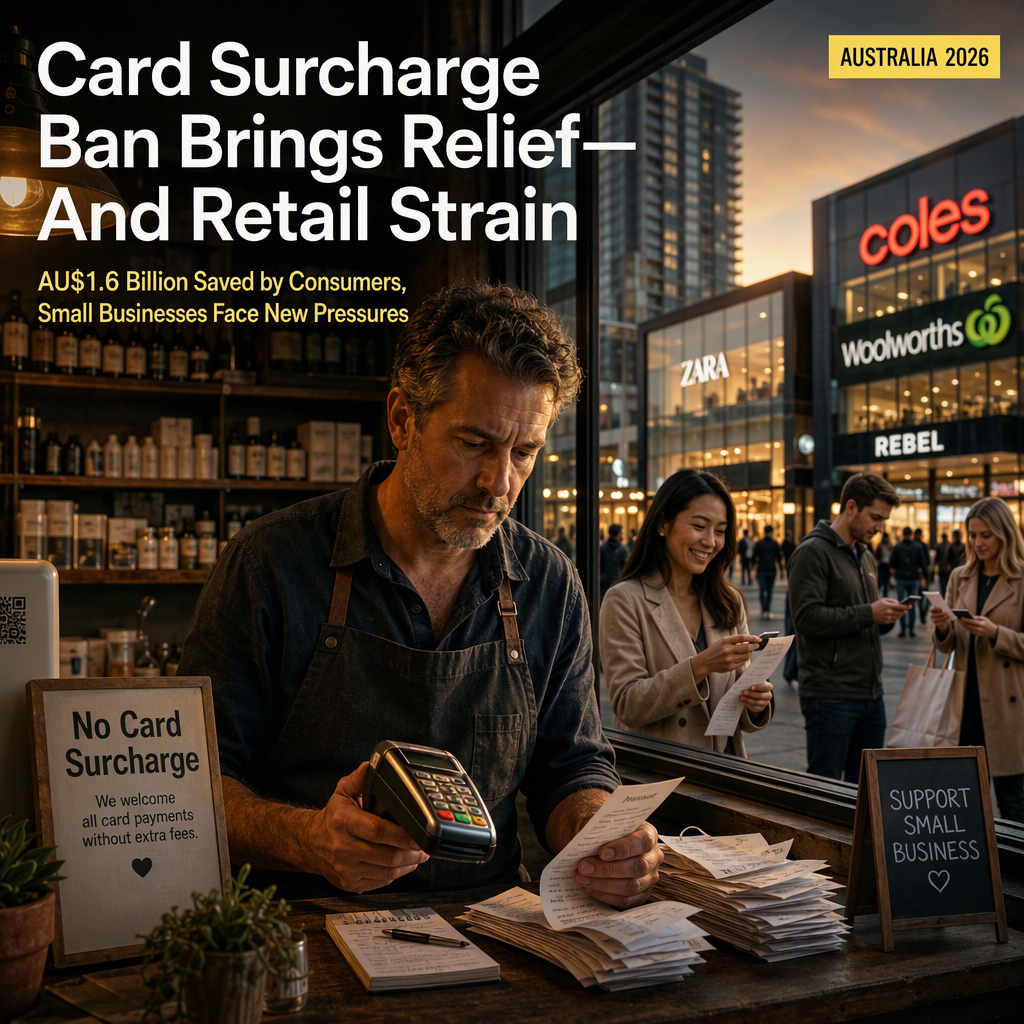
On October 1, 2026, Australia implemented a ban on credit and debit card payment surcharges, a move expected to save consumers 1.6 billion Australian dollars (US$1.12 billion) annually [1]. While this regulation provides relief to consumers who have long complained about extra fees when paying with cards, it places additional financial strain on small retailers, who will no longer be able to recoup the costs charged by payment processors such as Visa and Mastercard [1]. These processing fees remain unchanged, leaving businesses with no avenue to pass on these expenses to customers [1].
Retailers warn that the inability to offset these fees may force them to either raise prices or absorb the costs, potentially squeezing profit margins—especially for those already facing tough economic conditions [1]. Market analysts suggest that the AU$1.6 billion in annual savings for consumers could boost household spending, but caution that the ripple effect on small businesses may lead to consolidation or closures if profit pressures intensify [1].
Industry groups have called for further regulatory action to reduce payment processor fees, arguing that the current arrangement disproportionately affects small businesses compared to larger retailers, who may negotiate better terms [1]. The ban comes amid a challenging period for Australian retail, with rising interest rates, inflation, and subdued consumer confidence already weighing on the sector [1]. Retailers are now assessing strategies to adapt to the new regulatory landscape, including potential price adjustments and operational efficiencies [1].
No trading advice or technical chart analysis is included in the article [1].
CONCLUSION
Australia's ban on card payment surcharges is expected to benefit consumers through significant annual savings, but it poses new challenges for small retailers already facing economic headwinds. The regulation may prompt price increases or business consolidation as retailers seek ways to offset unchanged payment processing fees. The market impact is medium, with potential shifts in retail dynamics and consumer spending patterns.