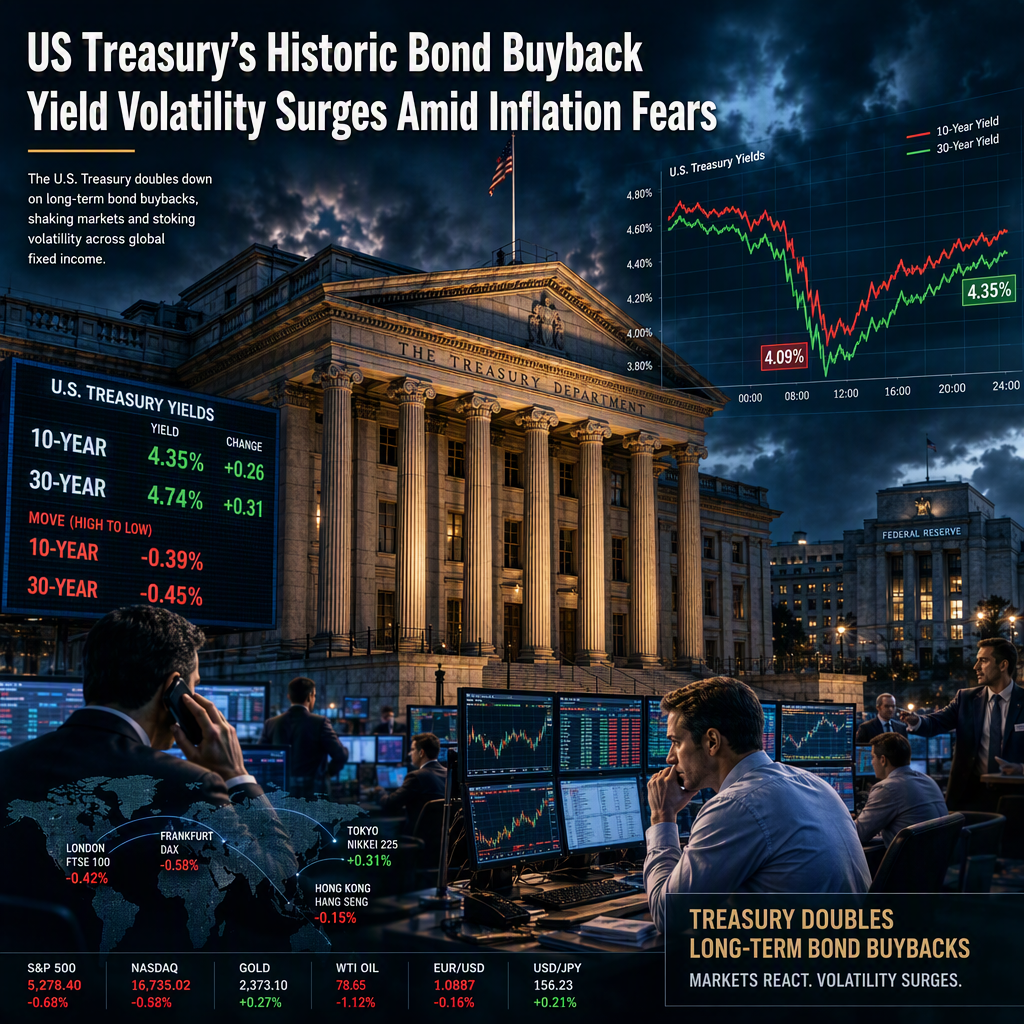
The US Treasury Department announced a significant policy shift by at least doubling the size of its long-term government bond repurchases, focusing on securities with maturities from 10 to 30 years [3][4][5]. This move, led by Treasury Secretary Scott Bessent, was aimed at addressing heightened concerns over market liquidity and stability following a surge in yields, which had reached levels not seen since before the 2008 Global Financial Crisis [3][4][5]. The announcement triggered an immediate rally in the bond market, with 10-year yields falling to levels seen a week prior and the 30-year yield plunging more than 10 basis points on the day, before edging higher by 3 basis points to 5.2256% in the following session [3][5]. The 10-year note yield also moved 1 basis point higher to 4.6723%, while the 2-year Treasury note held steady at 4.1727% [5].
UBS Chief Economist Paul Donovan noted that higher yields have exacerbated the US affordability crisis and debt service costs, making the Treasury's intervention a political focus to counter unintended consequences from policies such as the Gulf war and tariffs [3]. The total US government debt has now surpassed $40 trillion, more than double the level of a decade ago [5]. Despite the Treasury's actions, Federal Reserve policy uncertainty continues to add a risk premium to financial markets, with the latest FOMC minutes revealing most members favored unchanged rates but remained concerned about inflation persistence [2][3][5].
AI-driven analysis by MUFG found the July FOMC minutes to be slightly more hawkish than expected, with several participants supporting a 25bp rate hike and highlighting AI-related investment as a near-term inflation driver [2]. However, the minutes also contained dovish signals, such as the assessment that tariff pass-through effects on inflation are largely complete [2]. The muted reaction in major FX pairs and the broader US Dollar trend suggests that the minutes did not provide a strong enough signal to prompt a sustained repricing of the Fed's policy path [2].
The Treasury's buyback announcement also influenced global markets, with S&P 500 futures rising 0.15% and Asian stock markets moving significantly higher, reflecting a risk-on sentiment [4]. The Australian Dollar, however, remained under pressure due to weak domestic employment data, despite the broader positive market environment [4].
CONCLUSION
The US Treasury's decision to double long-term bond buybacks marked a historic intervention, temporarily easing yields and supporting market liquidity. However, persistent inflation concerns from the Federal Reserve and record-high government debt levels continue to weigh on market sentiment. While the immediate reaction was positive for risk assets, uncertainty around future Fed policy and inflation risks remains elevated.