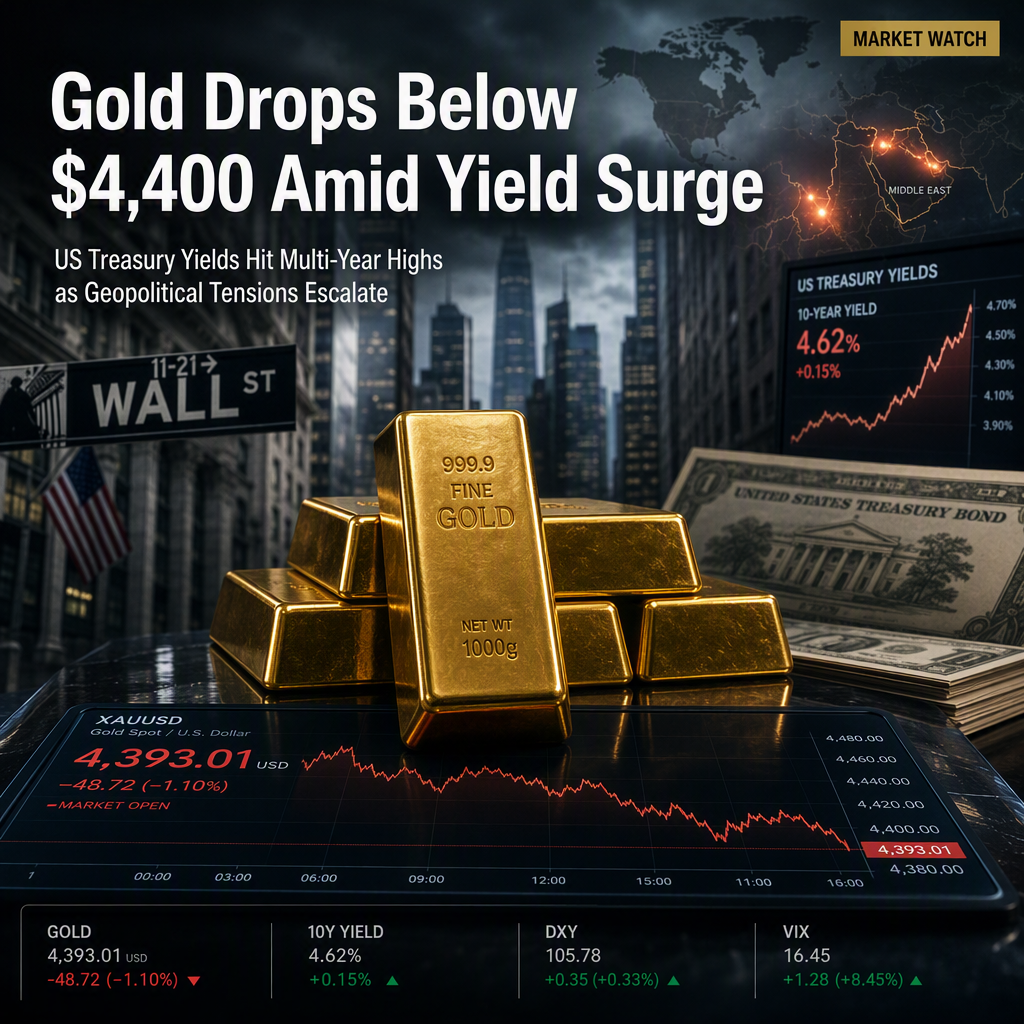
Gold (XAU/USD) experienced a decline on Tuesday, breaking a two-day winning streak as rising US Treasury yields and a stronger US Dollar weighed on the precious metal. At the time of writing, XAU/USD traded around $4,393, down 0.50% on the day, with price action remaining range-bound between $4,300 and $4,450 [1]. During the European morning session, Gold traded just below $4,400 after failing to sustain levels above $4,430, but remained above the weekly floor of $4,315 [2].
The benchmark 10-year US Treasury yield climbed toward 4.75%, while the 30-year yield rose above 5.30%, marking its highest level since 2007 according to [1], and fresh 19-year highs according to [2]. This surge in yields is part of a global bond sell-off driven by inflation and fiscal concerns, with borrowing costs also rising in the UK, Germany, and Japan [1]. Higher yields increase the opportunity cost of holding non-yielding assets such as Gold [1][2].
Geopolitical tensions contributed to risk aversion and safe-haven flows into the US Dollar. The Memorandum of Understanding between the US and Iran expired on Monday, with US President Donald Trump stating Washington is not seeking an extension and threatening to bomb Oman, while Iran shifted its military stance to 'fully offensive' [1][2]. The standoff over the Strait of Hormuz and rising crude oil prices have fueled inflation concerns and pushed bond yields higher [1][2].
Market expectations for a Federal Reserve rate hike have diminished due to recent weak US employment and consumer spending data, as well as soft inflation readings. The CME FedWatch Tool shows a 65% probability that the Fed will leave rates unchanged next month [1], while [3] reports a lower probability of 35%, down from 47% a month ago, highlighting a discrepancy in rate hike expectations. Strategists at Brown Brothers Harriman suggest that any US Dollar strength may be shallow and short-lived due to the risk of further dovish Fed repricing [1].
Technical analysis indicates that Gold retains a constructive bias above the 50-period SMA at $4,365, with momentum indicators such as the RSI at 52 (neutral) and MACD slightly bullish on the 4-hour chart [1]. On the daily chart, momentum remains bullish with RSI at 62.94 and MACD positive, suggesting ongoing upside pressure [2]. Key resistance levels are identified at $4,450 and the 200-day SMA just above $4,500, while a break below $4,317 could expose deeper support levels [2].
With a light US economic calendar this week, traders are expected to focus on the release of the FOMC Meeting Minutes on Wednesday and developments in the Middle East [1].
CONCLUSION
Gold's decline below $4,400 is primarily driven by rising US Treasury yields and heightened geopolitical tensions, which have strengthened the US Dollar and increased risk aversion. While fading expectations of a Fed rate hike provide some support, the near-term outlook for Gold remains constrained by firmer yields and ongoing uncertainty in the Middle East. Market participants are closely watching upcoming FOMC minutes and geopolitical developments for further direction.