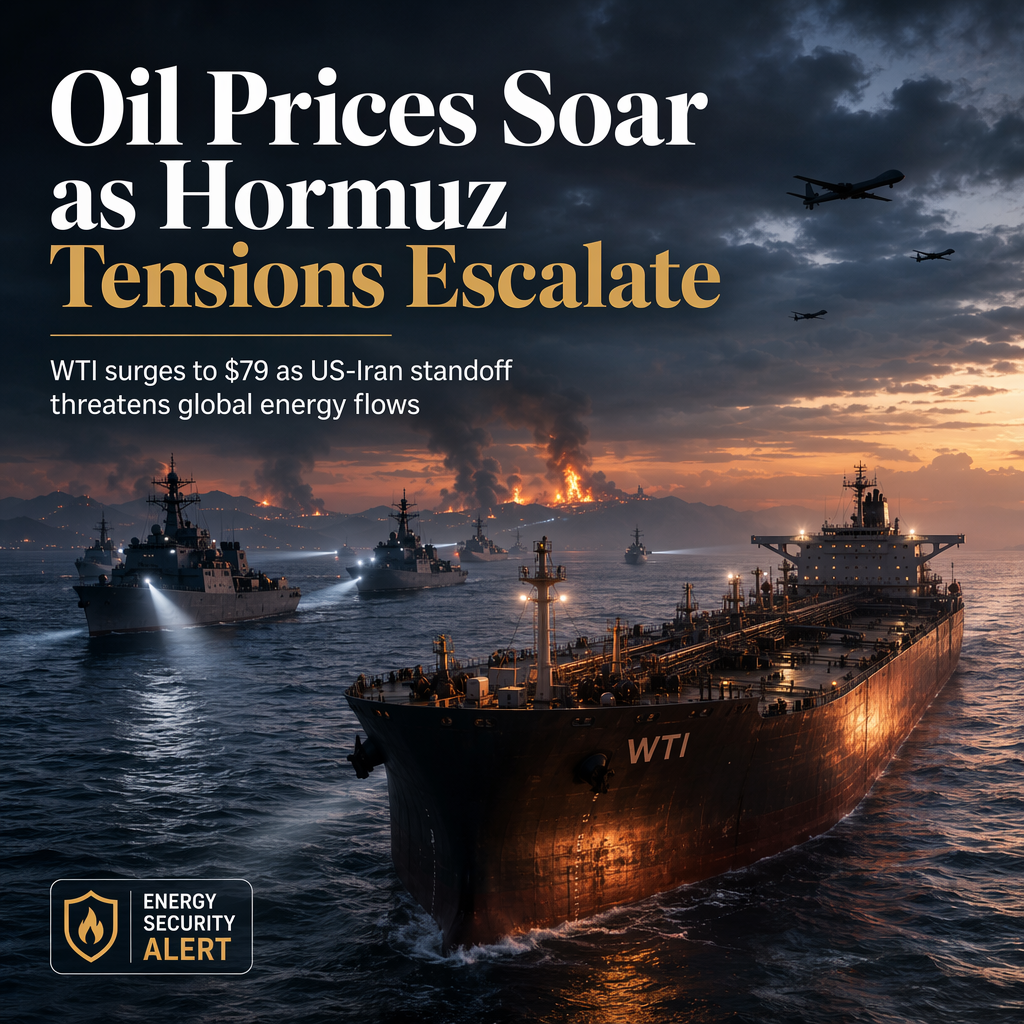
West Texas Intermediate (WTI), the US crude oil benchmark, is trading around $79.00 during early European trading hours on Friday, marking its biggest weekly advance since April. This surge is attributed to escalating tensions in the Middle East, specifically between the US and Iran, which have raised fears of potential disruptions to oil supply routes [1]. The BBC reported that the US Central Command (CENTCOM) launched a new wave of strikes against Iran, with the US military stating these attacks aimed to 'further degrade Iranian military capabilities.' Additionally, the US military boarded a vessel as part of its blockade of the Strait of Hormuz [1].
In response, the Iranian Islamic Revolutionary Guards Corps (IRGC) declared that no oil or gas would be exported through the Strait of Hormuz as long as US attacks continue [1]. The situation in the region remains volatile, with FarsNews reporting loud explosions in Kuwait and Basra, and Qatar’s Defence Ministry announcing the interception of a missile attack on Friday [1].
The International Energy Agency (IEA) Executive Director Fatih Birol warned on Thursday that if the US and Iran do not increase oil flows through the Strait of Hormuz soon, the world should be concerned about energy security [1]. The combination of military actions, threats to critical oil transit routes, and regional instability has contributed to the upward pressure on WTI prices [1].
No specific analyst forecasts or forward-looking price targets were provided, but the explicit warnings from the IEA and the IRGC’s statements underscore the market’s heightened sensitivity to further developments in the region [1].
CONCLUSION
WTI oil prices have climbed sharply amid escalating US-Iran tensions and threats to the Strait of Hormuz, a key global oil transit route. Market participants are closely monitoring the situation, as further disruptions could have significant implications for global energy security and oil prices.