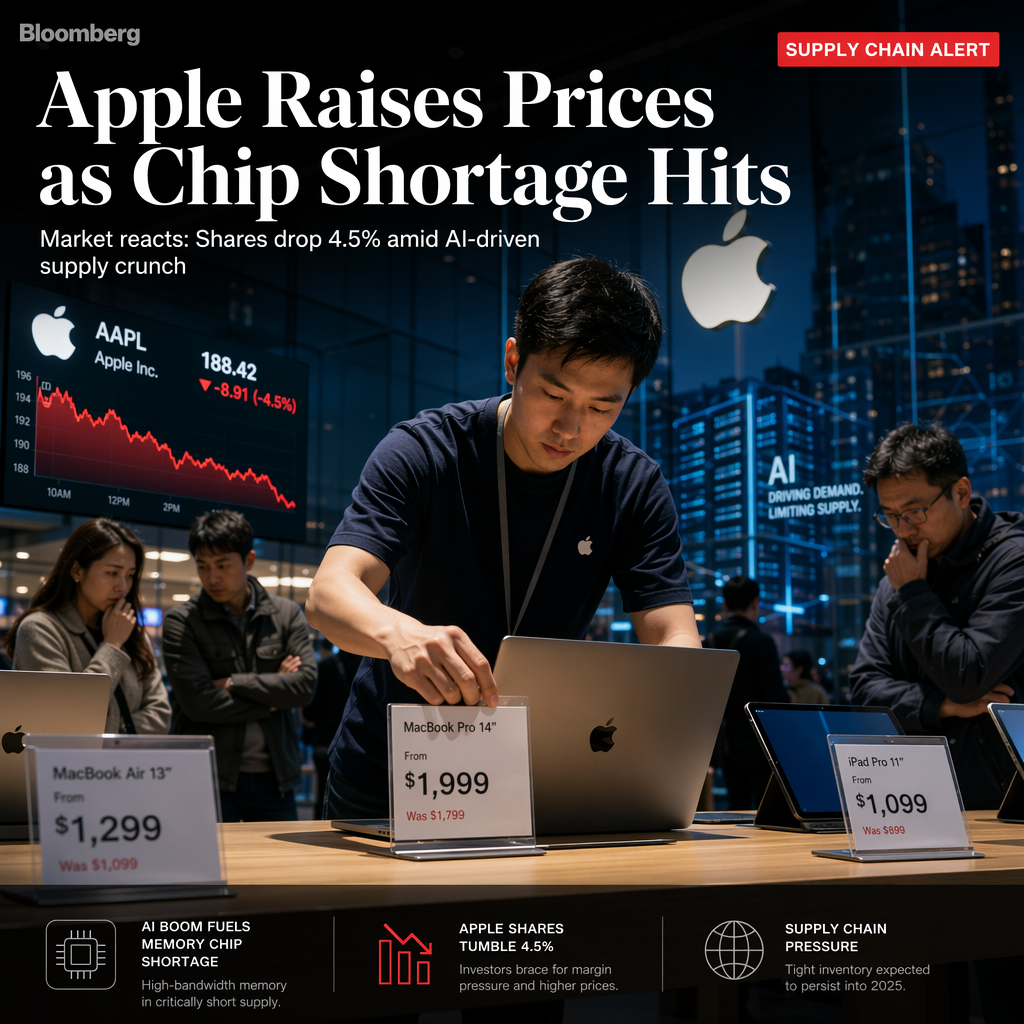
Apple announced on Thursday that it is raising prices for its Mac and iPad product lines, attributing the increases to a shortage of memory chips caused by surging demand from artificial intelligence data centers [1]. The company described the situation as an “unprecedented challenge” for the consumer electronics industry, noting that the rapid expansion of AI data centers has led to an extraordinary surge in demand for memory and storage components [1]. Apple stated, “We have never seen a component price increase this much, this quickly,” and explained that it has shielded customers from these cost pressures until now, but is now compelled to raise prices on several products [1].
Specific price changes include the new entry-level MacBook Neo rising to $699 from $599, the 512GB MacBook Air increasing to $1,299 from $1,099, and the 1TB MacBook Pro now costing $1,999, up from $1,699 [1]. For iPads, the 128GB iPad Air is now $749, up from $599, and the 256GB iPad Pro Wifi is $1,199, up from $999 [1].
Market reaction was swift, with Apple shares falling $13.29, or 4.5%, to $279.88 on Thursday afternoon [1]. Analyst Nabila Popal from IDC commented that the price hikes were higher than expected and suggested that iPhone prices may also rise later this year, potentially by as much as $200 for the iPhone Pro and Pro Max models [1]. Popal remarked, “I think the days of $50 price increases are over” [1].
Apple acknowledged the negative impact on consumers and stated it is working tirelessly to find solutions to the supply chain challenges [1].
CONCLUSION
Apple's decision to raise Mac and iPad prices due to a memory chip shortage has led to a significant drop in its share price and signals further potential price hikes for other products. The market response underscores investor concerns about supply chain pressures and their impact on consumer demand and company margins.