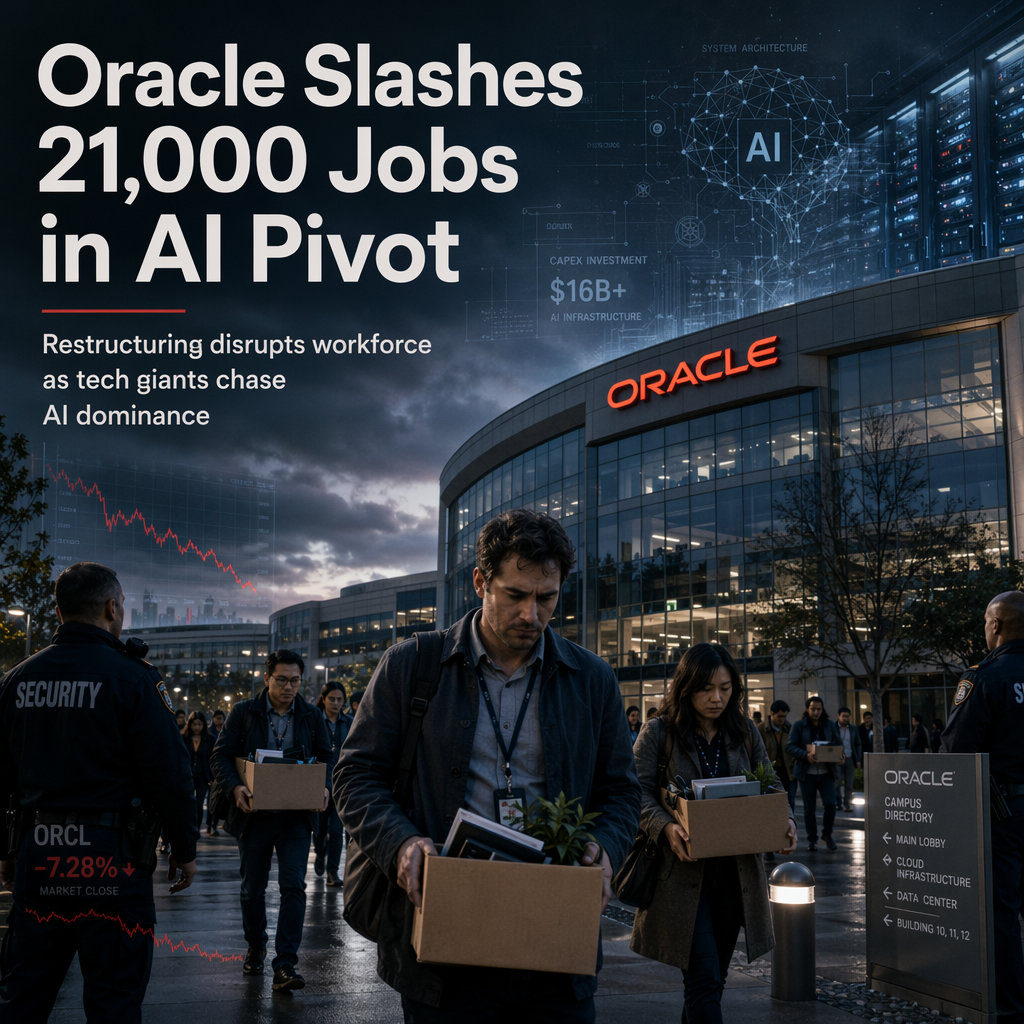
Oracle has reduced its workforce by 21,000 employees, representing nearly 13% of its total staff, over the past year as part of a broader wave of layoffs among tech giants driven by the adoption and deployment of AI technologies [1]. As of May 2026, Oracle's workforce stands at 141,000 full-time employees, down from 162,000 the previous year [1]. The company attributed these cuts to AI deployment and surging capital expenditures, noting in its annual regulatory filing that such changes may continue to result in further workforce reductions [1].
Oracle's restructuring efforts have resulted in $1.8 billion in costs, including severance and other exit payments, a significant increase from the $374 million spent the previous year [1]. The company acknowledged that these workforce changes can be disruptive, potentially leading to shortages of skilled employees, loss of institutional knowledge, and negative impacts on morale and retention [1].
The layoffs come as Oracle faces investor pressure over its substantial investments in AI infrastructure. In January, the company announced plans to raise $50 billion in debt and equity, while its free cash flow for the last fiscal year was negative $23.7 billion. Capital expenditure surged 162% to $55.7 billion [1]. Oracle's stock reacted negatively, falling 3.6% in premarket trading and down 15.4% since the start of the year, amid a broader global tech selloff [1].
Oracle's actions are part of a larger trend among major tech firms, with Meta, Google, Microsoft, and Amazon announcing combined capital expenditure plans that could reach $700 billion for AI data center development this year [1]. Meta laid off 8,000 employees (10% of its workforce) in May, and Microsoft offered voluntary buyouts to 7% of its U.S. employees in April [1]. In total, AI was responsible for over 50,000 layoffs in the U.S. in 2025, with companies like Salesforce and IBM also making significant cuts [1].
CONCLUSION
Oracle's significant workforce reduction highlights the disruptive impact of AI adoption and the financial pressures of large-scale infrastructure investments. The negative market reaction and increased restructuring costs underscore the challenges facing tech giants as they pivot toward AI-driven strategies. Investors and employees alike will be closely watching how Oracle and its peers manage these transitions in the coming months.