
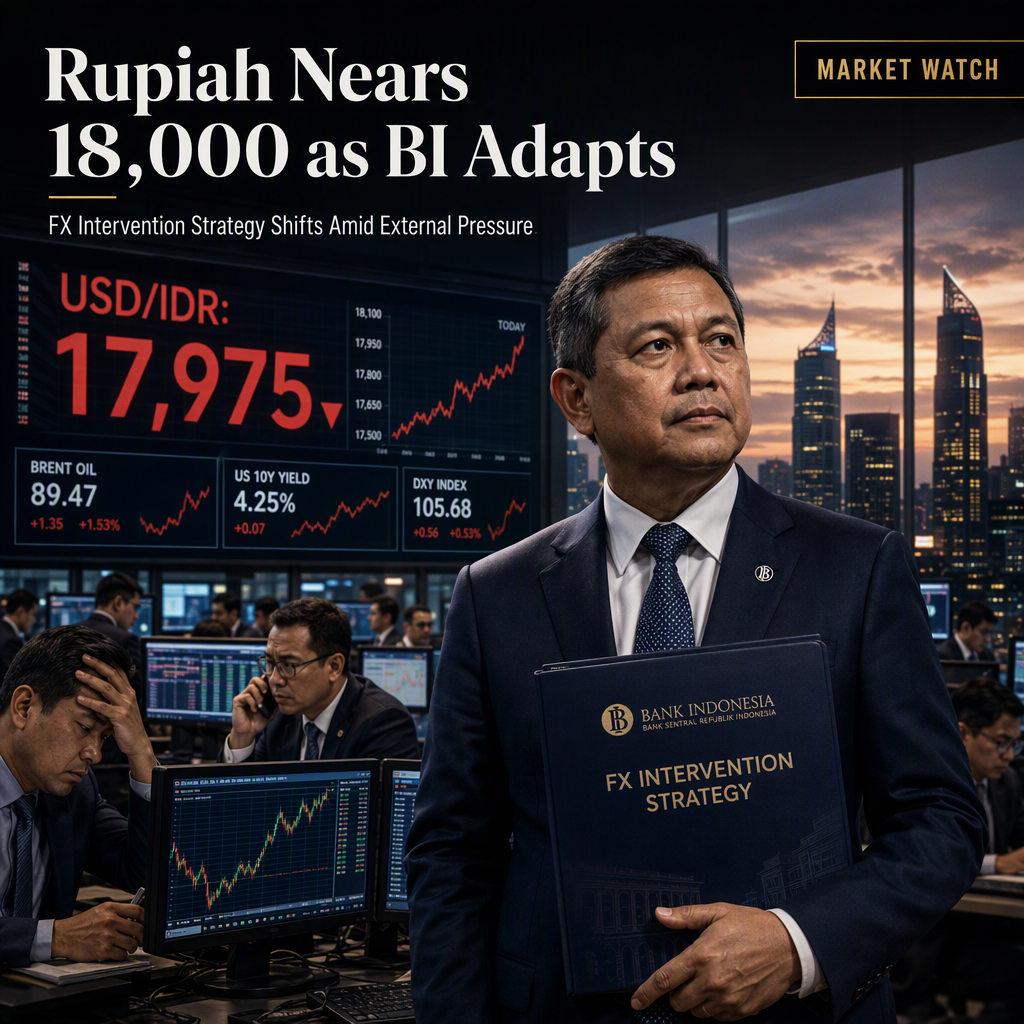
According to OCBC’s Christopher Wong, the Indonesian Rupiah (IDR) briefly traded back towards the 18,000 level against the US Dollar (USD), closing most recently at 17,975. This movement was attributed to higher oil prices, elevated US Treasury yields, and a firm US Dollar, all of which have weighed on the IDR and contributed to ongoing upside risks for the USD/IDR pair [1].
Bank Indonesia (BI) has responded by adjusting its foreign exchange intervention strategy. BI Governor Destry Damayanti stated that the central bank has reduced spot intervention to around 30% of its total FX intervention, shifting towards greater use of offshore Non-Deliverable Forwards (NDF) and domestic DNDF instruments. These are considered less reserve-intensive and, in BI’s assessment, more effective for stabilizing the currency [1].
OCBC emphasizes that this shift should not be interpreted as BI stepping back from efforts to stabilize the IDR, but rather as a change in the intervention mix. The report notes that the near-term outlook remains challenging for the IDR, with structural external pressures and a less favorable environment likely to keep risks skewed towards further USD/IDR gains. Technical analysis shows bullish momentum for USD/IDR remains intact, with the Relative Strength Index (RSI) approaching overbought conditions [1].
For the IDR to stabilize more convincingly, OCBC suggests that some easing in external pressures—such as lower US Treasury yields, oil prices, and a softer USD—would be necessary [1].
CONCLUSION
The Indonesian Rupiah remains under pressure from external factors, prompting Bank Indonesia to adjust its FX intervention strategy towards more effective and less reserve-intensive instruments. Upside risks for USD/IDR persist, and stabilization of the IDR will likely require an improvement in the external environment.